Seoul food guide for first-timers: mild dishes to start with, how ordering, kiosks and table bells work, eating alone, break times and convenience store meals.
PK
Peep Korea Editorial · 16 min read
Short answer
Start with mild, easy dishes like bibimbap, gimbap, kalguksu, mandu and bulgogi, and ask "maewoyo?" (is it spicy?) before you order anything red. Most casual places work the same way: say how many people, order from a person, a screen on the table or a machine by the door, press the bell for help, then pay at the counter by the door. When a restaurant feels like too much, a convenience store has hot water, a microwave and a counter to eat at, open around the clock in most of the city.
The first night in Seoul usually goes like this. A steamy window, a menu taped to the wall in Korean only, a room full of people who clearly know what they are doing. You walk past. Then the next one. Then you eat a sandwich in your hotel.
It does not have to go that way. Korean restaurants run on a short, predictable script, and once you know it, the Korean-only menu stops being a wall. This guide is the script, plus the dishes that are safe bets for a first meal.
What should a first-timer eat in Seoul?
Start with dishes that are mild by default and easy to order by pointing. The table below sorts common first meals by heat, with the official average price in Seoul for September 2026.1, 2
Dish
What it is
Heat
Seoul average, Sep 2026
Gimbap (김밥)
Rice and fillings rolled in seaweed, sliced
Mild
3,923 won per roll
Jajangmyeon (자장면)
Noodles in black bean sauce
Mild
7,808 won
Kimchi jjigae set (김치찌개 백반)
Kimchi stew with rice and sides
Medium to hot
8,846 won
Kalguksu (칼국수)
Knife-cut noodles in broth
Mild
10,038 won
Bibimbap (비빔밥)
Rice with vegetables; you add the chili paste
Mild if you skip the paste
12,000 won
Naengmyeon (냉면)
Cold buckwheat noodles
Mild (mul) or hot (bibim)
12,692 won
Samgyetang (삼계탕)
Whole small chicken soup with rice
Mild
18,269 won
Samgyeopsal (삼겹살), 200 g
Grilled pork belly
Mild; the sauces are optional
21,321 won
Prices are provisional survey averages for Seoul, published on the Korea Consumer Agency's Chamgagyeok price portal (source listed as the National Data Office, provided via the Ministry of the Interior and Safety). They are not any restaurant's menu, and they change monthly. Samgyeopsal is converted to a 200 g serving.1, 2 Heat levels are a Peep observation.
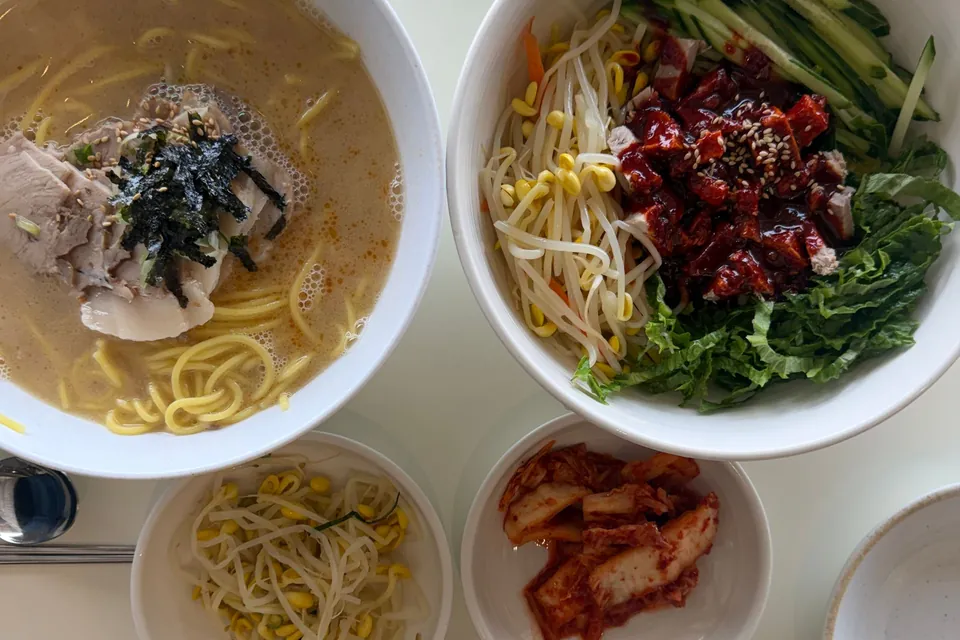
Other easy first meals: mandu (dumplings), bulgogi (sweet soy beef), gukbap (rice in hot soup), japchae (glass noodles) and fried chicken with the plain, not the sauced, coating.
Q. Do I have to try the spicy stuff? No. Plenty of Korean food is not spicy at all. Tteokbokki, dakgalbi, buldak and anything glowing red are the ones to approach on day three, not day one.
Barbecue and street food are big enough to get their own guides, so this page sticks to everyday meals.
How does ordering work in a Korean restaurant?
It runs on five steps: headcount, seat, order, bell, pay at the door. Staff will often greet you with "myeot buniseyo?" (how many people?). Hold up fingers and you are halfway there. (Peep observation)
Headcount. Show the number with your fingers. If staff point you to a table, sit there; if not, any empty one is usually fine.
Water and cutlery. Water may arrive at your table or wait for you in a self-serve fridge or dispenser. Spoons, chopsticks and napkins often sit in a small drawer built into the table.3
Order. Tell the staff, tap the screen fixed to your table, or use the ordering machine near the entrance. Point at the menu or a photo. (Peep observation)
Call for help. Press the bell on the table, or say "jeogiyo" (excuse me). Expect a loud ding; that is how it is meant to sound.3
Pay. In most casual places you pay at the counter on the way out, not at the table. No tip. Our tipping and etiquette guide covers paying, splitting the bill and table manners step by step.
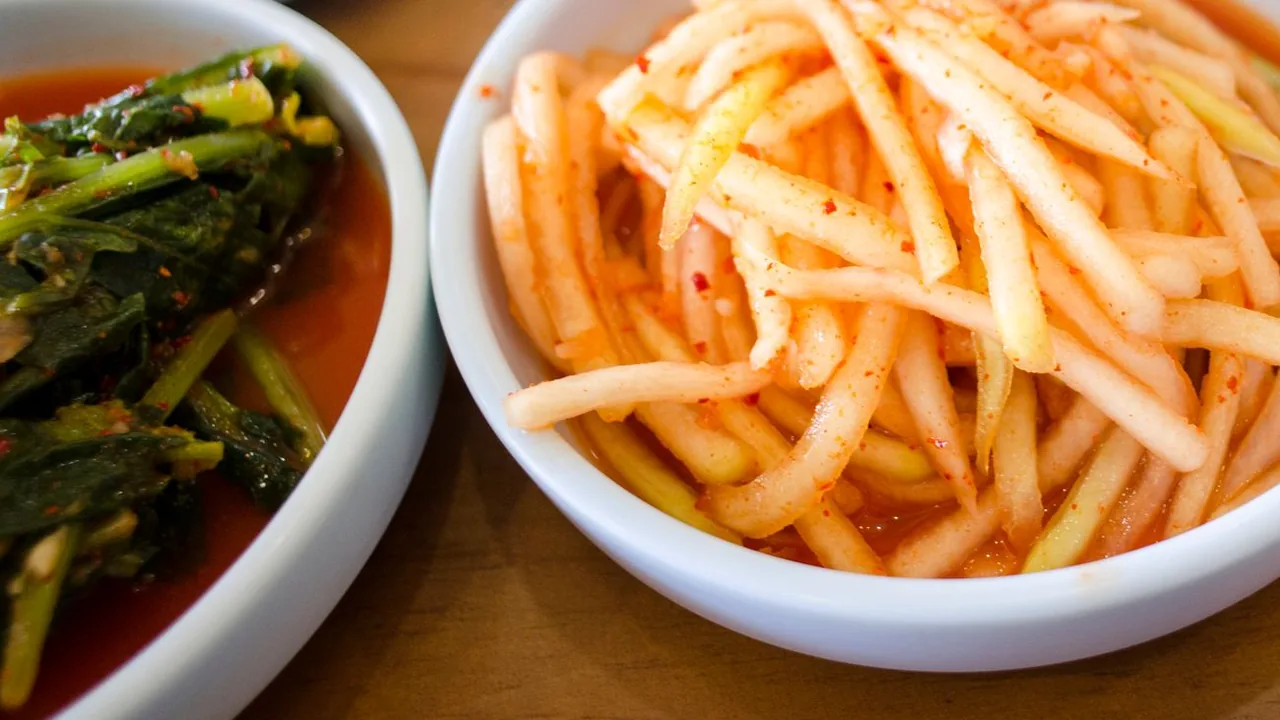
Side dishes (banchan) come with the main dish.3 They are usually refilled for free, and some places put them on a self-serve bar instead. (Peep observation)
Q. What if the menu is only in Korean? Use the camera mode of a translation app, or point at the photo wall many casual places have. The ordering lines in our Korean phrases guide cover "one of this, please", "less spicy" and "to go".
How do restaurant kiosks and table tablets work?
Look for a language button first: many kiosks and tablets offer English, often as a small flag or "EN" in a corner. Then pick dishes, check the cart, and pay by card on the spot before you sit down (kiosk) or at the end (tablet). (Peep observation)
What trips visitors up, and how to get past it:
The card slot. Some kiosks want the card inserted chip first, some want a tap. If it fails twice, go to the counter and pay there. Staff deal with this all day. (Peep observation)
Pickup number. A kiosk receipt usually prints an order number. Watch the screen above the counter or listen for the number in Korean, then collect the tray yourself.
Tablets add up. A table tablet keeps a running bill. Check the cart before you press the final order button, because a double tap can mean two dishes.
Self-serve after the meal. Where you picked up the tray, you usually return it. Look for a return shelf near the kitchen.
How you pay with foreign cards and cash is covered in our money guide.
Q. A restaurant has a tablet at the door asking for a phone number. What is it? A waiting list. If you have no Korean number, ask staff ("jeogiyo") and show the number of people; many will put your name on the list by hand. (Peep observation)
Can you eat alone in Seoul?
Yes, easily, and plenty of Koreans eat alone too. The only real limit is barbecue and some hot pot places that sell by the portion (inbun) and expect two portions per table. Ask before you sit down. (Peep observation)
Places that are made for solo meals:
Gimbap and snack shops. Rolls, noodles, rice bowls and stew, all single portions, fast.
Gukbap and noodle shops. One bowl, one person, usually a counter or small tables.
Food courts in department store basements and big malls. Pick by photo, pay at one counter, eat at shared tables.
Convenience stores for a quick, cheap fallback (see below).
Q. Is it awkward to sit alone in a busy restaurant at lunch? Not really, but you will be asked to share space or move to a smaller table at peak time. Arriving before 11:30 or after 13:30 avoids the office lunch rush. (Peep observation)
When are restaurants open, and what is break time?
Lunch runs from about 11:30 to 14:00, dinner from about 17:30, and many small restaurants close in between for a "break time" (브레이크 타임). (Peep observation) Breaks are not standard. Even the restaurant listings on the Korea Tourism Organization's vegetarian page show afternoon breaks from 30 to 90 minutes, so check before you go.4
Simple rules that avoid a closed door:
Check the hours in a map app on the day. Break time and the weekly day off are usually listed. You will need mobile data for this; see our SIM and eSIM guide.
Watch for "last order" (라스트 오더) 30 to 60 minutes before closing. (Peep observation)
Late-night food is easier in nightlife areas, near big stations and in convenience stores than in residential streets.
Q. Do restaurants close on public holidays? Many small family places close for the big holidays like Seollal and Chuseok, while chains, malls and convenience stores mostly stay open. Our when to visit Korea guide lists the 2027 dates.
What can you eat at a Korean convenience store?
A proper meal, not just snacks. Korean convenience stores sell boxed lunches (dosirak), triangle gimbap, instant noodles, boiled eggs, sandwiches, fruit cups and drinks, and most have a hot water dispenser, a microwave and a small eating counter. (Peep observation)
The fast first-timer meal:
Triangle gimbap (삼각김밥). Open it in the numbered order on the wrapper, usually 1 down the middle, then 2 and 3 to each side, and the seaweed stays crisp.
A cup of instant noodles (컵라면). Fill to the line inside the cup with the hot water machine, wait about three minutes, eat at the counter.
A drink and something sweet. Banana milk is a classic first try.
House rules that locals follow:
Clean up after yourself. Pour leftover noodle soup into the marked sink or bin, then sort cups, chopsticks and wrappers into the separate bins. (Peep observation)
Use the microwave for the store's own food. Boxed lunches print the microwave time on the label.
Look for "1+1" and "2+1" tags. Buy one or two, get one free. Bring the free item to the counter too.
Bring a bag. Many convenience stores do not hand out free plastic bags; expect a small fee for a paper or reusable one. (Peep observation) A foldable tote saves the hassle.
Packaged food sold in Korea usually lists allergens near the ingredients, often in a separate box, in Korean. (Peep observation) Our Korean phrases guide has the Hangul for common allergens so you can scan labels. A label check is a help, not a guarantee, so if an allergy is serious, ask staff too.
Q. Can I eat inside the convenience store? Usually yes, at the window counter or a few tables, and some stores have outdoor plastic tables in warm months. If there is no seating, there is no rule against eating on a park bench outside. (Peep observation)
How do you find good restaurants in Seoul?
Follow the locals at lunch, check reviews in Korean map apps, and pick places with short menus. A restaurant that sells four things usually sells those four things well. (Peep observation)
Signs worth trusting:
A queue of office workers at 12:10 on a weekday. They have an hour and they do not waste it.
One dish on the sign. Names like 칼국수 or 국밥 written large mean a specialist, not a menu of everything.
Reviews in Korean. Many visitors use a Korean map app instead of an international one, because local reviews and opening hours are more complete there. A translation app reads them for you. (Peep observation)
Lunch specials (점심 특선). A cheaper set menu on weekdays at lunch, often taped to the door.
Signs to be wary of are softer: a street hawker pulling you in, a picture menu with prices only in a foreign currency, or a tourist strip where every sign is in three languages. Not bad by default, just less local.
Q. Do I need a reservation? For casual places, almost never. For popular restaurants, tasting menus and anything trending on social media, yes, or expect a wait list at the door. (Peep observation)
Is Korean food very spicy, and how do you eat mild?
Some of it is, but much of it is not. Red color is the honest clue: a red broth or red sauce usually means chili, while clear broths, soy-based sauces and grilled meat without sauce are usually mild. (Peep observation)
How to keep a meal mild:
Bibimbap: the chili paste often comes on top or on the side. Add a little, or none.
Naengmyeon: "mul" (water) naengmyeon is the clear, cold, mild one; "bibim" is the spicy mixed one.
Stews: a soybean paste stew (된장찌개) is usually far milder than kimchi or soft tofu stew.
Ask first. "Igeo maewoyo?" (is this spicy?) and "an maepge hae juseyo" (not spicy, please). A few dishes come only one way, and staff will say so.
Keep a glass of water and a bite of rice nearby. Plain rice handles heat better than water does. (Peep observation)
Q. Is kimchi always spicy? Most red kimchi has some heat, but white kimchi (백김치) and water kimchi (물김치) are not spicy. You will not find them everywhere, so ask.
What if you are vegetarian, vegan, halal or have allergies?
Plan to ask every time. Many Korean restaurants are not set up for dietary requests (Peep observation), and plenty of broths are made with meat or fish even when the bowl looks like vegetables only. The Korea Tourism Organization suggests preparing written notes in Korean that say what you cannot eat.4
Practical moves:
Write it down in Korean. The Korea Tourism Organization suggests lines like "저는 채식주의자입니다" (I am vegetarian) and "육류, 달걀, 해산물 등을 먹지 못합니다" (I cannot eat meat, eggs or seafood).4
Know the hidden ingredients. Bibimbap usually comes with an egg on top and sometimes meat; gimbap usually has ham and egg, sometimes tuna or crab stick; many stews use meat or fish broth.4
Look for temple food. Korean Buddhist temple food leaves out animal ingredients other than dairy, and also the five pungent vegetables such as garlic and green onion.5 Seoul has restaurants built around it. Because dairy can be used, vegans should still ask.
Halal food clusters around Itaewon, near the Seoul Central Mosque. "Halal" on a sign can mean different things. A certificate from the Korea Muslim Federation (KMF) is the formal one; "Muslim-friendly" is usually the restaurant's own description. Not every place serving halal food holds KMF certification, so ask to see it rather than assuming, and ask about alcohol and how the meat was sourced. (Peep observation)
For allergies, carry a written allergy card in Korean that names your allergen and says even a small amount is not OK. Our Korean phrases guide has the allergen list and that line. Show it to staff before you order, every time. A card gets your message across, but it cannot see into the kitchen. Shared cooking oil, broths and sauces can still contain your allergen, and no restaurant can promise a meal is free of it. When staff hesitate, order something else. If you have a serious allergy, carry the medicine your doctor has prescribed for you, as you would at home.
Q. Is fish sauce or anchovy hidden in kimchi? Often, yes. Most kimchi is made with salted seafood or fish sauce, so strict vegans should ask or skip it. (Peep observation)
Is tap water safe, and do restaurants give free water?
Water in restaurants is free, and Seoul's tap water is managed as safe to drink. The city said in 2025 that it tests its Arisu tap water for 357 items, about six times the national drinking-water standard.6 A July 2026 news report put the number at 362.7 The catch is old building pipes and water tanks, which can affect what comes out of a particular tap, so many people still drink filtered or bottled water at home. (ref. 6; Peep observation)
In restaurants you will get water, barley tea or corn tea for free, from staff or a self-serve dispenser. (Peep observation) You never need to order it.
Q. Is the cold drink in the metal cup at a restaurant water? Usually water or a light grain tea like barley tea. It is free and unsweetened.
How much does a meal cost in Seoul?
A casual one-person meal in Seoul costs roughly 8,000 to 13,000 won, going by the official September 2026 averages: about 8,846 won for a kimchi stew set, 10,038 won for kalguksu and 12,000 won for bibimbap.1, 2 Grilled meat and chicken soup cost more, and a gimbap roll costs less.
How to keep the bill friendly:
Eat the big meal at lunch. Weekday lunch sets often cost less than the same dish at dinner. (Peep observation)
Use the free sides. Refilled banchan and rice make a small order go further.
Mix in convenience stores and markets for breakfast and snacks.
These are survey averages, not quotes from any restaurant. Prices in tourist streets and trendy cafes run higher.1
Q. Is tax included in menu prices? Usually yes. At most restaurants, VAT is already in the menu price, and you pay the number you see. Some hotel and high-end restaurants add tax or a service charge on top, so check the fine print on the menu. (Peep observation)
Q. Can I get a tourist tax refund on meals? No. Tourist tax refunds in Korea are for goods bought at tax-free shops, not for restaurant meals. Our money guide covers how refunds on shopping work.
Quick FAQ
Something mild and easy: bibimbap, gimbap, kalguksu, mandu or bulgogi.
Leave the red, spicy dishes for later in the trip.
Show the number of people, sit down, then order from a person, the tablet at your table or the kiosk by the door.
Press the bell for help and pay at the counter on the way out.
At most casual restaurants, at the counter by the door.
Fancier and Western-style places may bring the bill to your table.
Many do, behind a language button or a small flag on the screen.
If yours does not, or your card fails, order and pay at the counter.
It calls the server.
Press it once for orders, refills or the bill; nobody minds.
No. Banchan come with the meal and are usually refilled for free.
Some places put them on a self-serve bar.
Yes, especially at gimbap, noodle and gukbap shops.
Barbecue places may expect two portions per table, so ask first.
A pause between lunch and dinner when the kitchen closes, often in the mid-afternoon.
Check the hours in a map app before you go.
A triangle gimbap, a cup of instant noodles and a banana milk.
Most stores have hot water, a microwave and a counter to eat at.
Pull tab 1 down the middle, then pull 2 and 3 off each side.
The seaweed stays crisp until you open it.
Usually yes, at a window counter or a few tables.
Clean up after yourself and sort the trash.
No. Clear soups, soy-based dishes, noodles in black bean sauce and grilled meat are usually mild.
Red broth or red sauce usually means chili.
Say "an maepge hae juseyo" (not spicy, please).
A few dishes come only one way, so ask "igeo maewoyo?" first.
Possible, but you have to ask. Many soups use meat or fish stock.
Show a written Korean note and look for temple-food restaurants.
Usually not. Most kimchi contains salted seafood or fish sauce.
Ask, or look for vegan-labeled kimchi.
Around Itaewon, near the Seoul Central Mosque.
Ask to see a Korea Muslim Federation certificate; "Muslim-friendly" is not the same thing.
Carry a Korean allergy card and show it before every order.
No restaurant can guarantee a dish is allergen-free, so skip anything staff are unsure about.
Seoul manages its Arisu tap water as safe to drink and tests it for more than 350 items.6, 7
Old pipes in a building can affect a tap, so many people use filtered or bottled water.
Yes. Water or a grain tea comes free, from staff or a self-serve dispenser.
You do not need to order it.
About 4,000 won for a gimbap roll and 8,000 to 13,000 won for a simple stew, noodle or rice dish, by September 2026 averages.1, 2
Tourist streets cost more.
No. Tipping is not expected in Korea.
Our tipping guide covers what to do instead.
Not for casual places.
Popular and trending restaurants often use a wait list or bookings, so plan ahead.
Showing 5 of 22
Dining-out prices by region (외식비 가격정보), September 2026, Seoul. Korea Consumer Agency Chamgagyeok price portal; provisional figures, source listed as the National Data Office, provided via the Ministry of the Interior and Safety. Checked 28 October 2026. Link
"비빔밥 1만2000원 시대" (Seoul bibimbap average reaches 12,000 won). Asia Economy, 20 October 2026. Checked 28 October 2026. Link
About Korean Food. VISITKOREA, Korea Tourism Organization. Checked 28 October 2026. Link
Tips for Vegetarians. VISITKOREA, Korea Tourism Organization, 17 April 2023. Checked 28 October 2026. Link
Korean Temple Food: A Sustainable Cuisine Inspired by Buddhist Teachings. VISITKOREA, Korea Tourism Organization. Checked 28 October 2026. Link
Seoul Strengthens Arisu Water Quality Tests From Source to Home. Seoul Metropolitan Government, 7 February 2025. Checked 28 October 2026. Link
Over 5,400 water quality tests conducted at treatment centers, faucets and public facilities. The Herald Business (Herald Corporation), 4 July 2026. Checked 28 October 2026. Link