Gwangjang Market food guide for 2026: bindaetteok, mayak gimbap, yukhoe and kalguksu, food alley hours, cash or card, how to order at a stall price rules.
PK
Peep Korea Editorial · 19 min read
Short answer
At Gwangjang Market, start with bindaetteok (a crisp mung bean pancake), mayak gimbap (finger-sized rice rolls) and a bowl of kalguksu, then add yukhoe (seasoned raw beef) if you eat raw food.1, 19 The food alley runs 09:00 to 23:00 every day of the year, even on Sundays when the fabric and clothing shops close, and it is a 62 m walk from Exit 8 at Jongno 5-ga on Line 1.1 Sit on the bench at a stall, point at the line on the price board, confirm the price before the food arrives, and carry some won in small notes even though most food stalls now take cards.6, 12
Gwangjang is not a food court with a market attached. It is a working wholesale market for silk, bedding and dried fish that happens to hide one of Seoul's loudest, oiliest and most fun places to eat at its centre, where you sit elbow to elbow with office workers on a narrow bench while a griddle hisses a metre from your plate.
It is also the market that keeps making the news for overcharging. So this guide covers both halves: what to order, and how to order so the bill matches the board.
Updated November 2026. Hours, payment and price rules checked 4 November 2026.
Quick answer
Eat first: bindaetteok, mayak gimbap, kalguksu, assorted jeon and sundae. Yukhoe and raw octopus only if raw food is fine for you.1, 19
Opening hours: food alley daily 09:00 to 23:00, all year; the rest of the market 09:00 to 18:00, closed Sundays.1
Getting there: Exit 8 at Jongno 5-ga (Line 1), or Exit 4 at Euljiro 4-ga (Line 2 or 5), roughly 100 m off.3
Paying: card terminals reached 76 of the market's 94 stalls in 2024, but some stalls still steer people to cash or bank transfer.6, 12
Price rules: Jongno District has run a stall real-name system with penalty points since 1 June 2026.10
What should I eat at Gwangjang Market?
Bindaetteok is the signature. The official Seoul tourism site lists it first, alongside assorted jeon, mayak gimbap, sundae with head meat, yukhoe and Korean meatballs.1 Two or three dishes between two people is plenty for a first round, because everything is fried, rich or both.
Here is what each dish actually is, so you can point with confidence.
Bindaetteok (빈대떡). Ground mung beans mixed with bean sprouts, kimchi or pork, then shallow-fried until the edge turns lacy and crunchy. It arrives cut into wedges with soy and vinegar dip and pickled onion. (ref. 19; Peep note)
Mayak gimbap (마약김밥). Thumb-sized rolls of rice, pickled radish and carrot in seaweed, served with a mustard and soy dip. "Mayak" means narcotic; it is a joke about how hard it is to stop eating them. (ref. 1; Peep note)
Kalguksu (칼국수). Hand-cut wheat noodles in a hot broth, often with dumplings on the side. (Peep note) Netflix's Street Food: Asia filmed its Seoul episode in this market and featured knife-cut noodles.19
Modum-jeon (모둠전). An assorted plate of pan-fried bites: battered fish, zucchini, pepper, meatballs. The dish at the centre of the 2023 price row, which is why some boards now print its weight.5
Sundae and meori-gogi (순대, 머리고기). Korean blood sausage with sliced pork head meat, a classic plate to share with a drink.1
Yukhoe (육회). Strips of raw beef seasoned with sesame oil and sugar, usually topped with a raw egg yolk and served with sliced pear. (ref. 1; Peep note)
Sannakji (산낙지). Raw octopus cut into pieces that are still moving when they reach the plate, dressed with sesame oil and salt. (Peep note)
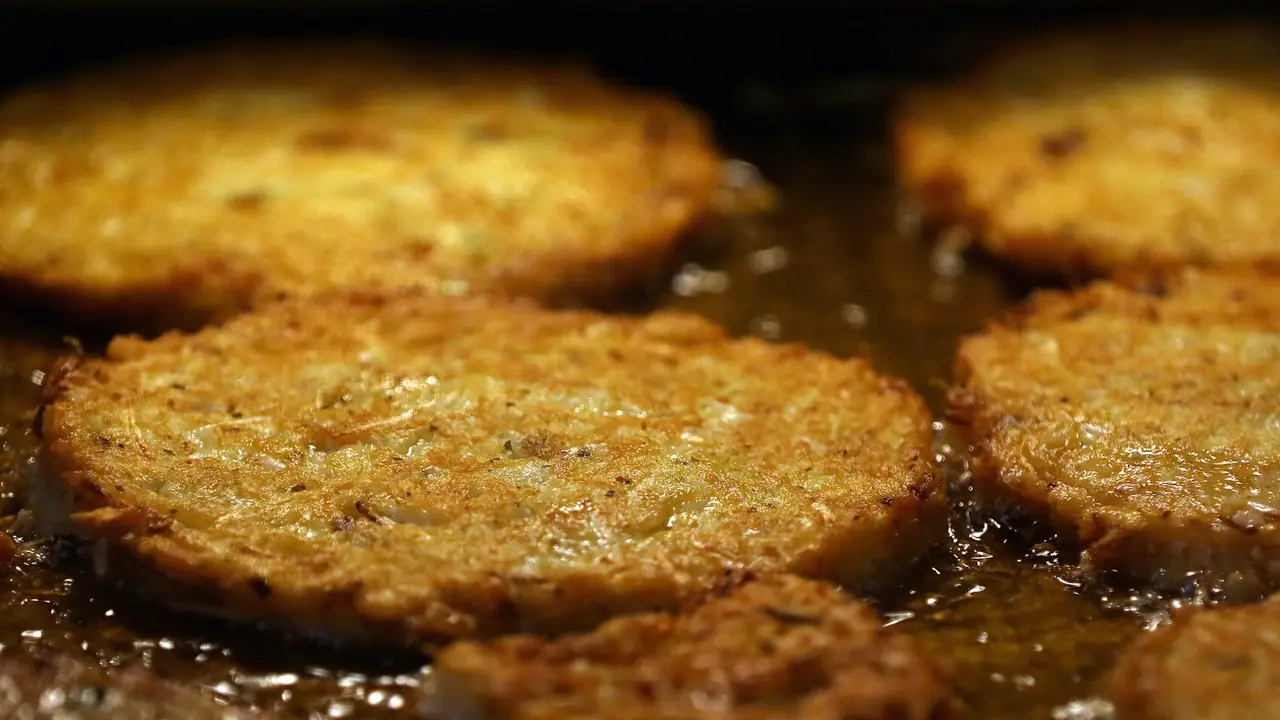
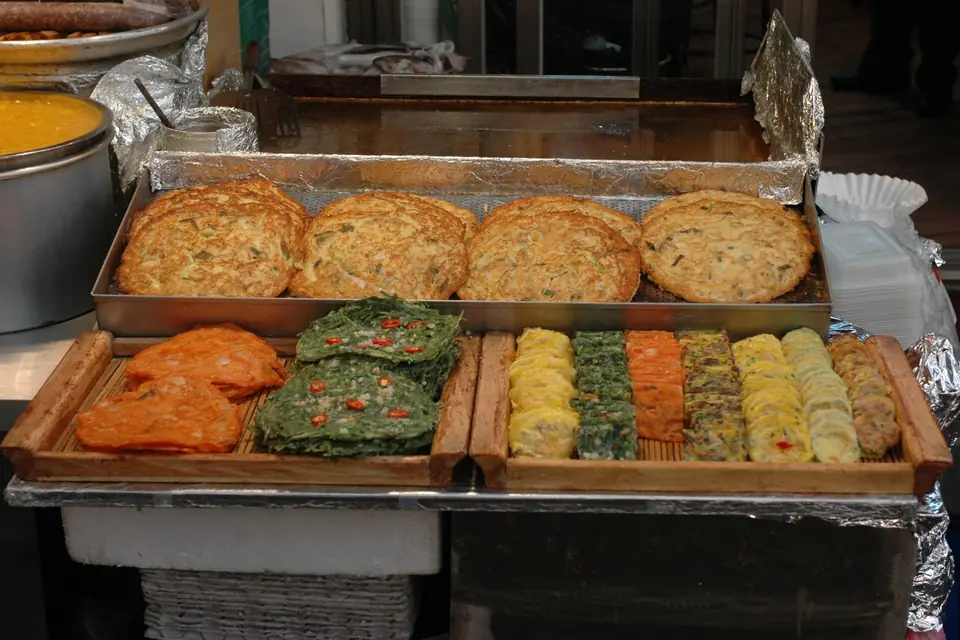
Jeon and pancakes laid out on a Gwangjang Market stall. Photo by Pfc. Bo Park, US Army 2nd Infantry Division Public Affairs, in the public domain, from Wikimedia Commons; cropped. Cover: bindaetteok on the griddle at Gwangjang Market, photo by Korea.net, run by the Korean Culture and Information Service, licensed CC BY-SA 2.0, from Wikimedia Commons; cropped.
Q. Should I order yukhoe? Order it if you already enjoy raw dishes like beef tartare. Yukhoe and sannakji are both served raw, so if you have been told to avoid raw food, skip them and order bindaetteok or kalguksu instead. (Peep note)
Q. What should I order on a first visit? One bindaetteok, one plate of mayak gimbap and one bowl of kalguksu covers crispy, cold and hot for two people. Add sundae or jeon if you are still hungry. (Peep advice) For the wider picture of Korean dishes that are not spicy, see our Seoul food guide.
Q. Is there anything to drink with it? Makgeolli, a milky rice wine, is the classic match for bindaetteok, and most stalls sell it with soft drinks and water. (Peep observation) Check the bottle price on the board too; water has been part of two price complaints.13
What are Gwangjang Market's hours?
The food alley is open 09:00 to 23:00, every day of the year. The general market (fabric, bedding, hanbok, groceries) runs 09:00 to 18:00 and closes on Sundays, and the second-floor vintage clothing arcade opens 10:00 to 19:00, also closed Sundays.1
What that means in practice:
Sunday is fine for eating. Only the shopping sections close.1, 2
23:00 is the alley's closing time, not every stall's. Each stall keeps its own hours and days off, so a favourite dish can be gone by 21:00. (Peep observation)
Public holidays: the market's official site says the vintage arcade trades as normal on public holidays.3
Quieter hours: weekday mid-morning, or mid-afternoon after the lunch crowd thins. Weekend evenings are shoulder to shoulder. (Peep observation)
Q. What time should I go to Gwangjang Market? For short queues, go on a weekday between 14:00 and 17:00. For atmosphere, go after 18:00, when the griddles are busiest and office workers arrive. (Peep advice)
Q. Is Gwangjang Market open on public holidays like Chuseok? The food alley is listed as open all year, but individual stalls close on their own schedule over the big Lunar New Year and Chuseok breaks. (ref. 1; Peep note) The 2026 and 2027 dates are in Korea public holidays.
Which subway station is nearest to Gwangjang Market?
Ride Line 1 to Jongno 5-ga and use Exit 8: Visit Seoul measures the walk at 62 m. On Line 2 or Line 5, get off at Euljiro 4-ga and take Exit 4, roughly 100 m from the market.1, 3
The food alley is the covered crossroads at the heart of the market, reached through the East Gate, the second North Gate or the first South Gate.2 Walk in from any of those and follow the smell of frying mung beans.
Q. Is there parking? The market points drivers to the public lot at Jongmyo, Jongno 4-ga.2 The subway is easier. Card top-ups and transfers are in getting around Seoul.
Q. What is near Gwangjang Market? Visit Seoul lists Dongdaemun Design Plaza, Jongmyo Shrine and Sewoon Shopping Center close by, and Cheonggyecheon stream runs just south of the market. (ref. 1; Peep note) Pair it with a palace morning in Gyeongbokgung and Bukchon.
How do you order and sit at a market stall?
Sit first, order second. Each stall is a counter with a bench or low stools wrapped around it; you sit at that stall's bench, order from the person cooking, eat there and pay that same stall when you finish. (Peep observation) Most boards now carry prices in Korean, English, Chinese and Japanese.12
Step by step
Walk the alley once before you sit. Look for a board with a price, and a weight where shown, next to every dish.4, 12
Take a seat at the bench of the stall you picked. If it is full, wait behind the bench; staff will wave you in. (Peep observation)
Point at the line on the board, not just at the food on the counter, and say "igeo hana juseyo" (이거 하나 주세요, this one please).
Ask the price before anything you did not choose lands on the table, such as bottled water or an "add meat?" offer.8, 13
If the stall has a QR menu, scan it: in 2024 Jongno District put 20-language menus with photos and prices at 88 food stalls.7
When you are done, ask "eolmayeyo?" (얼마예요?, how much?) and check the total against the board before you pay.
Phrases that help: "kadeu dwaeyo?" (카드 돼요?, card OK?), "pojang dwaeyo?" (포장 돼요?, takeaway OK?), "an maepge" (안 맵게, not spicy). More in our Korean phrases guide.
Q. Do I have to order from only one stall? You eat at the stall you sit at, so one seat means one stall's menu. To try more, move: have bindaetteok at one bench, then gimbap or noodles at another. (Peep observation)
Q. Can I get food to go? Yes. Many stalls pack bindaetteok and gimbap in foil or plastic boxes; ask "pojang dwaeyo?" Eating it hot at the bench is the point, though. (Peep observation)
Q. Can I sit down without ordering? Not at a busy stall. Benches are the stall's dining room, so sit when you are ready to order. (Peep observation)
Is Gwangjang Market cash only?
No, not any more, but carry some cash anyway. By September 2024, 76 of the market's 94 street stalls could take cards after Jongno District and the merchants' association brought in card terminals that work without a business registration.6, 7 Cards are marked as accepted on the Korea Tourism Organization's listing.2
The catch is consistency. A March 2026 visit by the Financial News found vendors calling out "credit card OK", yet some stalls displayed a bank account number to push for cash or transfers.12 Seoul's 2023 measures also told merchants not to steer customers into paying in cash.4
What to carry
Cash: 30,000 to 50,000 won per person in 10,000 won and 1,000 won notes covers a long snack crawl. (Peep estimate)
A card: for the stalls that take one. Look at the total on the card reader screen first. (Peep advice)
No T-money for food: transit cards are for the subway, not the stalls. (Peep observation)
Where foreign cards work and where to find an ATM that takes them: money in Korea.
Q. Can I pay by bank transfer? Only with a Korean bank app, which most visitors do not have. If a stall with a card terminal asks you for a transfer, pay by card or cash instead. (ref. 12; Peep advice)
What do dishes cost at Gwangjang Market?
Expect around 5,000 won for simple snacks and around 10,000 won for most dishes, based on a Financial News visit on 6 March 2026.12 Yukhoe and big shared platters cost more. Prices differ stall to stall, so the board in front of you is the only number that counts.
A few dated figures from the press, for scale:
Assorted jeon: 15,000 won for a plate labelled 600 g, January 2024.5
Sundae: 8,000 won on the board in November 2025, when a stall asked one customer for 10,000 won.8
Bottled water: 1,000 won on one board in August 2026, 1,500 won charged to a reporter posing as a tourist.13
Myeongdong for comparison: a chicken skewer or a gimbap roll for 5,000 won, grilled steak or lobster around 20,000 won, March 2026.12
Q. How much money should I bring to Gwangjang Market? For two people sharing four or five dishes and a drink, budget around 40,000 to 60,000 won. (Peep estimate from ref. 12) Bring part of it in cash.
What has Seoul done about overcharging at Gwangjang Market?
A lot, in stages. After a viral 2023 video about a thin 15,000 won jeon plate, Seoul and Jongno District introduced weight labels on menus; in 2024 came QR menus, card terminals and mystery shoppers; and since 1 June 2026 stalls face penalty points that can end in losing their street permit.4, 5, 7, 10
The timeline
December 2023: Seoul announces weight labels next to prices and food models for signature dishes, phased in from 2024.4
January 2024: a press check finds food models on most counters and a 600 g label on assorted jeon, but few weights on other dishes yet.5
2024: QR menus in 20 languages at 88 food stalls, card terminals for 77 unregistered stalls, and 241 mystery shopper visits that flagged 89 issues.7
November 2025: a viral sundae video leads the merchants' association to suspend one stall for 10 days.8
December 2025: the Ministry of SMEs and Startups, Seoul, Jongno District and merchants agree on joint checks of price display, hygiene and menus.9
May and June 2026: Seoul and Jongno District run joint inspections, including mystery shoppers with foreign members.11
1 June 2026: the stall real-name system starts. More than 120 penalty points in a year, or four or more violations, can cost a stall its road permit.10
August 2026: a broadcaster finds a stall charging a reporter more for water than its board showed; the district says no stall had yet received penalty points and promises on-site checks.13
1 September 2026: a national rule starts suspending registered restaurants for 5 days on a first offence of not posting prices or charging above them.14
The honest summary: the rules are stronger than ever, and enforcement is still catching up. The habits in this guide (read the board, confirm the total, keep a photo) are what protect you on the day.
Q. What should I do if I am overcharged? Point at the board and say the posted price politely. If that fails, call the 1330 Korea Travel Helpline (dial +82-2-1330 on a non-Korean SIM), or Seoul's 120 line, with a photo of the board, your receipt and the time. (ref. 2, 11; Peep advice)
Gwangjang or Dongdaemun, Namdaemun and Myeongdong: which is better for food?
For a sit-down street food meal, Gwangjang. It has the widest spread of market dishes in one covered alley, it opens every day, and you eat seated. Namdaemun is for noodles at lunch, Dongdaemun for one dish done well, and Myeongdong for snacks on foot in the evening.
Hours are from Visit Seoul and the Korea Tourism Organization; stalls inside each area keep their own hours.
Q. Is Gwangjang Market part of Dongdaemun Market? Not officially, but they are neighbours. Gwangjang sits on the western edge of the Dongdaemun wholesale district, and the dak hanmari alley is a short walk east along Jongno. (ref. 2, 17; Peep note)
Q. Gwangjang or a Korean BBQ dinner? Different meals. Gwangjang is grazing at a counter; barbecue is a sit-down grill night with a group. If you want both, do Gwangjang for lunch and read Korean BBQ in Seoul for the evening.
Is Gwangjang Market worth it?
Yes, if you go for the food and the scene and go in with a plan. The Korea Tourism Organization calls it Korea's first permanent market, and it is still where Seoul comes to eat bindaetteok with makgeolli.2 The overcharging stories are real; the reported cases involve individual stalls, and the board-first habit is the simple way to stay out of them. (ref. 8, 13; Peep note)
Skip it if you hate crowds and narrow benches, or go on a weekday afternoon, when it is calmer.
Quick FAQ
Gwangjang Market is famous for its covered food alley and above all for bindaetteok, a crisp mung bean pancake fried to order.1
Visit Seoul also lists assorted jeon, mayak gimbap, sundae with head meat, yukhoe and Korean meatballs as the dishes people come for, eaten at benches around each stall.
The food alley opens at 09:00 and runs until 23:00, every day of the year.1
The fabric, bedding and general shops keep 09:00 to 18:00, and the vintage clothing arcade 10:00 to 19:00. Stalls inside the food alley set their own closing times, so some finish early.
Yes for food, no for shopping. The food alley is open all year, Sundays included.1
The general market and the second-floor vintage arcade close on Sundays, so come Monday to Saturday if you also want fabric, hanbok or secondhand clothes after you eat.
No. By September 2024, 76 of the market's 94 street stalls could take cards after the district installed terminals that do not need a business registration.6
Some stalls still push for cash or transfers, so carry a few 10,000 won notes as a backup.12
Around 30,000 to 50,000 won per person in small notes is a comfortable buffer for a snack crawl. (Peep estimate)
Simple snacks ran about 5,000 won and most dishes about 10,000 won in a March 2026 press visit, so cash plus a card covers almost any order.12
Exit 8 of Jongno 5-ga, on Line 1, is the nearest; Visit Seoul gives the distance as 62 m.1
Coming on Line 2 or 5, Exit 4 of Euljiro 4-ga is roughly 100 m off. The food alley is at the central crossroads inside.3
Bindaetteok is a thick pancake of ground mung beans with bean sprouts, kimchi or pork, shallow-fried until the edges go crisp. (Peep note)
It is the signature dish of Gwangjang Market, served in wedges with soy and vinegar dip, and it is traditionally paired with a bowl of makgeolli.1
Mayak gimbap is a mini rice roll, about finger length, filled with simple vegetables and served with a mustard and soy dip. (ref. 1; Peep note)
The name means "narcotic gimbap", a joke about how addictive it is; there is nothing unusual in it beyond rice, seaweed and pickled radish.
Yukhoe is Korean beef tartare: thin strips of raw beef seasoned with sesame oil, often with a raw egg yolk and sliced pear. (ref. 1; Peep note)
It is one of the market's most ordered dishes. If you have been told to avoid raw food, skip it and order a cooked dish instead.
Yes, some stalls serve sannakji, raw octopus cut into small pieces that still move on the plate, seasoned with sesame oil. (Peep note)
It is a novelty for many visitors, so watch someone order it first. If raw food is not for you, order a cooked seafood pancake or a bowl of noodles instead.
Yes. Gwangjang Market is the setting of the Seoul episode of Netflix's Street Food: Asia, released in April 2019.19
The episode shows the food stalls and dishes including soy-marinated crab and knife-cut noodles, and it put the market on many overseas travellers' lists. (Peep note)
Sit at the bench of the stall you like, then point at the dish on its price board and say "igeo hana juseyo", this one please. (Peep advice)
Check the price, and the weight where shown, before you order, and pay that same stall when you finish.4, 12
It is not a trap, but it is busy with tourists and has had real overcharging cases, including a 2025 sundae dispute and a 2026 water price case.8, 13
Read the board, confirm the total and keep a photo; in our experience that keeps most visits smooth and fair. (Peep observation)
Since 1 June 2026, Jongno District has given stalls penalty points for violations such as overcharging; over 120 points or four violations can cost a stall its permit.10
Since 1 September 2026, registered restaurants face a 5-day suspension for a first pricing offence.14
Call the 1330 Korea Travel Helpline, dialling +82-2-1330 on a non-Korean SIM; it answers in English, Japanese and Chinese as well as Korean.2
Seoul's 120 line also takes complaints. Have a photo of the price board, your receipt or card record, the time and the stall's location ready before you call.11
Yes, most stalls will pack food to go if you ask "pojang dwaeyo?", meaning takeaway OK? (Peep observation)
Bindaetteok and gimbap travel well in foil. Hot noodle soups and yukhoe are made to be eaten at the bench, so plan to sit for those.
Partly. Mung bean pancakes without pork, vegetable jeon and plain gimbap can work, but broths, fillings and dips often contain meat or fish. (Peep note)
Ask "gogi isseoyo?" (is there meat in it?) before ordering. Our Seoul food guide covers vegetarian ordering in more detail.
Weekday mid-morning and mid-afternoon are the quietest, roughly 10:00 to 11:30 and 14:00 to 17:00. (Peep observation)
Weekend evenings are the busiest, with queues behind popular benches. If you go then, eat at a quieter stall first and come back later for the busy ones.
For a seated meal of traditional market dishes, yes; Gwangjang has benches at every stall and a fixed food alley open from 09:00.1
Myeongdong's stalls set up around dusk and sell skewers and grilled snacks to eat standing, at around 5,000 won and up in 2026.12
One to two hours is enough for two or three stalls and a short walk through the fabric and vintage sections. (Peep estimate)
Add time on weekends for queues, and combine it with Cheonggyecheon stream, Jongmyo Shrine or Dongdaemun Design Plaza, all within walking distance.1
Showing 5 of 20
Gwangjang Market. Visit Seoul, Seoul Tourism Organization (English). Hours by section, Sunday closure, Exit 8 distance, signature dishes, nearby sights. Edited 8 October 2026; checked 4 November 2026. Link
Gwangjang Market (광장시장). VisitKorea, Korea Tourism Organization (English). First permanent market, food street gates, Sunday closure, parking, cards accepted, 1330 Travel Hotline. Checked 4 November 2026. Link
오시는길 (Directions). Gwangjang Market official site (in Korean; English page also available). Subway exits, market and vintage arcade hours, public holiday note for the vintage arcade. Checked 4 November 2026. Link
광장시장 '정량표기제' 도입…바가지요금 근절 나선다 (Gwangjang Market introduces weight labels to stop overcharging). Seoul Metropolitan Government, Naeson-an Seoul, 4 December 2023 (in Korean). Link
[르포] '바가지 반성' 광장시장…음식 모형 제작하고 메뉴 '정량 표시' (Gwangjang Market after the overcharging row: food models and weight labels). Chosun Biz, 15 January 2024 (in Korean). Link
"광장시장, 이제 카드 받아요" (Gwangjang Market now takes cards). Munhwa Ilbo, 13 September 2024 (in Korean). Link
종로구, 광장전통시장 '노점 실명제'로 신뢰 높인다 (Jongno District to raise trust with a stall real-name system). Jongno News, 6 November 2025 (in Korean). QR menus, card service, mystery shoppers in 2024. Link
'광장시장 바가지' 대책이 노점 실명제? (Is a stall real-name system the answer to Gwangjang overcharging?). Kyunghyang Shinmun, 6 November 2025 (in Korean). Link
광장시장, 신뢰 회복 나선다…가격 표시·위생·서비스 전면 점검 (Gwangjang Market to restore trust with full checks of prices, hygiene and service). Ministry of SMEs and Startups via Korea.kr, 5 December 2025 (in Korean). Link
"걸리면 퇴출"…바가지 논란 광장시장, 노점상에 초강수 (Gwangjang Market stalls face removal for violations). Edaily, 18 May 2026 (in Korean). Link
서울시, 광장시장 '위생·상거래·안전' 종합점검 실시 (Seoul runs joint hygiene, trade and safety inspections at Gwangjang Market). Seoul Metropolitan Government, 20 May 2026 (in Korean). Link
[르포] "BTS 보러 30만 오는데"… 종로는 '위생 허점', 명동은 'K-푸드' 실종 (Field report: Jongno and Myeongdong street food before the BTS concert). Financial News, 8 March 2026 (in Korean). Link
광장시장 또…"AI가 잔반 재활용해도 된다고 했다" 황당 해명 (Gwangjang stall overcharges for water; no penalty points in three months). JoongAng Ilbo, 31 August 2026 (in Korean). Link
식당 바가지요금 처벌 강화…1차 위반부터 영업정지 (Restaurants face suspension from the first overcharging offence). Yonhap News Agency, 1 September 2026 (in Korean). Link
Namdaemun Market Gourmand Alley (Kalguksu Alley). VisitKorea, Korea Tourism Organization (English). Checked 4 November 2026. Link
Namdaemun Market. Visit Seoul, Seoul Tourism Organization (English). Edited 10 September 2026; checked 4 November 2026. Link
Dongdaemun Dak Hanmari Alley. VisitKorea, Korea Tourism Organization (English). Checked 4 November 2026. Link
Myeongdong. Visit Seoul, Seoul Tourism Organization (English). Edited 4 May 2026; checked 4 November 2026. Link
Street Food: Asia, episode 6, "Seoul, South Korea". Netflix, released April 2019. Checked 4 November 2026. Link