Seoul subway map in English, exit numbers, which map app works, buses, taxi fares and night surcharges, and k.ride for visitors, checked October 2026.
PK
Peep Korea Editorial · 15 min read
Short answer
Use Naver Map in English for routes in Seoul: it gives you the line, the direction and the exit number; Google Maps still has no turn-by-turn walking directions in Korea as of October 2026.9, 10, 11 The subway costs 1,550 won and a city bus 1,500 won with a transit card, transfers within 30 minutes are cheap or free, and Seoul buses no longer take cash.1, 3, 5 Regular taxis open at 4,800 won by day and charge 20 to 40% more late at night; k.ride lets visitors call one in English and pay with a foreign card.6, 7
The station is right. The line is right. Then you come up exit 2 instead of exit 11 and the clinic is on the far side of an eight-lane road with no crossing in sight.
In Seoul the map is the easy part. The route lives in three small details the map skips: which direction the train is heading, which car you ride, and which exit you climb out of. Get those right and the city feels small.
How do I read the Seoul subway map in English?
Read it by line number and end station, not by color alone. Every line has a number and a color, every station has a three-digit number, and every train is signed by the last station it is heading to. The Seoul Metropolitan Government posts the full English map as a free download.2
Line number. Lines 1 to 9 carry numbers; others carry names, such as AREX, Shinbundang or Gyeongui-Jungang.
Station number. The number on each station sign tells you the line: Gangnam is 222, so it sits on Line 2. Handy when two names sound alike.
Direction. Platforms are signed "toward" a station, often the last stop. Look up your next stop, not the end of the line, and match it to the platform sign.
Transfers. Big stations like Seoul Station or Express Bus Terminal can mean a long walk between lines. Budget 5 to 10 minutes for a transfer there (our estimate).
Q. Is the Seoul subway map in English on the trains? Yes. Station names are announced and shown in Korean and English. Still, keep your stop written down in Korean too, for the odd sign or exit board that shows only Korean.
Q. Do private lines cost extra? Some do. The Shinbundang Line, the fast line from Gangnam toward Sinsa and the southern suburbs, adds its own fare on top of the base fare.1
Which map app works in Seoul: Naver Map, Kakao Map or Google Maps?
Naver Map, with Kakao Map as your backup. Google Maps works for transit routes in Korea, but it still gives no turn-by-turn walking or driving directions; walking legs show up as dotted lines.11
That changed on paper this year. On 27 February 2026, the Korean government conditionally approved the export of 1:5,000 map data to Google, with data released only after the government checks the security conditions.10 Google said in August that full navigation is planned for Korea but gave no launch date.11 Until it lands, plan as if it has not.
App
Strong at
Weak at
Naver Map
English menus, exit numbers, bus arrivals, booking places
Search sometimes needs the Korean name
Kakao Map
Bus arrivals, walking routes, a second opinion on a route
Fewer English labels in places
Google Maps
Familiar, your saved places
No walking or driving navigation in Korea as of Oct 202611
App features as of 26 October 2026. Not a ranking, and no app is endorsed.
Naver has also let visitors prove who they are with a foreign passport since 4 June 2026, so you can book a table, order or pay inside the app with no Korean number.9 For routes alone you do not need to sign in at all.
Q. What is the one setting to change? Switch Naver Map to English in the app settings, then search the place in English. If nothing comes up, paste the Korean address. Ask your hotel or clinic for it in Korean before you arrive.
How do subway exit numbers work, and which exit should I take?
Every station has numbered exits, often 8 to 12 at large stations, each one coming up on a different corner or side of the street. Your map app shows the exit nearest your destination when you plan the route. That one number saves you from crossing a big road on foot.
How to use it:
Plan the route in Naver Map and look for the exit number in the last step.
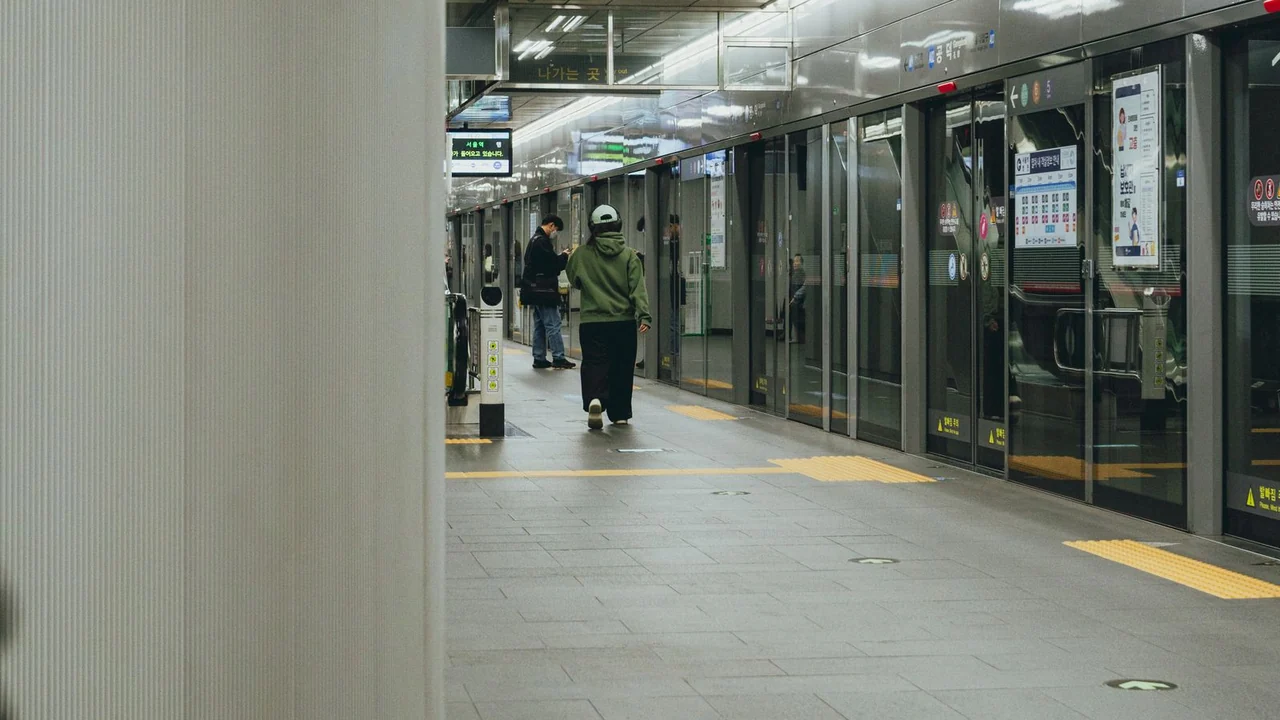
On the platform, look up. Yellow signs list exit numbers and the main buildings above each one.
Follow the number, not the crowd. Most people are heading somewhere else.
Check for an elevator symbol on the exit sign if you have a suitcase or a sore face.
Every one of the 338 stations operated by Seoul's own subway companies now has an elevator path from the street down to the trains, the city says.12 At some stations that elevator sits at a single exit, so it may be a different number from the one your app suggests.
Q. My app says exit 3, but the sign says exit 3 is closed. Now what? Exits close for repairs. Take the nearest open number on the same side of the road, then re-route on foot. That is where Naver's walking line earns its keep.
How much is the subway in Seoul, and how do I pay?
1,550 won for an adult ride of up to 10 km with a transit card, or 1,650 won with a single-journey ticket, as of October 2026.1, 2 Longer trips add 100 won for every 5 km after the first 10 km.1
The way you pay changes the price:
Transit card or mobile transit card. Tap in, tap out, pay the lower fare and get transfer discounts.1, 5
Single-journey ticket. Bought at the station machine for the fare plus a 500 won deposit, which you get back from the refund machine after you exit.3
Early bird. Tap a card before 6:30 a.m. and the first ride is 20% off.1, 5
One catch: you cannot yet tap a foreign Visa or Mastercard at the gate. Seoul plans to replace the gate readers on Lines 1 to 8 with card-tap readers in 2027 and finish the switch by 2030.16 Which card to buy, how to load it with cash or a foreign card, and the Climate Card short-term pass are all in our money guide. This guide sticks to riding.
Q. Do I tap out on the subway? Yes, always. The gate calculates the fare when you leave. Forget to tap out and the next ride can bill you oddly.
How do Seoul buses work for visitors?
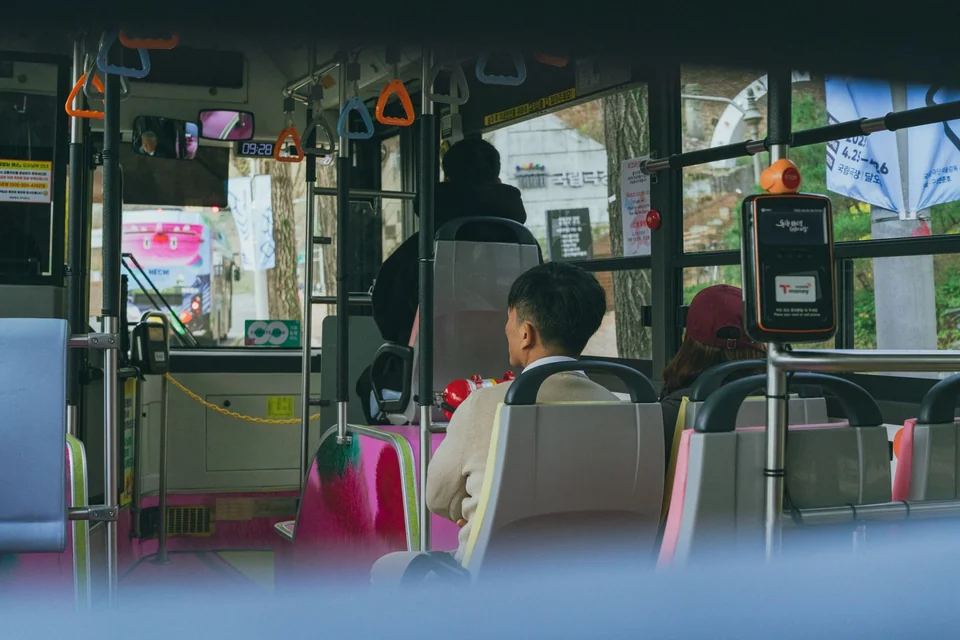
Board at the front, tap your card, tap again at the rear door when you get off. Seoul city buses cost 1,500 won for adults with a transit card, and they no longer accept cash, so have a card ready before you board.3
Types from the Seoul Metropolitan Government. Fares as of June 2026, Visit Seoul.3, 4
The tap at the back door matters. Transfers between buses and the subway are discounted only if you tap off and board the next ride within 30 minutes, or within an hour between 9 p.m. and 7 a.m.3, 5
Q. How do I know when to get off? Stops are announced in Korean and English on most city buses, and the next stop shows on a screen. Watch the stop on your map app as well, and press the red stop button early.
Q. Bus or subway? Subway for speed and fewer surprises. Bus for short hops, steep neighborhoods without stations, and seeing the city on a calm day.
What time does the Seoul subway stop running?
Plan on trains from about 5:30 a.m. to around midnight. The exact last train depends on the line, the station, the direction and the day, so check it in your app before a late dinner.13 After the trains stop, Seoul runs late-night Owl buses with route numbers that start with N.14
Night bus fares differ from day buses, and there are far fewer routes. Check the fare before boarding.3
Last trains at transfer stations leave earlier than you think. A transfer at 11:40 p.m. may already be gone.
After midnight a taxi is often the realistic choice. Expect the night surcharge below.
Q. Will I be stuck if I miss the last train? No, just poorer. Taxis run all night, with the night surcharge below, and you can call one in the app.
How much is a taxi in Seoul, and how does the night surcharge work?
A regular Seoul taxi's meter opens at 4,800 won, which covers the first 1.6 km; after that it ticks up 100 won every 131 m, or every 30 seconds when traffic crawls.6 Late at night it climbs: 20% extra between 10 and 11 p.m. and between 2 and 4 a.m., 40% extra from 11 p.m. until 2 a.m.6
Seoul Metropolitan Government fares, in force since 1 February 2023, checked 26 October 2026. Not a quote.
Rides leaving Seoul's city limits add 20%, and tolls are paid on top.6 All Seoul taxis must charge by the meter, apart from fare plans the city has approved.6
Q. Can I pay a taxi with a card? Transit cards work in taxis.15 If you book through k.ride, the fare goes on the foreign card or wallet you added in the app.7 Keep a little cash as a backup for an old card reader.
Q. Why did the taxi drive past me? It may have been booked through an app already. A red light in the windshield usually means free; if a cab will not stop on a busy road, call one in the app instead.
Can tourists use Kakao T, or should I use k.ride?
Kakao T is built around Korean accounts. k.ride is Kakao Mobility's version for foreign visitors: you sign up with Google, Apple or email, pay with a foreign-issued card or wallets such as Alipay or GrabPay, and see an estimated fare before you call.7 It runs in English, Japanese and Chinese, and you can search destinations and chat with the driver in more than 100 languages.7, 8
Two extras most people miss:
Book ahead. Visitors in Korea can reserve a taxi for a set time and place, handy for an early clinic slot or an airport run.7
Check the estimate first. The app shows an expected fare before you call, so a long ride across the river is no surprise.7 Still save the Korean address, just in case.
Setup tips for the visitor apps also sit in our Korea entry requirements guide. Brand taxi services in Seoul, such as premium black cars and vans, use their own app fares and can surge.6
Q. Do Seoul taxi drivers speak English? Some do, many do not. That is why the app with a written destination works so well: nothing to pronounce. International Taxis come with a driver who speaks a foreign language, for a 20% surcharge.3, 6
How do I get around Seoul after a procedure or with a swollen face?
Door to door by taxi for the first days, then the subway in quiet hours. Swelling, cold packs and a hat make a packed 8 a.m. train a long ride.
A plan that works:
Taxi to and from the clinic for the first two days after surgery. Book it in k.ride before your check-up ends.
Ride between rush hours. Seoul's commuter peaks are roughly 7 to 9 a.m. and 6 to 8 p.m. (our planning note). Mid-morning and early afternoon trains are calmer.
Use the elevator exit. Find it once on a good day, so you know it on a bad one.12
Sit near the end of a car. Quieter, and close to the doors. Priority seats are for older riders, pregnant women and people with disabilities; leave them free.
Keep the clinic's address in Korean on your phone's lock screen for any driver.
How long to stay before you fly home is a separate question; our stay-length guide covers it by procedure.
Q. Is the subway too much the day after a skin treatment? Follow what your clinic tells you first. If you feel fine, a quiet-hour train is easy; if you are sore or swollen, the taxi costs little and spares you the stairs.
Quick FAQ
Read lines by number, stations by their three-digit number, and trains by the station they are heading toward.
The city posts the English map as a free download.2
For transit routes, yes. For turn-by-turn walking or driving, not as of October 2026.11
Use Naver Map or Kakao Map for the walking part.
No date yet. Korea conditionally approved the map data export on 27 February 2026, and Google says full navigation is planned.10, 11
Yes. Change the language in settings and search in English, or paste the Korean address.
Since June 2026, a foreign passport also unlocks bookings and payments there.9
The one your route app names in the last step.
Follow the yellow exit signs by number, and look for the elevator symbol if you have bags.
1,550 won per adult ride up to 10 km with a transit card, 1,650 won with a single-journey ticket, as of October 2026.1
Longer rides add 100 won per 5 km.
Not by tapping a foreign card at the gate yet (October 2026). The city aims to fit card-reading gates on Lines 1 to 8 in 2027.16
For now, buy a ticket or pass at the station machine; card options are in our money guide.
No. Seoul city buses are cash-free, so carry a transit card.3
Yes. Tap at the rear door.
Without it you lose the transfer discount on your next ride.3
30 minutes after you tap off, or one hour between 9 p.m. and 7 a.m.3, 5
Up to five rides in a row can count as one trip.5
Around midnight on most lines, with last trains varying by station and day.13
After that, use N buses or a taxi.14
By day the meter opens at 4,800 won for 1.6 km, then adds 100 won every 131 m, or every 30 seconds in a jam.6
Tolls and rides outside Seoul cost extra.
From 10 p.m. to 4 a.m. the meter runs 20% higher, rising to 40% in the middle stretch, 11 p.m. until 2 a.m.6
Plan a late dinner with that in mind.
Visitors are steered to k.ride, Kakao Mobility's app for foreigners, with sign-up by Google, Apple or email and payment by foreign card.7
Our entry guide has the sign-up basics.
Yes, foreign-issued cards plus wallets such as Alipay and GrabPay.7
You see an estimated fare before you call.
Yes. k.ride lets visitors in Korea reserve a taxi for a set time and place.7
International Taxis can also be booked ahead.3
If you want a driver who speaks a foreign language, yes. It costs the meter plus 20%.6
For short city hops, an app-called regular taxi is cheaper.
Mostly. Each of the 338 stations under Seoul's own operators now has an elevator path to the platform.12
That elevator may be at only one exit, so check it in the app.
Yes, through licensed taxi services: the city's fare table lists Uber Black and Uber Premier Van, each with its own app pricing.6
For a regular metered cab with a foreign card, k.ride is the visitor-focused option.7
Taxi, door to door, in the early days after facial surgery.
Otherwise, follow your clinic's advice and ride in quiet hours.
Showing 5 of 20
Passenger Transport Terms and Conditions (fares, transfers, early-bird discount, private-line fares). Seoul Metro. Checked 26 October 2026. Link
Subway (fares as of 28 June 2025, English subway map download). Seoul Metropolitan Government. Checked 26 October 2026. Link
Getting Around Seoul: transport cards, subway, bus and taxi. Visit Seoul, the Official Travel Guide to Seoul (Seoul Tourism Organization), fares as of June 2026. Link
Bus (Seoul bus route system and colors). Seoul Metropolitan Government. Checked 26 October 2026. Link
교통 요금 안내 (Public transport fares and integrated transfer discount). Seoul Metropolitan Government, updated 11 July 2025 (in Korean). Link
Taxi (fares and surcharges, International Taxi, brand taxis). Seoul Metropolitan Government. Checked 26 October 2026. Link
k.ride. Kakao Mobility service page. Checked 26 October 2026 (in Korean). Link
Kakao launches K.ride for foreign travelers. The Korea Herald, June 2024. Link
NAVER Introduces Passport Verification to Make Travel in Korea Easier for Foreign Visitors. NAVER Corp. press release, 9 June 2026. Link
구글社 1:5000 지도 반출 허가 결정 (Decision to permit export of 1:5,000 map data to Google). Ministry of Foreign Affairs, joint press note, 27 February 2026 (in Korean). Link
Google builds Korea team for full-functioning Maps service. The Investor (Herald Corporation), 25 August 2026. Link
서울지하철 338개역 전체에 엘리베이터 설치 (Elevators now at all 338 Seoul subway stations). Yonhap News, 29 December 2025 (in Korean). Link
Seoul Transportation Corporation: first and last trains by subway line. Public Data Portal (data.go.kr). Checked 26 October 2026. Link
심야 전용 시내버스(올빼미버스) 운행 (Late-night Owl buses). Seoul Metropolitan Government (in Korean). Checked 26 October 2026. Link
Transportation Cards. VisitKorea (Korea Tourism Organization), page updated August 2026. Link
Seoul Implements Open-Loop Payments for International Tourists. Seoul Metropolitan Government, 24 October 2025. Link