Korean Drinking Etiquette: The Soju Rules First-Timers Miss
Korean drinking etiquette for visitors: two-hand pouring, turning away from elders, how to say no, alcohol-free options, legal age and public drinking rules.
PK
Peep Korea Editorial · 20 min read
Short answer
Korean drinking etiquette comes down to three moves: pour for others and let them pour for you, use two hands with anyone older, and angle your head away from an elder as you drink.7, 8 You never have to finish a glass. Leave it full and the refills stop, and alcohol-free beer is now on the menu in tens of thousands of Korean restaurants. (ref. 12; Peep observation) The legal lines are firm: in 2026 you can buy alcohol if you were born in 2007 or earlier, and driving at a blood alcohol level of 0.03% or more is a crime.1, 2
The first time someone older fills your soju glass, there is a half second of panic. One hand or two? Drink now or wait? Do you have to empty it? Koreans watch for the gesture, not perfection, and a foreign guest who gets the basics right earns real goodwill at the table.
Below: the pouring and receiving rules, why people turn away from elders, how to slow down or say no in Korean, what soju, makgeolli and somaek actually are, and the hard legal facts on age, public drinking and driving.
Updated November 2026. Laws, fines and drink strengths checked 4 November 2026.
Quick answer
Pouring: fill other people's glasses, never your own, and wait for someone to fill yours.7
Two hands: hold the bottle or your glass with both hands when the other person is older or senior.7, 8
Turning away: with an elder at the table, turn your head to the side as you sip.7
Saying no: a full glass is a polite stop sign, and "gwaenchanseumnida" means "I am fine, thank you." (Peep advice)
The law: the drinking age counts by birth year, not birthday, and drink-driving starts at 0.03%.1, 2
What are the basic Korean drinking rules?
Pour for others, receive with respect, and let the oldest person set the pace. Seoul's official tourism site lists the core of it: do not pour your own drink, pour for a senior first, use two hands both pouring and receiving, and let the most senior person drink first.7
Here is the table routine most first-timers can follow:
Wait for the first pour. The oldest or most senior person usually starts, or someone pours a round for everyone.7
Lift your glass when they pour. Pick it up off the table, hold it with your right hand and support it with your left. (ref. 8; Peep note)
Toast together. Glasses meet, someone says "geonbae" (cheers) or just "jjan" (the clink sound), and everyone drinks. (Peep note)
Return the favour. When the senior person's glass is empty, pick up the bottle and refill it.7, 8
Do not top up a half-full glass. In Korea, an empty glass is the signal for a refill. (Peep observation)
Q. Is pouring your own drink rude in Korea? At a group table, yes, a little. It reads as if nobody is looking after you.7 If you need a refill, pour for the person next to you; they will almost always return it at once.
Q. Do these rules apply with friends my own age? Much less. Korea.net notes that one-handed pouring has long been acceptable between people less than about five years apart in age.8 Among close friends, many rules relax to "pour for each other and keep it fun."
How do you pour and receive a drink in Korea?
With an older or senior person, use two hands for both. Hold the bottle in your right hand with your left hand lightly touching your right wrist or forearm, or hold the glass with your right hand while your left supports it from below. (ref. 7, 8; Peep note)
The gesture has a long history. Korea.net traces it to the Joseon-era manual Sohak (Lesser Learning), which told the person pouring to hold the bottle in the right hand and keep the right sleeve back with the left, so clothing never touched the food.8 The sleeve is gone; the supporting left hand stayed.
Pouring, step by step
Hold the bottle near the bottom with your right hand, label facing up. (Peep note)
Rest your left hand on your right wrist, forearm or chest. All three read as polite. (Peep observation)
Pour to about three quarters full and stop cleanly. (Peep note)
Receiving, step by step
Lift your glass from the table toward the bottle.
Hold it in your right hand, with your left palm or fingers underneath.
Say "gamsahamnida" (thank you), then wait for the toast or the elder's first sip.8
Q. Which hand is polite with a soju glass? The right hand, supported by the left.7, 8 If you are left-handed, holding with the left and supporting with the right is understood; the point is that both hands are visibly involved.
Q. Do I have to stand up to pour for someone? Not at a normal restaurant table. Lean in, use both hands, and that is enough. (Peep observation) At very formal company dinners, juniors sometimes walk round to pour for the most senior person.
Why do Koreans turn away when drinking with elders?
It is a sign of respect, rooted in Confucian manners. Seoul's tourism guide says a junior drinking with someone senior should turn the head to the side, away from the senior.7 Korea.net adds that, traditionally, a younger drinker turned aside and covered the cup with a hand.8
In practice, you turn your head and shoulders a little away from the oldest person present, take your sip, and turn back. Nobody expects a dramatic swivel. A small turn, with your free hand near the glass, is the modern version. (Peep observation)
Q. Do I need to turn away from someone my age? No. The turn is for elders, bosses and anyone you speak to formally.7 With friends of about the same age, it would look oddly formal.
Q. Who counts as an elder at a casual dinner? Anyone clearly older than you, plus a boss or a host who invited you. (Peep observation) If in doubt, turn slightly for the oldest person at the table. Nobody minds too much courtesy.
Do you have to finish every glass in Korea?
No. Leave some in your glass, or leave it full, and people will stop refilling it, because a refill goes into an empty glass. (Peep observation) Korea.net's history piece notes that, traditionally, even non-drinkers lifted the cup and took a small sip before setting it down.8 Today, a touch of the lips for the first toast is plenty.
What first-timers often miss:
"One shot" is an invitation. Someone may call out "wonsyat" (one shot) for the first glass. You can sip instead. (Peep observation)
Pace with water. Keep a glass of water beside your soju glass and drink from both. (Peep advice)
Food is part of the deal. Korean drinking almost always comes with food, called anju, and the table expects you to eat. (Peep observation)
Leaving early is normal. Groups often move on to a second place, called 2-cha. You can thank everyone and head home after the first. (Peep observation)
Q. Does saying no to a drink cause offence? Not if you refuse warmly. A smile, a thank-you and a raised glass of something else is the standard move. (Peep advice) Saying it early in the evening is easier than refusing round after round.
Q. What does an empty glass mean? It tells the table you would like more. (Peep observation) If you want to stop, do not drain the last sip.
How do you say no to a drink politely in Korean?
Smile, cover the top of your glass lightly with your hand, and say "gwaenchanseumnida" (I am fine, thank you). (Peep advice) For a clearer reason, the lines below are polite and formal enough for a boss or a host's parents.
English
Korean
Say it like
I am fine, thank you.
괜찮습니다.
gwaenchanseumnida
I cannot drink alcohol.
술을 못 마십니다.
sureul mot masimnida
I will not drink today.
오늘은 안 마시겠습니다.
oneureun an masigetseumnida
Just a little, please.
조금만 주십시오.
jogeumman jusipsio
I will drink slowly.
천천히 마시겠습니다.
cheoncheonhi masigetseumnida
Do you have alcohol-free beer?
무알코올 맥주 있습니까?
mualkool maekju itseumnikka?
Cheers!
건배!
geonbae!
Romanization is approximate. "Mot" (cannot) sounds firmer than "an" (will not), so it ends the topic quickly.
Q. Must I give a reason? No. "I cannot drink" is accepted in Korea on its own. (Peep observation) People rarely ask why, and you do not owe anyone a medical or personal explanation.
Q. What if someone keeps pouring? Keep your glass full and keep the hand over it. (Peep advice) A host who sees a full glass usually moves the bottle on.
What can you drink if you do not drink alcohol?
Plenty, and it is easier than ever. Alcohol-free and low-alcohol beer has moved from supermarket shelves into restaurants: one brewer's non-alcoholic beers were on sale in about 64,000 Korean restaurants, barbecue places and pubs by May 2026, up from 12,000 in June 2024.12 A 2024 rule change let products under 1% alcohol be sold in restaurants and bars.12
Read the label if you want none at all. Under Korea's food labelling standard, "alcohol-free" (무알코올) means no alcohol, while "non-alcoholic" (비알코올 or 논알코올릭) can mean a small amount under 1%.12 Bottles marked 0.00 are the alcohol-free ones.
Other normal choices at a Korean table:
Cider (사이다). In Korea "cider" means lemon-lime soda, and it is the classic stand-in for soju. (Peep note)
Cola, juice or barley tea. Ask for "cola" or "boricha"; barley tea is often free. (Peep observation)
Water. Restaurant water is free and usually self-serve. (Peep observation)
Q. Can I toast with a soft drink? Yes. Raise your glass, clink, and say "geonbae" like everyone else. (Peep observation) What matters is joining the moment, not what is in the glass.
Q. Are fewer Koreans drinking now? Spending says yes. Monthly household spending on alcohol fell 9.0% year on year in the first quarter of 2026, according to national statistics cited by Yonhap.9 Brewers have answered with more alcohol-free beer and lower-strength soju.9, 13
What are soju, makgeolli and somaek?
Soju is the clear spirit in the small green bottle, makgeolli is milky rice wine, and somaek is soju mixed into beer. The table compares them with an alcohol-free beer, with strengths from dated sources.
Drink
What it is
Usual strength
How it is served
Etiquette tip
Last checked
Soju (소주)
Clear spirit, the table default
15.7% for the main green-bottle labels after 2026 cuts9, 10
Strengths change: both of Korea's big soju makers cut their main brands from 16% to 15.7% during 2026.9, 10
Soju strength has been falling for two decades. Lotte Chilsung's Chum Churum launched at 20% in 2006, went from 16.5% to 16% in 2025, and reached 15.7% in September 2026.10 HiteJinro moved Chamisul Fresh to 15.7% from June 2026.9 Lower than it was, but still about three to four times a typical lager, which is why somaek sneaks up on people.
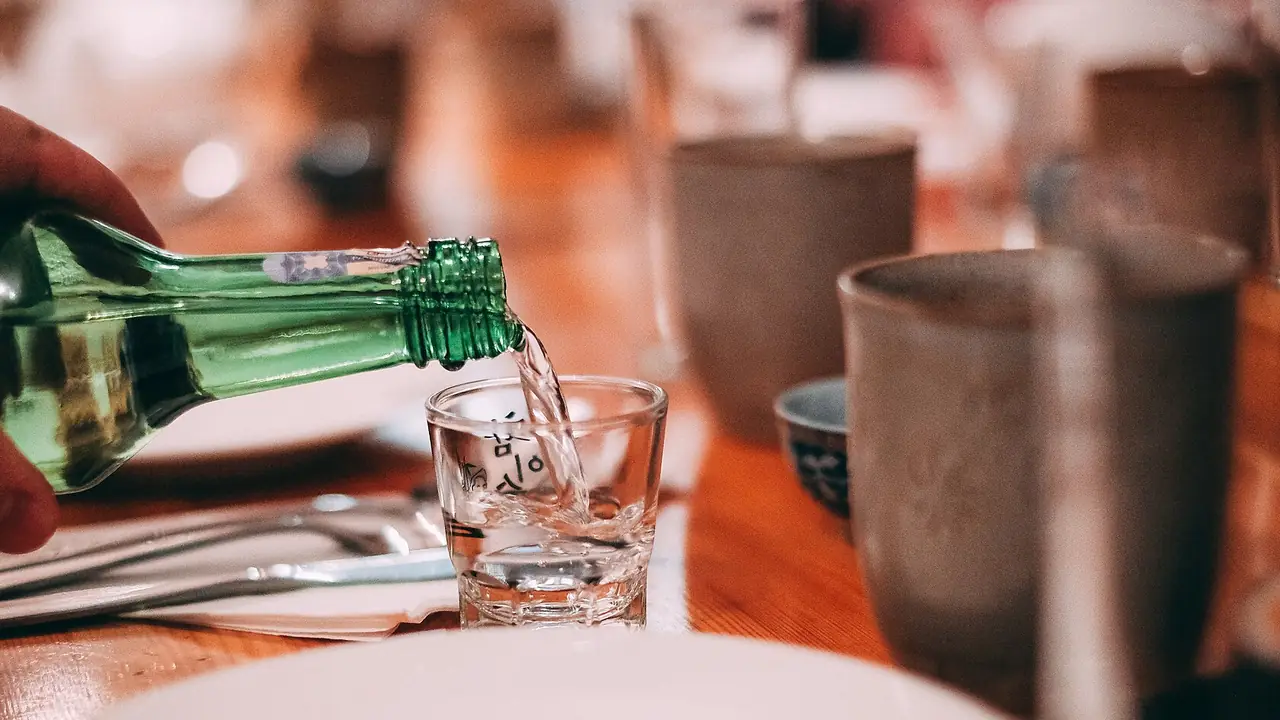
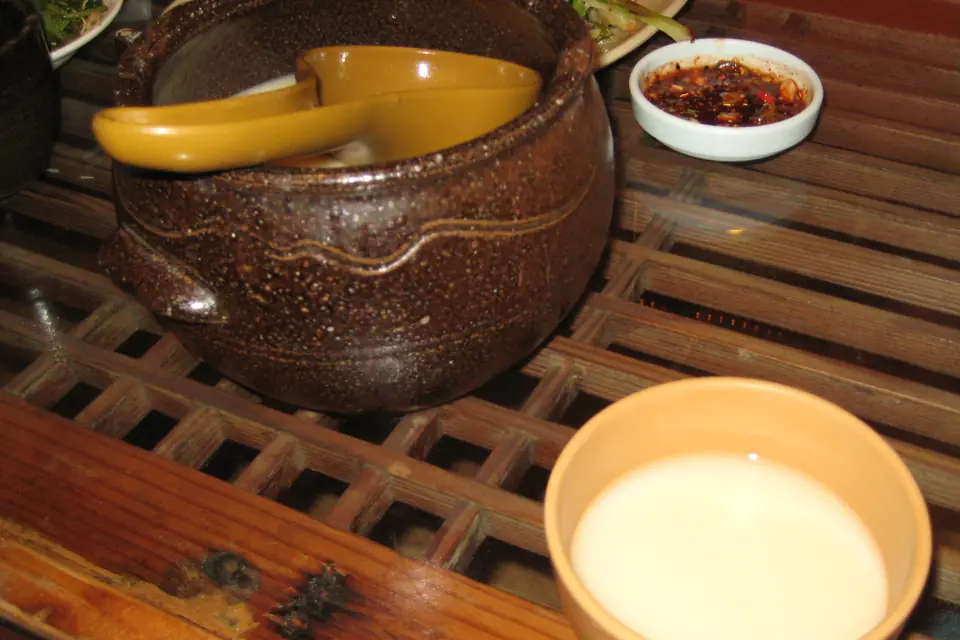
Rice wine served the traditional way, in an earthenware pot with a ladle and small cups. Photo credit: Timber Tank on Wikimedia Commons, licence CC BY-SA 2.0, trimmed for this page. Cover image of soju being poured: Kārlis Dambrāns on Wikimedia Commons, licence CC BY 2.0, trimmed.
Q. Why is makgeolli served in bowls? Tradition. It is a farmers' drink, called nongju (farmer's liquor) in older writing, and was shared in the fields from simple cups.8 Many restaurants still pour it from a kettle into small bowls. (Peep observation)
Q. Is somaek compulsory? No. It is a group habit, not a rule. (Peep advice) If someone mixes a round, you can ask for beer only, or let your glass sit after the toast.
Where does soju fit at a Korean barbecue?
Right in the middle. Pork belly and soju is the classic Seoul dinner, and the same pouring rules apply over the grill. Our Korean BBQ guide covers ordering, cuts, who grills and dated 2026 prices, so this guide skips them.
Two table tips that help at barbecue nights:
The grill person gets poured for. Whoever is cooking has their hands full, so keep their glass filled. (Peep advice)
Pay at the counter. The bill is settled at the front as you leave, with nothing extra on top. How paying and splitting work is in our guide to tipping and table manners.
Q. Who pays after drinks in Korea? Often the most senior person, or the one who invited you. (Peep observation) Offer once. If they insist, say thank you and pick up the next coffee or the second round instead.
What is the legal drinking age in Korea?
You can buy alcohol from 1 January of the year you turn 19, whatever your birthday. In 2026, that means anyone born in 2007 or earlier; people born in 2008 or later cannot buy alcohol until 1 January 2027.1
The rule comes from Korea's Youth Protection Act, which counts by birth year. Korea moved most legal ages to international age in June 2023, but the government confirmed that the alcohol and tobacco purchase age did not change.1, 14
Carry ID. Sellers must check age, and a 2025 amendment to the act now requires customers to show ID when a shop owner or staff member asks.1 For visitors that means your passport. (Peep note)
Q. Do bars in Korea check foreigners' ID? Many do, especially clubs and late-night places, and convenience stores may ask for anyone who looks young. (Peep observation) Under the 2025 amendment you are expected to show ID when asked.1
Q. Is it the same age for tobacco? Yes. The same birth-year rule covers alcohol and cigarettes.1
Can you drink in public in Korea?
Usually yes, but not everywhere. Korea has no single nationwide ban on drinking outdoors; instead, cities and districts can declare no-drinking zones under the National Health Promotion Act, with fines of up to 100,000 won.6 Look for signs at the entrance of parks and plazas.
Zones visitors are most likely to meet in Seoul:
Seoul Station Plaza. Designated a no-drinking zone from 9 November 2026, across about 19,853 square metres of outdoor space; after a guidance period, drinking there is fined 50,000 won from 1 March 2027. Indoor restaurants, Seoullo 7017 and the underground walkways are excluded.5, 15
Cheonggyecheon. Seoul announced in August 2026 that it plans to make the full 8.12 km walk along the stream a no-drinking and no-smoking zone, aiming to start fines by the end of 2026. Drinking there is already on the list of banned acts.6
Some city parks. Seoul's drinking-culture ordinance lets the mayor designate urban parks and children's playgrounds as no-drinking areas, with signs at the entrance.16
Q. Can I drink on the street in Seoul? Outside a signed zone, there is no general ban. (ref. 6; Peep note) A quiet drink is one thing; loud, drunken behaviour can still bring complaints and the police. (Peep note)
Is drinking allowed in Han River parks?
Yes. Han River parks are not a designated no-drinking zone, so a beer with fried chicken on the grass is legal.3, 4 The park rules fine the behaviour, not the drink: drunken rowdiness, heavy noise or anything that makes others feel disgust or anxiety costs 70,000 won, and leaving your picnic trash behind costs 100,000 won.3
The debate is not over. Seoul's council shelved a 2023 proposal that would have let riverside areas become no-drinking zones, citing a lack of public consensus.4 We found no designation as of 4 November 2026, but check the signs at the park entrance before you open a can.
Q. Can I cook or grill at the Han River with my drinks? No. Cooking or camping outside designated places is fined 1,000,000 won the first time.3 Delivered food and ready-made convenience store food are the usual picnic.
What is the drink-driving limit in Korea?
0.03% blood alcohol. At that level or above, driving is a criminal offence under the Road Traffic Act, and the rule covers cars and motorised two-wheelers.2 It is a low line, so the simple plan is not to drive at all after drinking. (Peep advice)
The penalties, per the government's legal information service2:
Blood alcohol
Penalty
Licence
0.03% to under 0.08%
Up to 1 year in prison or a fine up to 5 million won
Suspended, 100 penalty points
0.08% to under 0.2%
1 to 2 years in prison or a fine of 5 to 10 million won
Revoked
0.2% or more
2 to 5 years in prison or a fine of 10 to 20 million won
Revoked
Q. Does it apply to electric scooters? Yes. The same law covers mopeds and motorised two-wheelers, and shared electric kick scooters are regulated in that class. (ref. 2; Peep note) Walk, take a taxi or use the subway instead.
Q. Does the limit apply the morning after? Yes. The 0.03% line applies at any hour, not just at night.2 If you drank the evening before, let the subway or a taxi do the driving. (Peep advice)
Quick FAQ
Pour for others and never for yourself, which Seoul's official tourism guide lists as the first rule of drinking etiquette.7
Add two hands with anyone older and a small turn of the head when you drink in front of them, and you have covered what most Koreans notice.
Two hands show respect to someone older or senior, a habit Korea.net traces back to Joseon-era etiquette manuals.8
Hold the bottle in your right hand and touch your right wrist or forearm with your left. Between close friends of similar age, one hand is fine.
Turning slightly away from an elder while you drink is a sign of respect, according to Seoul's tourism guide.7
It applies to elders, bosses and anyone you address formally, not friends your own age. A small turn of the head and shoulders is enough.
No. Declining warmly is accepted, and many Koreans now drink less or not at all; household spending on alcohol fell 9.0% early in 2026.9
Smile, keep your glass full and say "gwaenchanseumnida". Raise a soft drink for the toast so you still join in.
Cover the top of your glass lightly with your hand and say "gwaenchanseumnida", which means "I am fine, thank you". (Peep advice)
If people keep offering, "sureul mot masimnida" (I cannot drink alcohol) ends the topic politely. You do not need to explain why.
No, you never have to finish a glass in Korea. A refill normally goes into an empty glass, so a glass with drink left in it tells people you are fine for now. (Peep observation)
Sip at your own pace and keep water next to your soju glass.
At a group table it is considered a little rude, because it suggests nobody is looking after you.7
Pour for the person beside you instead, and they will usually return the favour straight away. Drinking alone or with one close friend, nobody will mind.
"Geonbae" is the Korean word for cheers, said as glasses meet for a toast. (Peep note)
You will also hear "jjan", the sound of the clink, among friends. At a company dinner the senior person often gives a short toast first, and everyone drinks together after it.
"Wonsyat" (one shot) means emptying a glass in one go, and someone may call it for the first toast. (Peep observation)
It is a playful invitation, not an obligation. A small sip is completely acceptable, and nobody at a polite table should push you past it.
The main green-bottle soju brands are 15.7% alcohol after both big makers cut strength in 2026.9, 10
That is well below the 20% of 2006, but still roughly three to four times a standard lager, so pace it with food and water.
Most bottled makgeolli sits around 6%; Seoul Takju's Jangsu makgeolli is listed at 6% alcohol.11
It is milky and slightly fizzy, often sweet, and poured into small bowls. The same two-hand manners apply when an older person pours for you.
Somaek is soju poured into beer, a name made from "so" for soju and "maek" for maekju, beer. (Peep note)
One person usually mixes a round for the table. You can ask for plain beer or skip it, and you are never obliged to drink one.
Yes, and it is growing fast; one brewer's non-alcoholic beers were in about 64,000 Korean restaurants and pubs by May 2026.12
Look for 0.00 on the label if you want no alcohol at all, because "non-alcoholic" can mean just under 1%.
In 2026 you can buy alcohol if you were born in 2007 or earlier, because the rule counts from 1 January of the year you turn 19.1
Your birthday does not matter. People born in 2008 can buy alcohol from 1 January 2027.
Bring your passport, because sellers must check age and a 2025 amendment requires customers to show ID when the seller asks.1
Convenience stores, bars and clubs may ask anyone who looks young. A photo of your passport may not be accepted, so carry the real one at night. (Peep advice)
Generally yes, because Korea has no nationwide ban, but cities and districts can mark no-drinking zones with fines of up to 100,000 won.6
Seoul Station Plaza becomes one from 9 November 2026, and Cheonggyecheon is next on the city's list. Look for signs at park entrances.
Yes. Han River parks are not a no-drinking zone, so drinking on the grass is allowed.3, 4
What is fined is the behaviour: drunken rowdiness or heavy noise costs 70,000 won, and leaving your picnic trash behind costs 100,000 won. Take everything back to the bins.
The limit is 0.03% blood alcohol, and driving at or above it is a crime under the Road Traffic Act.2
From 0.08% your licence is revoked and fines start at 5 million won. Do not drive at all after drinking, including electric scooters.
Often the most senior person or whoever invited you pays, while splitting is common among friends of the same age. (Peep observation)
Offer once with both hands on the card. If they insist, accept with thanks and offer to pay for coffee or the next round.
Company dinners called hoesik still happen, but pressure to drink has eased and leaving after the first round is normal. (Peep observation)
Join the toast, follow the two-hand and turn-away manners with seniors, and switch to a soft drink whenever you like.
Showing 5 of 20
2026년 '청소년 보호법' 상 청소년 연령은? (Who counts as a youth under the Youth Protection Act in 2026?). Ministry of Gender Equality and Family, via Korea.kr policy briefing, 8 January 2026 (in Korean). Born 2007 or earlier can buy alcohol in 2026; ID duty from the April 2025 amendment. Link
음주운전 금지 (Drink-driving ban and penalties). Ministry of Government Legislation, Easy Law (찾기쉬운 생활법령정보) (in Korean). Checked 4 November 2026. Link
한강공원 금지행위(과태료) (Han River park prohibited acts and fines). Seoul Metropolitan Government, Future Hangang Headquarters (in Korean). Ordinance in force 29 December 2023. Checked 4 November 2026. Link
낮에는 벚꽃 구경 밤에는 술판…한강공원, 미성년자 음주에 무방비 (Han River parks left out of no-drinking rules). Digital Times, 9 April 2024 (in Korean). Link
"서울역 광장 음주금지"…내년 3월부터 적발시 과태료 5만원 (Seoul Station Plaza no-drinking zone, 50,000 won fines from March). Yonhap News Agency, 12 October 2026 (in Korean). Link
Drinking at Cheonggye Stream? It could cost you $70. The Korea Times, 13 August 2026. Link
Korean Etiquette. Seoul Tourism Organization, Visit Seoul (official Seoul tourism site), edited 13 February 2019. Checked 4 November 2026. Link
Alcohol in Korean Life [8]. Korea.net, Korean Culture and Information Service, 29 January 2014. Link
하이트진로, '참이슬 후레쉬' 알코올 도수 16→15.7도 조정 (Chamisul Fresh cut from 16% to 15.7%). Yonhap News Agency, 2 June 2026 (in Korean). Link
'처음처럼' 도수 16도→15.7도로…저도주 트렌드 확산 (Chum Churum cut to 15.7%). Yonhap News TV, 1 September 2026 (in Korean). Link
장수 생막걸리 (Jangsu makgeolli product page). Seoul Takju Manufacturers Association (in Korean). Alcohol 6%. Checked 4 November 2026. Link
"술보다 분위기"…'논알코올 맥주' 판매식당 2년 새 5배 (Restaurants selling non-alcoholic beer up fivefold in two years). Good Morning Economy, 30 June 2026 (in Korean). Link
주류업계, '논알코올' 맥주 시장 경쟁…제품군·외식 판매 확대 (Brewers expand non-alcoholic beer in restaurants). Yonhap News Agency, 16 July 2026 (in Korean). Link
'만 나이' 시행…술·담배 구매 연령은 어떻게? (International age takes effect: what about the alcohol and tobacco age?). Ministry of Gender Equality and Family, via Korea.kr policy briefing, 28 June 2023 (in Korean). Link
서울역광장 '술판' 새달 사라진다 (Seoul Station Plaza no-drinking zone, 19,853 square metres). Seoul Shinmun, 13 October 2026 (in Korean). Link
Seoul Metropolitan Government Ordinance on Creation of Sound Drinking Culture. Seoul Metropolitan Government legal information (English), amended 7 January 2021. Checked 4 November 2026. Link