Korea tipping culture and travel etiquette for visitors: why you do not tip, how paying at the counter works, table manners, and subway and bus manners.
PK
Peep Korea Editorial · 11 min read
Short answer
You do not tip in Korea: not at restaurants, not in taxis, not at cafés, and staff do not expect it.1, 2, 3 At most casual restaurants you pay at the counter on your way out, refills of water and side dishes are free, and the button on the table calls the server.2 On the subway, let people off first, leave the pink and priority seats for those who need them, and keep calls short and quiet.5, 6
The polite move in Seoul often looks wrong to a visitor. You leave no money on the table. You get up without asking for the check. You press a button to call the server. Every instinct from home says "rude".
Here it is just normal. The awkward moment is usually the reverse: a server running after you to hand back the cash you "forgot".
Do you tip in Korea?
No. Tipping is not a Korean custom, and service staff do not expect it.1 The Korea Tourism Organization says the same for restaurants: tipping is "not required or expected".2
That covers almost every situation a visitor meets:
Restaurant, taxi and hotel rows from Visit Seoul and VISITKOREA, checked 26 October 2026. Café, salon and tour rows are Peep observations, not an official rule.
Q. Will people be offended if I tip? Rarely offended, often confused. Visit Seoul's own advice is that some people may take it and some may refuse, so "go with the flow".4 If someone refuses, do not insist. Pushing money back and forth is the awkward part.
Do hotels or restaurants add a service charge in Korea?
Some do. Visit Seoul notes that many major hotels and upscale restaurants add a 10 percent service charge on top of the 10 percent VAT.1 That page is dated 2019, so read your own bill rather than assuming.
What to check:
The menu or rate card. Look for "service charge" or "봉사료" (bongsaryo).
The final bill. If a service charge is printed, that is the tip. Nothing more on top.
Casual places. Everyday restaurants, food courts and cafés generally show one price, VAT included.
Q. Should I leave a tip for hotel housekeeping? It is not expected. If you want to say thanks, a short note in English or a tidy room says it well. Leaving cash on the pillow may simply be handed to the front desk as lost property.
How do you pay at a Korean restaurant?
In most casual restaurants you do not wait for a check. When you are done, get up, take the bill if one was left at your table, and pay at the counter near the door. This is the step that confuses visitors most.
How the meal usually runs:
Order. From a server, a tablet on the table, or a kiosk by the door. Kiosks and self-serve water and side dishes are becoming more common.2
Call the server. Press the bell on the table. It is louder than you expect, and that is fine.2 Saying "jeogiyo" (excuse me) also works.
Refills. More water, more kimchi, more side dishes: usually free.2
Pay. Walk to the counter with the bill or just your table number. Say "gyesan hal-geyo" (I'd like to pay).
Leave. No tip. A quick "jal meogeosseumnida" (I ate well, thank you) earns a smile.
Fancier places and some Western-style restaurants bring the bill to the table, as at home. If staff hand you a folder at the table, pay there.
Q. Can we split the bill? Often yes at the counter. Say "ttaro gyesan-hal-geyo" (we will pay separately). At peak lunch hours, a busy counter may prefer one payment, so one person pays and the group settles up later. (Peep observation.)
Q. Is it rude to leave food? No. Side dishes are refilled freely, so finishing everything is not expected. Order a little less if you hate waste.
What are basic Korean table manners?
A few simple habits cover most meals. Visit Seoul lists the main ones: wait until the eldest at the table starts eating, do not stand chopsticks or a spoon upright in your rice, eat rice with the spoon, and put your chopsticks and spoon back where they were when you finish.4
Also worth knowing:
Use both hands when you pass or receive something, a drink, a card, a gift.4
Do not touch food with your fingers, except when wrapping it in lettuce or cabbage.4
Shoes come off in homes, temples and guesthouses.4 Some restaurants with floor seating ask for it too; look for a row of shoes at the step.
Q. Who pays when a Korean friend invites me out? Often the person who invited you, or the older person at the table. Seniority comes with obligations as well as respect.4 Offer to pay, accept graciously if they insist, and offer to get the coffee or the next meal.
What is subway etiquette in Seoul?
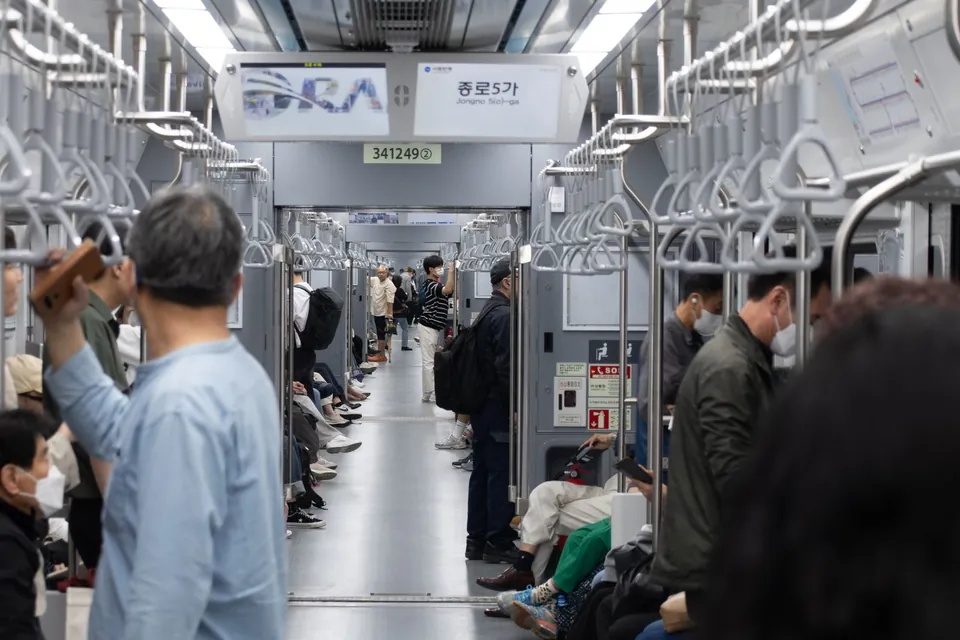
Short version: let people off before you board, do not push, offer your seat to those who need it, keep phone calls low, and keep right when walking in stations. Those come straight from Seoul Metro's own list of subway manners.5
The seats are the part visitors get wrong:
Priority seats at both ends of each car are for older people, people with disabilities, the injured and others who need them.6 Leave them empty even when the train is crowded.
Pink seats are pregnancy priority seats: two per car on Lines 1 to 8, at the ends of the long middle benches, and also on Line 9 and other city lines. The city campaign asks riders to keep them empty.6
Anyone holding a baby or small child should be offered a seat.5
Escalators: Seoul Metro asks riders not to walk or run on them.5 Many people still walk on the left. Stand still on the right and you are fine either way.
Big backpacks: take them off and hold them low in a crowded car. (Peep observation.)
Food: eating a full meal on a train is frowned on, and strong smells draw looks. A drink with a lid is fine. (Peep observation.)
Q. Can I sit in the pink seat if no one is pregnant? The city calls it a "consideration seat" for pregnant riders and runs a campaign asking everyone to leave it empty.6 Many riders do. Since early pregnancy does not show, leaving it free is the safe choice.
Can I bring coffee on a Seoul bus?
Usually not in an open takeaway cup. Since 2018, Seoul city bus drivers may refuse passengers carrying drinks, ice or food in disposable cups, or other food that could spill, and can ask someone eating on board to get off.7
What is allowed: sealed plastic bottles, unopened cans, closed tumblers and thermoses, and food in closed boxes such as pizza or chicken.7 Finish the latte at the stop.
Do you tip taxi drivers in Korea?
No. Most taxis charge by the meter and do not expect tips.3 Visit Seoul notes that drivers do appreciate it if you let them keep small change.1
Small manners that help:
Sit in the back unless the back is full.
Show the destination in Korean on your phone. Drivers read addresses faster than names.
Fasten your seat belt.
Say "gamsahamnida" (thank you) when you get out.
Q. What if the fare seems wrong? Ask for a receipt ("yeongsujeung juseyo") before you get out, and call the 24-hour Korea Travel Hotline, 1330, for help in English.2, 3
Do you tip at hair salons, spas or clinics in Korea?
No. Prices at salons, spas and nail shops are set on the menu, and there is no tip line. (Peep observation.) Clinics work the same way: you pay the quoted price, and staff do not expect cash or gifts.
If you are visiting a clinic, the useful courtesy is preparation, not money: arrive on time, bring your questions written down, and ask for anything unclear to be repeated. Our consultation checklist has the questions. For buying over-the-counter basics, see Korean pharmacies in Seoul.
What other Korean etiquette should visitors know?
Most Koreans understand that visitors make small mistakes, and they do not read them as disrespect.4 A few habits still go a long way.
A small bow. A nod of the head when you say hello or thank you.4
Polite speech first. Start formal, with "-yo" endings, even with people your age.4
Quiet in homes and old neighborhoods. Hanok areas and residential lanes are people's homes; keep your voice down.
Trash. Public bins can be hard to find. Keep a small bag and throw it out at your hotel or a convenience store bin you use. (Peep observation.)
Queues. Line up for buses, taxis and popular restaurants. Some restaurants use a waiting list or a tablet at the door instead.
Which Korean phrases help most at restaurants and on the subway?
Six short phrases cover nearly every daily moment. Romanization is approximate; people will understand you.
Point a translation app's camera at a menu or sign and it reads it for you in seconds. It needs data, so set up your phone first with our Korea SIM and eSIM guide. Arriving soon? Incheon Airport to Seoul covers the first hour.
Quick FAQ
No. Tipping is not a Korean custom, and staff do not expect it.1
That includes restaurants, cafés and taxis.
Not rude, but it can cause confusion. Some people accept and some refuse.4
If someone refuses, thank them and put the money away.
No. The Korea Tourism Organization says tipping is not required or expected.2
Pay what the bill says.
At most casual places, take your bill or table number to the counter by the door and pay on the way out.
If staff bring a bill folder to your table, pay at the table instead.
Press the call button on the table.2
If there is none, raise a hand and say "jeogiyo".
Yes, side dishes and water refills are usually free.2
Some places are self-serve, with a refill station.
Often yes. Say "ttaro gyesan-hal-geyo" at the counter.
At very busy times one person may pay and the group settles up later.
Some major hotels and upscale restaurants add 10 percent on top of 10 percent VAT.1
Check the rate card and the bill; if it is printed, it replaces a tip.
No. Taxis charge by the meter and do not expect tips.3
Letting the driver keep small change is fine.1
It depends on the tour. There is no national custom.
Follow what the tour operator states in writing, and do not feel pushed.
No. The menu price is the price.
A sincere thank you is enough.
Do not stand chopsticks or a spoon upright in your rice.4
Also wait for the eldest to start eating.
Yes, in homes, temples and guesthouses.4
In restaurants, only where there is floor seating or a shoe step.
Pregnancy priority seats, two per car on Lines 1 to 8.6
The city asks riders to leave them empty.
The seats at the car ends are for older riders, disabled or injured people and others who need them.5
Leave them free, even on a crowded train.
A drink with a lid is fine. A full meal or strong-smelling food is frowned on (Peep observation).
On city buses, drivers can refuse open takeaway cups and food that may spill.7
Yes, briefly and quietly. Seoul Metro asks for phones on vibrate and low voices.5
Video calls on speaker draw looks.
Seoul Metro asks people not to walk or run on escalators.5
Many still walk on the left, so stand on the right.
A small nod with hello or thank you is enough.4
Nobody expects a deep bow from a visitor.
Most Koreans know visitors make small slips and do not read them as disrespect.4
Say "joesonghamnida" (sorry), smile and carry on.
Showing 5 of 20
Money (currency, tax refund and tipping). Visit Seoul, the Official Travel Guide to Seoul (Seoul Tourism Organization), edited 14 March 2019. Link
About Korean Food (Visiting a Korean restaurant). VISITKOREA, Korea Tourism Organization, updated 24 March 2023. Link
Taxi. VISITKOREA, Korea Tourism Organization, updated 22 January 2026. Link
Etiquette. Visit Seoul, the Official Travel Guide to Seoul (Seoul Tourism Organization), edited 19 March 2020. Link
How to use the subway (Subway Etiquette). Seoul Metro. Checked 26 October 2026. Link
'임산부배려석' 안내 (Pregnancy priority seats on the subway). Seoul Metropolitan Government, updated 11 November 2024 (in Korean). Link
Seoul City's Specified Provisions for 'Foods Prohibited from Carry On'. Seoul Metropolitan Government, 4 April 2018. Link