Best time to visit Korea, month by month: Seoul highs, lows and rain from KMA normals, cherry blossom and rainy season timing, crowd peaks and 2027 holiday dates.
PK
Peep Korea Editorial · 15 min read
Short answer
For comfortable weather, aim for mid April to early June or mid September to early November; Seoul averages highs of about 18 to 24°C in April and May and 20 to 26°C in September and October.1 Those are also busy weeks, so dodge Korea's own long weekends, like Seollal on 6 to 9 February 2027 and Chuseok on 14 to 16 September 2027.9, 10 Late June to late July is the rainy season and August is the hottest month; January is the coldest, and in 2025 it drew about 1.12 million foreign visitors against 1.82 million in August.1, 2, 12, 13
Most people pick a month from a photo. Pink trees in April. Red maples in October. Then they land in a city where everyone else picked the same photo.
Every season in Korea has a catch. Spring has dust and crowds, summer has rain and heat, autumn has crowds again, and winter has real cold. The trick is choosing the catch you can live with, then picking the right week inside that month.
When is the best time to visit Korea?
For weather alone, mid April to early June and mid September to early November. Days are mild and rain is moderate.1 For fewer crowds, look at March, or at January and February with a well-packed bag.
Here is the short version by traveler type:
You want
Go
The catch
Mild walking weather
Mid April to early June
Spring dust days, festival crowds
Autumn color
Mid October to early November
Busy sights and full hotels (Peep observation)
Fewer visitors
January, February
Highs near 2 to 5°C, wind
Beaches and long evenings
Late July, August
Heat, humidity, typhoon risk
Flowers
Late March to mid April
The bloom moves every year
Weather from KMA 1991 to 2020 Seoul normals; crowd notes from 2025 arrival data and Peep observation. (ref. 1, 12 to 15)
Q. Is there a month to avoid completely? No. July is the hardest month for sightseeing because of rain, and late January can be bitter. Both still work if you plan indoor days.
What is the weather in Korea by month?
Seoul runs from below freezing in January to about 30°C in August, with most of the year's rain falling in July and August. The table uses the Korea Meteorological Administration's 30-year normals for the Seoul station, the figures Korean forecasters compare against.1
Month
Avg high
Avg low
Rain
Wet days (1 mm+)
In one line
January
2.1°C (36°F)
minus 5.5°C (22°F)
17 mm
3.3
Coldest and driest
February
5.1°C (41°F)
minus 3.2°C (26°F)
28 mm
3.4
Still winter, Seollal crowds on the roads
March
11.0°C (52°F)
1.9°C (35°F)
37 mm
4.7
Cold mornings, first blossoms late in the month
April
17.9°C (64°F)
8.0°C (46°F)
73 mm
6.5
Cherry blossoms, dust days, pleasant afternoons
May
23.6°C (74°F)
13.5°C (56°F)
104 mm
6.8
Warm, green, holiday-heavy
June
27.6°C (82°F)
18.7°C (66°F)
130 mm
7.6
Getting humid; rain starts late in the month
July
29.0°C (84°F)
22.3°C (72°F)
414 mm
13.3
Rainy season, the wettest month
August
30.0°C (86°F)
22.9°C (73°F)
348 mm
11.8
Hottest, humid, storms possible
September
26.2°C (79°F)
17.7°C (64°F)
142 mm
6.5
Warm, drying out, Chuseok
October
20.2°C (68°F)
10.6°C (51°F)
52 mm
4.8
Crisp, sunny, autumn color starts
November
11.9°C (53°F)
3.5°C (38°F)
51 mm
6.4
Leaves fall fast, first freeze
December
4.2°C (40°F)
minus 3.4°C (26°F)
23 mm
4.2
Cold, festive lights, short days
Seoul station, KMA climate normals 1991 to 2020, checked 27 October 2026. Averages, not a forecast.1
Two things the table hides. July's 414 mm does not fall evenly; it comes in heavy bursts with dry gaps between. And a winter "high" of 2°C feels much colder by the river or on a hilltop with wind.
When is the rainy season in Korea?
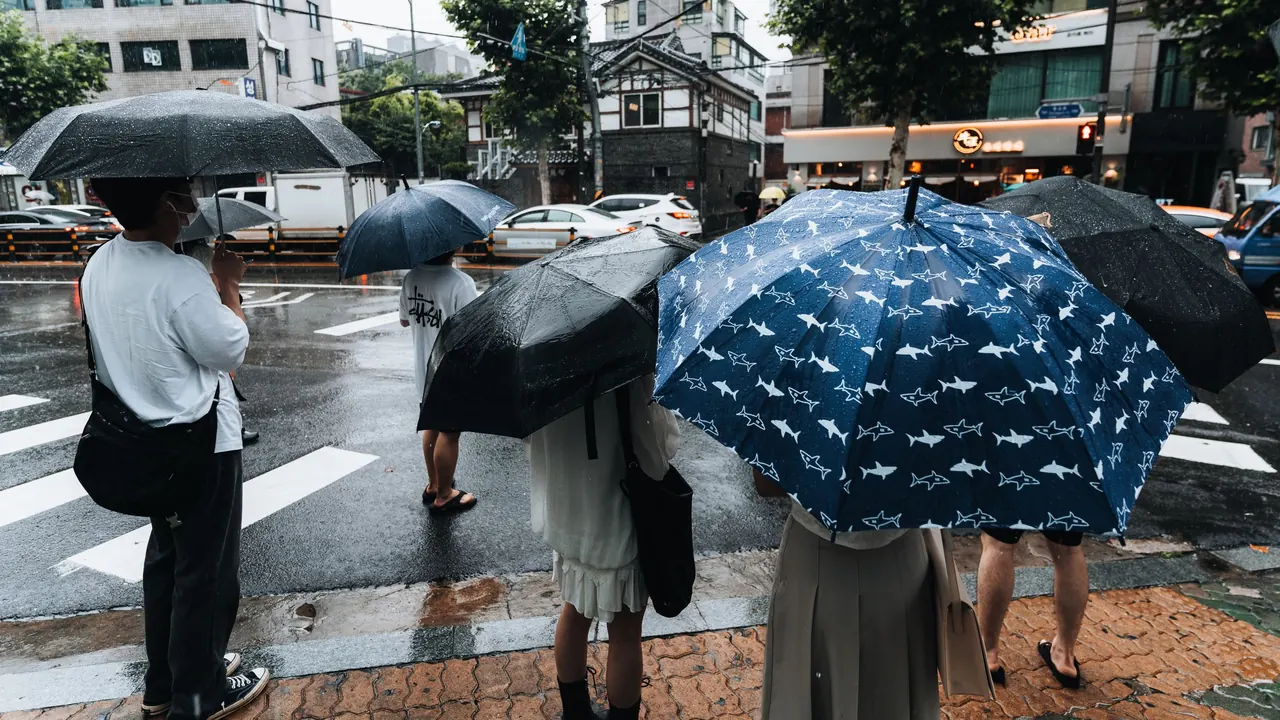
In Seoul and the central region, the rainy season (jangma) normally runs from about 25 June to 26 July, roughly 31 days.2 It reaches Jeju first, around 19 June, and the south around 23 June.2
It shifts every year. In 2026 the central region's rainy season started late, on 1 July, and ended on 26 July, five days shorter than normal.3 KMA called the 2026 dates provisionally after the rain stopped, so treat any early "start date" you read online as an estimate.3
What it means for a trip:
Expect some rain on most days, often heavy for an hour or two, then a break.
Plan one indoor anchor per day: a museum, a market hall, a long lunch.
Pack quick-dry shoes. A week in wet sneakers ruins trips.
Convenience stores sell umbrellas, so travel light.
Q. Is the rain over once jangma ends? Not always. August still averages 348 mm of rain in Seoul, often in short, heavy downpours, and typhoons arrive later in the summer.1, 4
Does Korea get typhoons, and when?
Yes, but not many. On the 1991 to 2020 average, about 3.4 typhoons a year affect Korea, mostly in July (1.0), August (1.2) and September (0.8).4 October averages 0.1.
So a typhoon is a risk to plan around, not a reason to cancel a summer trip. If one is forecast:
Check KMA's English site or a local weather app every morning.
Island ferries are often the first service suspended (Peep observation), so keep island days flexible.
Keep the storm day for indoor plans in the city.
Ask your airline about rebooking before you head to the airport.
Is Korea too hot in summer?
It is hot and humid, and the humidity is the hard part. Seoul's August averages a high of 30.0°C and a low near 23°C, so nights stay warm.1 Relative humidity sits around 74 to 76% in July and August, against about 55% in spring.1
The good news: subways, malls, museums and cafés are strongly air-conditioned. Do outdoor sightseeing before 11:00 and after 17:00, and spend the middle of the day indoors.
Q. What should I wear in a Korean summer? Breathable fabrics, a light layer for cold air-conditioning, and shoes that can get wet.
When do cherry blossoms bloom in Seoul?
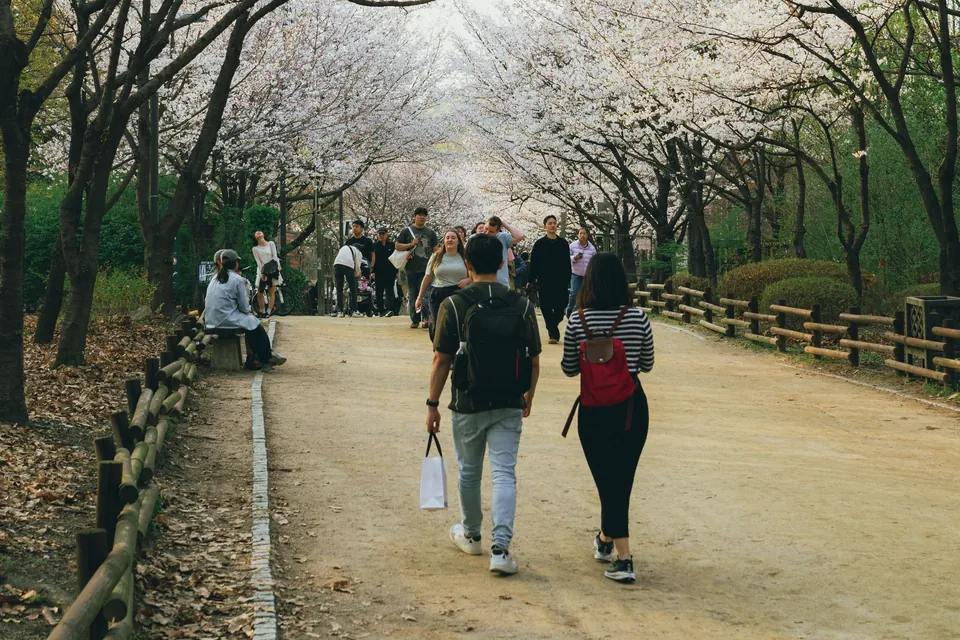
Normally around 8 April, with full bloom about two days later, on 10 April.5, 6 That "normal" is a 30-year average, and recent springs have run early: in 2026, Seoul's official tree bloomed on 29 March, ten days ahead of normal.5
Blossoms open earlier in the south and later in the mountains, so the season moves north through late March and April. Private weather companies publish bloom forecasts in late winter, so book flexible dates or a longer window rather than one fixed weekend.
The petals last about a week in any one place. Rain or wind can strip a street in a day.
Q. What about spring dust? Yellow dust (hwangsa) blows in mostly from March to May. Seoul logged it on 9 days in spring 2024 and 6 in spring 2025.7 Separately, Korea runs a seasonal fine dust program from December to March.8 Check an air quality app each morning and keep a mask in your bag for bad days.
What festivals are worth planning around?
Pick one or two that match your dates, then confirm the year's official schedule before you book. Festival dates change every year.
Cherry blossom season, late March to mid April: street festivals follow the bloom, so dates move.5
Lotus Lantern Festival, May: a night lantern parade through central Seoul before Buddha's Birthday. In 2026 it ran on Saturday 16 May, 19:00 to 21:30, from Heunginjimun to Jogyesa.11 Buddha's Birthday 2027 falls on 13 May.10
Q. When is the 2027 Lotus Lantern parade? Not announced yet as of 27 October 2026. Based on past years it usually falls on a weekend shortly before Buddha's Birthday. Check the festival's official site in spring.11
When is Korea most crowded?
Spring and autumn feel the busiest at famous sights (Peep observation), but foreign arrivals peak in summer and autumn. In 2025, about 1.82 million foreign visitors arrived in August and 1.74 million in October, against about 1.12 million in January.12, 13, 14 The full year set a record of about 18.94 million.15
Month (2025)
Foreign arrivals
January
1,117,243
August
1,820,199
October
1,739,020
December
about 1.5 million
Korea Tourism Organization monthly statistics, as reported in 2025 and January 2026. (ref. 12 to 15)
Arrivals are half the picture. Korean holidays move crowds inside the country, and that is when trains and highways fill up.
Q. Is Seoul empty during Seollal and Chuseok? Quieter in some business areas, busier at palaces, malls and family spots. Many people leave Seoul for their hometowns, so trains and highways out of the city fill up around those dates. Some small restaurants and shops close for a day or two (Peep observation).
What are the 2027 public holidays in Korea?
Korea's 2027 calendar was published by the Korea AeroSpace Administration on 29 June 2026. The ones that matter most for crowds are Seollal and Chuseok.9, 10
Holiday
2027 date
Crowd effect
New Year's Day
Fri 1 January
Long weekend, 1 to 3 January
Seollal (Lunar New Year)
6 to 8 February, plus Tue 9 February in lieu
Four-day break; trains and roads packed
Independence Movement Day
Mon 1 March
Long weekend, 27 February to 1 March
Labor Day
Sat 1 May, plus Mon 3 May in lieu
Long weekend, 1 to 3 May
Children's Day
Wed 5 May
Family crowds at parks and zoos
Buddha's Birthday
Thu 13 May
Temple events
Memorial Day
Sun 6 June
Falls on a Sunday, no substitute day
Constitution Day
Sat 17 July, plus Mon 19 July in lieu
Long weekend
Liberation Day
Sun 15 August, plus Mon 16 August in lieu
Long weekend, peak summer travel
Chuseok
14 to 16 September (Tue to Thu)
Three-day break; trains and roads packed
National Foundation Day
Sun 3 October, plus Mon 4 October in lieu
Long weekend
Hangeul Day
Sat 9 October, plus Mon 11 October in lieu
Long weekend
Christmas
Sat 25 December, plus Mon 27 December in lieu
Long weekend
From the Korea AeroSpace Administration 2027 almanac and KASI calendar data, checked 27 October 2026. Holiday rules can change by law; check an official calendar before you book.9, 10
Labor Day and Constitution Day were made public holidays from 2026, which is why 2027 has more red dates than older lists online show.9
Q. How do I use this table? Book trains and island flights early if your trip touches any long weekend. If you want quieter sights, avoid the four Seollal days and the three Chuseok days, or plan city-only days around them. For what closes on those days, ask your hotel a week ahead.
What is Seoul's weather like in September?
Warm, then pleasant. Seoul's September averages a high of 26.2°C and a low of 17.7°C, with about 142 mm of rain, far less than August.1 Early September can still feel like summer; the last third is usually comfortable.
Two things to watch:
Typhoons: September averages 0.8 typhoons affecting Korea, the last real risk month of the year.4
Chuseok: 14 to 16 September in 2027. Trains and roads out of Seoul fill around those days.9, 10
Q. Is late September a good time to visit Seoul? Often, yes. It is drier and cooler than August, and in 2027 Chuseok falls mid month, so the last week of September avoids it.
What is Korea like in January?
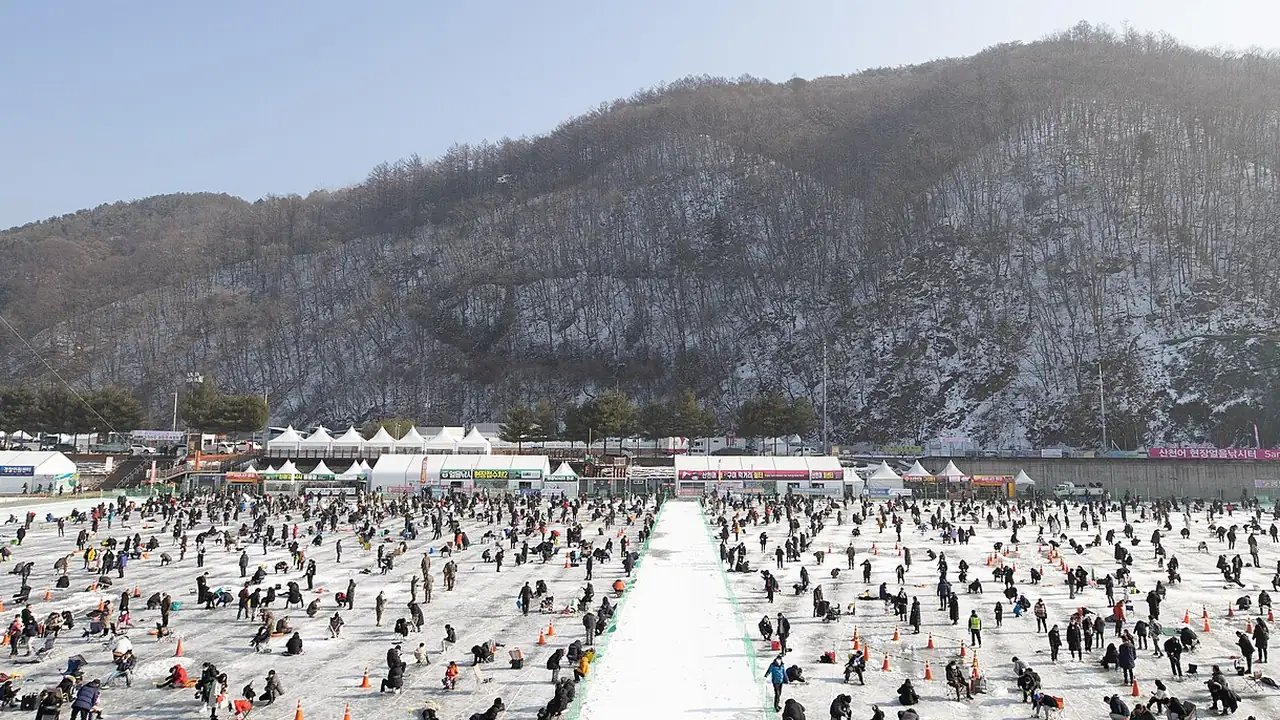
Cold and dry. Seoul's January averages a high of 2.1°C and a low of minus 5.5°C, and cold snaps below minus 10°C are not unusual, so pack for them.1 It also draws far fewer foreign visitors than summer or autumn.12, 13
Why people still choose it:
Dry days: January is one of the driest months, with about 3 wet days.1
Fewer visitors: about 1.12 million arrivals in January 2025, against 1.74 million in October.13, 14
Snow chances: Seoul averages about 7 snowy days in January.1
Indoor Seoul: markets, museums, cafés and heated subway stations.
Pack a long padded coat, thermal layers, gloves and a hat. Walk outdoors in the warmest hours, around 13:00 to 15:00.
Q. Is Seollal in January in 2027? No. In 2027 it falls on 6 to 9 February, including the substitute day.9 January 2027 has only one public holiday, New Year's Day.
How long should my trip be, and does the season change that?
Five to seven days in Seoul with one day trip is a comfortable first-trip pace in any season (Peep estimate). In July and deep winter, add a buffer day, because rain or cold will cost you an outdoor day.
For weather, mid April to early June and mid September to early November.1
Both are busy, so avoid Korean long weekends inside those windows.
May or October, for mild highs of about 24°C and 20°C.1
Late October adds autumn color; May adds green parks and festivals.
Winter. January 2025 drew about 1.12 million foreign visitors, against 1.82 million in August.12, 13
Avoid the Seollal days (6 to 9 February 2027) if you want quieter trains.
May and October are the most comfortable on average, with highs of about 24°C and 20°C.1
October is also one of the drier months, with about 52 mm of rain on average.1
In Seoul, normally about 25 June to 26 July.2
Dates shift each year; in 2026 it ran 1 to 26 July.3
It is the wettest month, with about 414 mm of rain in Seoul.1
It works if you plan indoor anchors and pack quick-dry shoes.
Seoul averages a high of 30.0°C and a low near 23°C.1
Humidity makes it feel hotter, so plan sightseeing early and late in the day.
July to September, with August the most likely month.4
On average about 3.4 typhoons a year affect Korea.
Highs around 26°C, lows around 18°C, and much less rain than August.1
The last third of the month is usually the most comfortable.
Seoul averages a high of 2.1°C and a low of minus 5.5°C.1
Cold snaps below minus 10°C are possible, so pack for them.
Yes, but lightly most years. January averages about 7 snowy days.1
For first snow and December details, see our Seoul in November and December guide.
The normal date is 8 April, with full bloom around 10 April.5, 6
In 2026 they opened on 29 March, so build in flexibility.
Dust blown in from inland Asia, mostly from March to May.7
Check air quality daily and carry a mask for high-dust days.
Seollal runs 6 to 9 February 2027, including a substitute day.9, 10
Chuseok runs 14 to 16 September 2027.
Big malls, chain stores and convenience stores usually stay open (Peep observation).
Some small family restaurants and shops close for a day or two, so check before you go.
By foreign arrivals, summer and autumn: 1.82 million visitors in August 2025 and 1.74 million in October.12, 14
At famous sights, spring blossom weeks and autumn color weeks feel the busiest.
Yes, for weather. October is crisp and one of the drier months.1
Book rooms early, and see our November and December guide for the late-season detail.
Autumn has fewer yellow dust days, and October and November are among the drier months, though September still averages about 142 mm of rain.1, 7
Spring has the blossoms, but the bloom window is short and moves every year.
Five to seven days covers Seoul plus one day trip without rushing (Peep estimate).
In July or deep winter, keep one spare day for weather.
The current exemption for listed passports ends on 31 December 2026.16
For trips from 1 January 2027, check the official K-ETA site before you book.
Yes, if you pack for it. January is one of the driest months of the year.1
Plan indoor afternoons for the coldest, windiest days.
Showing 5 of 21
기후평년값 1991~2020 (Climate normals 1991 to 2020, Seoul station 108). Korea Meteorological Administration, Climate Data Open Portal. Checked 27 October 2026 (in Korean). Link
장마 평년값 (Rainy season normals by region). Korea Meteorological Administration, Climate Data Open Portal. Checked 27 October 2026 (in Korean). Link
올여름 장마 종료…늦게 시작했지만 제때 끝났다 (This summer's rainy season ends: started late, ended on time). Yonhap News, 27 July 2026 (in Korean). Link
태풍발생통계 (Typhoon statistics, normals 1991 to 2020). Korea Meteorological Administration, Weather Nuri. Checked 27 October 2026 (in Korean). Link
오늘(29일), 서울과 여의도 윤중로 벚꽃 개화 (Cherry blossoms bloom in Seoul and on Yeouido's Yunjung-ro today). Korea Meteorological Administration press release, 29 March 2026 (in Korean). Link
서울 벚꽃 '공식' 개화…작년보다 엿새, 평년보다 열흘 일러 (Seoul's cherry blossoms officially bloom, ten days ahead of normal). Yonhap News, 29 March 2026 (in Korean). Link
황사 통계: 연도별, 월별 황사 관측일수, 서울 (Yellow dust observation days by year and month, Seoul). Korea Meteorological Administration, Weather Nuri. Checked 27 October 2026 (in Korean). Link
제7차 미세먼지 계절관리제 (7th seasonal fine dust management, December to March). Korea.kr policy briefing, Ministry of Climate, Energy and Environment, 2 December 2025 (in Korean). Link
「2027년 월력요항」 발표 (2027 calendar almanac released). Korea AeroSpace Administration press release, 29 June 2026 (in Korean). Link
2027년 달력자료 (2027 calendar data: holidays and substitute holidays). Korea Astronomy and Space Science Institute. Checked 27 October 2026 (in Korean). Link
Festival Schedule By Time Line (Yeon Deung Hoe 2026). Lotus Lantern Festival official site. Checked 27 October 2026. Link
'케데헌 효과' 8월 방한객 182만명 방한…전년비 16.4% 증가 (1.82 million visitors in August 2025, KTO statistics). Yonhap News TV, 30 September 2025 (in Korean). Link
한국관광공사, 2025년 1월 한국관광통계 발표 (KTO January 2025 tourism statistics). Discovery News, 28 February 2025 (in Korean). Link
한국관광공사, 2025년 10월 한국관광통계 발표 (KTO October 2025 tourism statistics). Discovery News, 1 December 2025 (in Korean). Link
외국인 관광객 1894만 명…한국 관광, 사상 최대 기록 (18.94 million foreign visitors in 2025, a record). Hyundai Economy News, 30 January 2026 (in Korean). Link
K-ETA temporary exemption notice (exemption through 31 December 2026). K-ETA official portal, Ministry of Justice. Checked 27 October 2026. Link