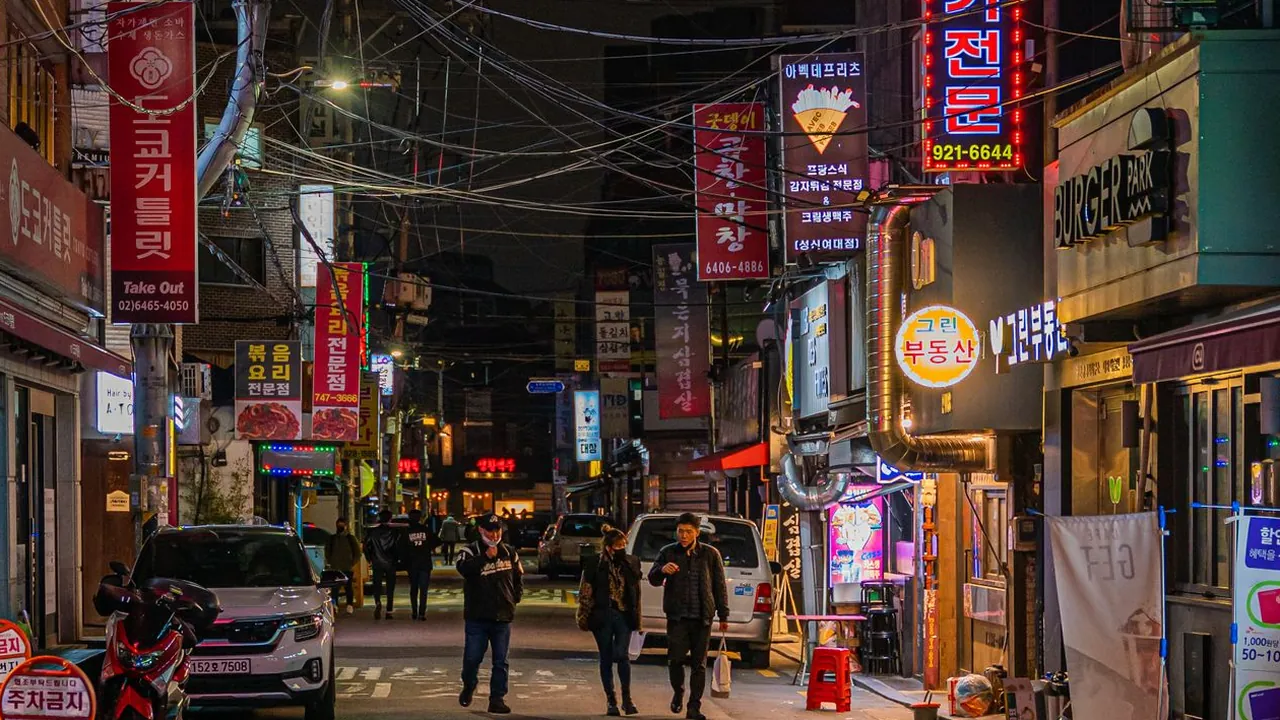
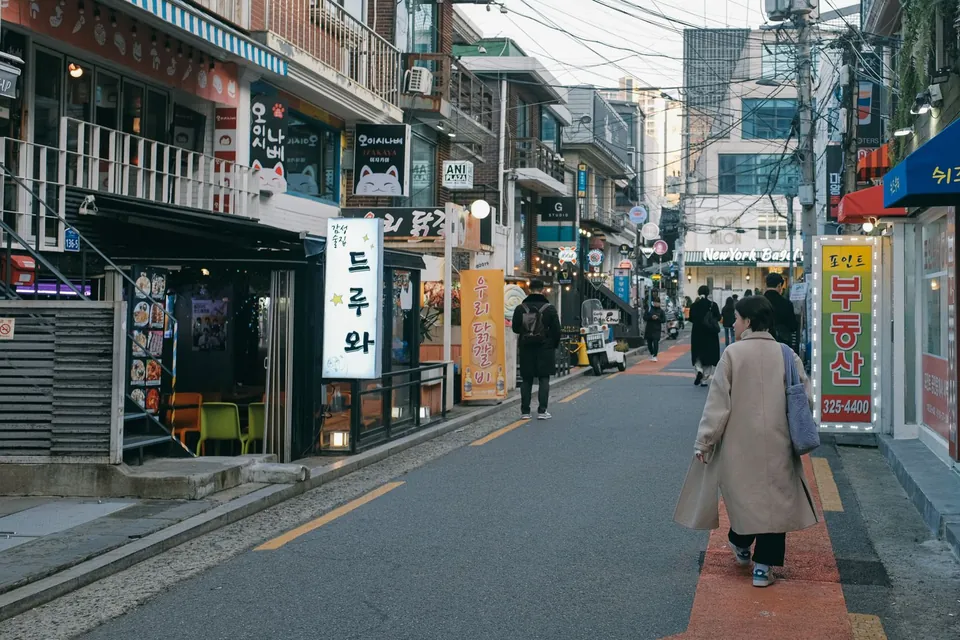
Seongsu-dong, Hongdae and Itaewon compared: what each area is like, stations and exits, pop-ups, busking, hills, crowd times and how to link all three in a day.
PK
Peep Korea Editorial · 15 min read
Short answer
Seongsu is for cafes, design shops and short-run pop-up stores in old factory buildings; Hongdae is for students, street music and late nights; Itaewon is for food from around the world on steep, hilly streets. Seongsu and Hongdae sit on the same subway loop, Line 2, and Line 6 links Hongdae with Itaewon, so all three fit in one long day.3, 6, 12 Go on a weekday afternoon if you want room to walk, and plan around Halloween weekend (30 October to 1 November 2026), when the city runs its strongest crowd-safety measures in all three.10
Ask five people in Seoul where to spend an afternoon and you will hear the same three names. Then you go on a Saturday and spend it in a queue, on a slope, or in a crowd outside a subway exit.
The neighborhoods are worth it. The timing is the part most guides skip. This page covers what each area is like, which exit to use, when it is calm, and how to string them together without crossing the city three times.
Seongsu, Hongdae or Itaewon: which one should you visit?
Choose by the kind of afternoon you are after, not by which name you have heard most. All three are busy, none of them is quiet at night, and each has a different kind of busy. (Peep observation)
Seongsu-dong
Hongdae
Itaewon
Feels like
Old factories and workshops turned into cafes, galleries and shops1
University district with street music, bars and clubs4
International streets, food from many countries, a lot of hills7, 8
Go for
Cafes, pop-up stores, design shops, Seoul Forest park
Stations from VISITKOREA, Visit Seoul and Mapo-gu, checked 28 October 2026. Crowd times are a Peep observation.
Q. I only have time for one. Which is it? For a first trip in daylight, Seongsu. For one fun night out, Hongdae. For one great dinner, Itaewon. (Peep observation)
What is Seongsu-dong known for?
Seongsu-dong is a former factory and shoemaking district east of central Seoul, now full of cafes, galleries and shops in converted industrial buildings. The Korea Tourism Organization describes it through its upcycled spaces, a rice mill turned gallery cafe, its cafe street, a handmade shoe street and the big Seoul Forest park next door.1
What you actually do there:
Walk the cafe streets between Seongsu Station and Seoul Forest. Most of the interesting buildings are on side streets, not the main road.
Visit a pop-up store or two. Brands open short-run shops here that last days or weeks.2
Look for the handmade shoe shops near Seongsu Station, a reminder of what the area made before cafes.1
Rest in Seoul Forest, a large park with lawns, paths and trees, a short walk from Seoul Forest Station.1
Most shops open late morning, around 11:00 or 12:00, so an early start mostly means closed doors. (Peep observation)
Q. Is Seongsu worth it if I do not care about shopping? Yes, for a few hours. Walk the brick streets, sit in a cafe in an old warehouse, then spend the rest of the afternoon in Seoul Forest.
How do you get to Seongsu, and which exit should you use?
Take Line 2 to Seongsu Station, but think twice before using Exit 3. It is the exit most visitors aim for, and it gets so crowded at peak times that Seoul Metro, the subway operator, is adding an extra staircase entrance, Exit 3-1. In November 2025 it planned to finish by December 2026, so it may not be open yet when you visit.3
Ways around the squeeze:
Use Exit 4 or another exit and walk a block. The streets connect.
Start from the other end. Get off at Seoul Forest Station (Suin-Bundang Line) or Ttukseom Station (Line 2) and walk toward Seongsu through the park side.1
Arrive before lunch on a weekday, when the exits are calm. (Peep observation)
Q. How long does Seongsu take? Half a day covers the cafe streets and the park at an easy pace. Add more if you plan to queue for pop-ups. (Peep observation)
How do Seongsu pop-up stores work?
Pop-ups are temporary stores with a fixed run, usually a few days to a few weeks, and then they are gone. On 28 October 2026, one tracker listed 22 Seongsu pop-ups, about half of them still running, from beauty and fashion launches to character exhibitions.2
How to plan around them:
Check the dates and entry method with the organizer before you go. Some are walk-in, some need a booking, and some hand out timed queue numbers on site.2
Check the actual address. A pop-up labeled "Seongsu" can be on the far side of the neighborhood from where you are standing. (Peep observation)
Expect a Korean phone number for many online bookings and queue apps. If you do not have one, go early and ask staff about a walk-in line. (Peep observation) Our Korea SIM card and eSIM guide covers staying connected.
Pick one main stop, then let the rest be a walk. Planning a day around five pop-ups usually means five queues. (Peep observation)
The ending date of an event is not a promise of stock or entry on the last day. Treat popular pop-ups as a maybe.
What is Hongdae known for?
Hongdae is the area around Hongik University in western Seoul, known for students, live and street music, art, cheap food, vintage shops and nightlife. Mapo-gu, the local district, runs a pedestrian street with marked zones for busking performances and exhibitions.4
What to do there:
Catch street performances on the pedestrian street, Eoulmadang-ro, from late afternoon into the evening. From Hongik Univ. Station, take Exit 8 or 9 and walk straight toward the university.4
Walk the Gyeongui Line Forest Park in Yeonnam-dong, a long park built on an old railway line, right outside Exit 3 of Hongik Univ. Station.5
Eat cheap and late. Hongdae has plenty of budget-friendly food, and many places stay open late on weekends. (Peep observation)
Go out. Bars, live music clubs and dance clubs fill the side streets after dark, busiest on Friday and Saturday. (Peep observation)
Q. Is Hongdae the same as Yeonnam-dong? Next door. Yeonnam-dong is the quieter, leafier neighborhood north of Hongik Univ. Station, along the forest park, with small cafes and restaurants. Many visitors like it more than the main Hongdae strip in daytime. (Peep observation)
How do you get to Hongdae from the airport or the rest of Seoul?
Hongik Univ. Station sits on three lines, Line 2, the AREX airport line and the Gyeongui-Jungang Line, so you can ride the AREX all-stop train in from Incheon Airport without changing.6, 13 Our Incheon Airport to Seoul guide compares the express and all-stop trains.
Useful stations around the area:
Hongik Univ. (Line 2, AREX, Gyeongui-Jungang): the main hub. Exit 8 or 9 for the pedestrian street, Exit 3 for the forest park.4, 5
Hapjeong (Lines 2 and 6): one stop from Hongik Univ., and your link to Itaewon on Line 6.6, 12
Sangsu (Line 6): the south side of the area, handy for the clubs and the riverside.
If you want to stay in Hongdae, our where to stay in Seoul guide compares it with other areas and gives ride times across the city.
Q. Is Hongdae too loud to stay in? It depends on the street. Rooms right above the bar lanes can hear music late on weekends. Look for a place a few blocks from the main strip, or in Yeonnam-dong. (Peep observation)
What is Itaewon known for?
Itaewon has been Seoul's international neighborhood for decades. It became Seoul's first special tourist zone in 1997, more than 20,000 foreign residents live in the area, and around 2,000 shops line its streets, including an antique furniture street.7 Food from many countries is the main draw.
What to do there:
Eat your way around the world. The area around Itaewon Station's main road and the World Food Street behind it has food from dozens of countries.7, 10
Find halal food. The Seoul Central Mosque is in Itaewon, with halal food stores nearby.8
Walk up to Haebangchon and Gyeongnidan-gil, hillside neighborhoods with small restaurants, bars and city views, toward Noksapyeong Station.9
Browse antique and furniture shops along the antique furniture street.7
The hills are real. Side streets climb steeply and some end in stairs, so wear shoes you can walk in and allow extra time. (Peep observation)
Q. Is Itaewon good in the daytime? Yes, for lunch, the antique street and the hillside cafes. It comes alive at night, but daytime is calmer and easier on the legs. (Peep observation)
What should you know before visiting around Halloween?
Start with the history. On the night of 29 October 2022, during Halloween weekend, 159 people died in a crowd crush in a narrow alley near Itaewon Station, among them people from other countries. The government now counts 160 victims.14, 15 This 29 October marks four years, and the government holds its official remembrance ceremony that morning at Gwanghwamun Square.14 This year, Seoul, the district offices and the police are again running a large crowd-safety operation.10, 11
The alley by Exit 1 of Itaewon Station is now marked as the "October 29 Path of Remembrance and Safety," and people leave flowers and messages there.15 If you pass by, please keep your voice low, and do not treat the spot as a photo stop or a costume backdrop. (Peep note)
No guide can promise that a crowd will be safe. What we can share is what the city has announced and how to lower your own risk.
For 2026, the city has set a special safety period from 23 October to 1 November, with the heaviest controls from 30 October to 1 November. It is managing 14 areas, and Itaewon, Hongdae and the Seongsu cafe street are among the eight priority ones.10 Measures include:
Car-free Itaewon-ro on Saturday 31 October, and possible closures on 23, 24 and 30 October if crowds build. One lane of the Hongdae club street closes to cars on 31 October.10
One-way walking lines and dividers in narrow alleys like the World Food Street.10
Exit controls and trains skipping stations at Itaewon, Hongik Univ., Seongsu and Konkuk Univ. if crowds get too dense.10
Emergency text alerts to phones when the city sees signs of danger.10
AI crowd cameras and drones watching crowd density in the busiest spots.10
Exact times are not in the city's announcement, so follow staff and signs on the day.10
How to stay comfortable in any big crowd:
Follow staff and one-way signs, even when they feel slow.
Keep out of the narrowest alleys when they are packed, and step into a wider street or a shop to let pressure ease.
Agree on a meeting point with your group before you go in, in case phones fail.
Skip prop weapons and police-style costumes. Police have asked people not to carry or wear prop guns, knives or police uniforms as costumes this year, so that others are not alarmed.11
Save 112 (police) and 119 (fire and ambulance) in your phone before you go out.
Q. Should I visit Itaewon on Halloween weekend? If crowds make you uneasy, visit on a weekday before or after, when the streets are open. If you do go that weekend, follow staff and signs, and keep to wider streets. (Peep observation)
Can you visit Seongsu, Hongdae and Itaewon in one day?
Yes, because the subway lines line up. Line 2 runs between Hongik Univ. and Seongsu without a transfer, Line 6 runs between Hapjeong and Itaewon, and Sindang Station, where Line 2 meets Line 6, links Seongsu and Itaewon.3, 6, 12
A sample day that follows the crowds instead of fighting them:
Late morning, Seongsu. Cafes and shops as they open, then Seoul Forest.
Afternoon, Itaewon. Line 2 from Seongsu toward Sindang, change to Line 6 for Itaewon. Lunch or an early dinner, a walk up toward Haebangchon.
Evening, Hongdae. Line 6 west to Hapjeong or Sangsu. Busking, street food, a late night.
Each leg takes roughly 30 to 40 minutes door to door, by map app estimates. (Peep estimate) Check live times on the day, and see our Seoul subway, bus and taxi guide for cards, fares and transfers.
Q. Is one day too rushed? For a first visit it works, but you will only skim each one. Two half days, Seongsu plus Itaewon and then Hongdae with Yeonnam-dong, feel easier. (Peep observation)
When is each neighborhood least crowded?
Weekday mornings and early afternoons, in all three. Weekends after 14:00 are the busiest time in Seongsu, and Friday and Saturday nights are the busiest in Hongdae and Itaewon. (Peep observation)
Timing tips that help:
Seongsu: go Tuesday to Thursday, around 11:00. Some shops close one weekday, so check before you go.
Hongdae: daytime is for Yeonnam-dong and vintage shops; come back after 18:00 for music.
Itaewon: lunch on a weekday is calm; weekend nights are loud and packed.
Big dates: Halloween weekend, Christmas and New Year's Eve bring the biggest crowds. Our Seoul in November and December guide covers the year-end season.
Seoul also tracks crowd levels in busy areas through its Seoul Real-time City Data service, based on phone signals, so a quick check on the day can save a wasted trip.10 For the best seasons overall, see our best time to visit Korea guide.
Quick FAQ
Old factories and workshops turned into cafes, galleries and shops, plus short-run pop-up stores.
It is next to Seoul Forest, a large park.1
Yes, for half a day of cafes, design shops and a walk in Seoul Forest.
Go on a weekday late morning to avoid the weekend crowds.
Seongsu Station on Line 2.
Ttukseom (Line 2) and Seoul Forest (Suin-Bundang Line) also work and are often calmer.1
It is the exit most visitors use, and it was not built for those numbers.
A new Exit 3-1 was planned for December 2026, so check whether it is open.3
Some do, some are walk-in, and some hand out queue numbers on site.
Check the organizer's announcement before you go.2
A university district with busking, live music, cheap food, vintage shops and nightlife.4
It is busiest on Friday and Saturday nights.
On the pedestrian street around Eoulmadang-ro.
From Hongik Univ. Station, take Exit 8 or 9 and walk toward the university.4
Yes. Walk the Gyeongui Line Forest Park and Yeonnam-dong cafes.
Come back after dark for music.
Take the AREX all-stop train to Hongik Univ. Station; no transfer is needed.13
See our airport guide for timings and tickets.
International food, bars and shops in Seoul's first special tourist zone.7
The Seoul Central Mosque and halal food stores are here too.8
Yes. Side streets climb steeply, especially toward Haebangchon and Gyeongnidan-gil.
Wear comfortable shoes.
Yes. The Seoul Central Mosque is in Itaewon, with halal food stores nearby.8
Check for certification on the door.
On 29 October 2022, 159 people died in a crowd crush in an Itaewon alley; the government now counts 160 victims.14, 15
The city runs a crowd-safety operation again this Halloween; please be quiet and respectful near the memorial by Exit 1.10, 15
Itaewon-ro closes to cars on 31 October, with one-way walking in narrow alleys and crowd monitoring.10
The heaviest controls run from 30 October to 1 November. Follow staff and signs on the day.
Yes. Both are among Seoul's eight priority crowd-safety areas for 2026.10
Stations may control exits or let trains pass when crowds are too dense.
Yes. Line 2 links Hongdae and Seongsu, and Line 6 links Hongdae and Itaewon.
Change at Sindang between Seongsu and Itaewon.
Roughly 35 to 40 minutes on Line 2, no transfer, by map app estimates (Peep estimate).
Check live times on the day.
Hongdae leans younger, with student bars, live music and clubs.
Itaewon leans international, with bars and restaurants from many countries.
It depends on your plans. Hongdae is easy from the airport and good for nights out.
Our where to stay in Seoul guide compares the main areas.
Weekday late mornings and early afternoons are calmest in all three.
Avoid weekend afternoons in Seongsu and weekend nights in Hongdae and Itaewon if crowds bother you.
Showing 5 of 20
This is the trendiest place in Seoul right now! (Seongsu-dong course). VISITKOREA, Korea Tourism Organization. Checked 28 October 2026. Link
Seongsu Pop-Up List. Korea Trip Scout, updated 27 October 2026. Checked 28 October 2026. Link
서울교통공사, 성수역 3-1번 출구 신설 입찰…혼잡도 낮춘다 (Seoul Metro tenders new Exit 3-1 at Seongsu Station). Yonhap News, 5 November 2025. Checked 28 October 2026. Link
Onestop Mapo Tour: Hongdae Pedestrian-Friendly Street. Mapo-gu Office. Checked 28 October 2026. Link
An Urban Respite, the Gyeongui Line Forest Park. Visit Seoul, Seoul Tourism Organization. Checked 28 October 2026. Link
Korea Subway Tour (Line 2). VISITKOREA, Korea Tourism Organization. Checked 28 October 2026. Link
Itaewon Special Tourist Zone (이태원 관광특구). VISITKOREA, Korea Tourism Organization. Checked 28 October 2026. Link
Itaewon. Visit Seoul, Seoul Tourism Organization. Checked 28 October 2026. Link
Gyeongnidan Street (경리단길). VISITKOREA, Korea Tourism Organization. Checked 28 October 2026. Link
서울시, 핼러윈 대비 인파안전관리 강화… 이태원·홍대 등 14개 지역 집중관리 (Seoul's 2026 Halloween crowd safety plan). Seoul Metropolitan Government. Checked 28 October 2026. Link
경찰, 핼러윈 이태원 등에 4천600명 투입 (Police deploy 4,600 officers for Halloween). Yonhap News, 23 October 2026. Checked 28 October 2026. Link
Korea Subway Tour (Line 6). VISITKOREA, Korea Tourism Organization. Checked 28 October 2026. Link
일반열차 소개 (AREX all-stop train: route and stations). AREX Airport Railroad. Checked 28 October 2026 (in Korean). Link
이태원참사 4주기 기억식, 29일 광화문 광장에서 개최 (Fourth-anniversary remembrance ceremony for the Itaewon disaster, 29 October, Gwanghwamun Square). Ministry of the Interior and Safety, 27 October 2026 (in Korean). Checked 28 October 2026. Link
Memorials Ahead of 4th Anniversary of Itaewon Tragedy. SBS News, 24 October 2026. Checked 28 October 2026. Link