Flying to Korea from the US: Your Body Clock Lands Later
Flying to Korea from the USA in 2026: nonstop flight times by city, the Korea time difference after US clocks change on 1 November, jet lag math, arrival day.
PK
Peep Korea Editorial · 14 min read
Short answer
Nonstop, Seoul is about 10 to 11 hours from Honolulu, 11.5 to 13.5 hours from the West Coast and 15 to 16 hours from Chicago, Dallas, Atlanta or New York; the flight home is one to two hours shorter. (ref. 3, 4, 5, 6; Peep check of timetables) Korea does not change its clocks, so when US daylight saving time ends on 1 November 2026, Seoul becomes 14 hours ahead of New York and 17 ahead of Los Angeles until 14 March 2027.1, 2 Expect to feel normal after several days, and plan nothing important for arrival day. (ref. 9; Peep estimate)
Flight time: about 9.5 to 16 hours nonstop, depending on the US city, landing at Incheon (ICN).3, 4, 5, 6
Time difference in winter: Seoul is 14 hours ahead of New York and 17 ahead of Los Angeles from 1 November 2026 to 13 March 2027.1, 2
Arrival date: usually the next calendar day; some late-night departures land two calendar days later.3, 5
Jet lag: roughly 5 days from the West Coast and about a week from the East Coast, at the CDC's average rate. (ref. 9; Peep estimate)
Entry: no visa for a short 2026 trip, but fill in the free e-Arrival card; see Korea entry requirements.
You take off on Tuesday and land on Wednesday. Your phone flips the date, your watch disagrees, and your stomach asks for breakfast at 9 p.m.
None of that is a problem if you plan for it. Here is the flight length from each US gateway, what time it is in Seoul from every US time zone, the jet lag math nobody explains, and a calm plan for the first 24 hours.
How long is the flight from the USA to Korea?
Between about 9.5 and 16 hours nonstop, depending on the city. The West Coast is the short hop; the East Coast and the South add two to three more hours. Every flight lands at Incheon International Airport (ICN), about an hour outside central Seoul.
Why is the trip home shorter? You fly with the prevailing westerly winds over the Pacific instead of into them. (Peep observation) Exact times move by season and by airline, so read the duration on your own booking. Last checked 30 October 2026.
Q. Which US cities fly nonstop to Seoul? In October 2026, nonstop service ran from Atlanta, Boston, Chicago, Dallas/Fort Worth, Detroit, Honolulu, Las Vegas, Los Angeles, Minneapolis, New York JFK, Newark, Salt Lake City, San Francisco, Seattle and Washington Dulles.7 Some routes are seasonal, so check the airline's own timetable for your dates.
Q. Is a connecting flight much longer? Usually by three hours or more, counting the layover. A short domestic hop to a West Coast gateway keeps the long leg as short as it gets. (Peep observation)
What day will I land in Seoul?
Usually the next calendar day, and on some late-night departures, two days later. You cross the International Date Line, so the date jumps forward on the way out and rolls back on the way home.
Two real examples from published 2026 schedules:
United's 10:35 a.m. San Francisco departure reaches Incheon at 3:00 p.m. the next day; its 11:45 p.m. departure lands at 4:20 a.m. two calendar days later.3
Delta's 11:45 p.m. Atlanta flight lands at 4:45 a.m., two days after the departure date.5
Coming home, the calendar works in your favor. United's 11:30 a.m. flight from Incheon lands in San Francisco at 6:10 a.m. the same date, so you arrive "before" you left.3
Q. I take off Monday night and land Wednesday. Is my ticket wrong? Probably not; late-night departures can land two calendar days later.3, 5 The real catch is the hotel: for a pre-dawn landing you may need the room from the night before, so you are not waiting in a lobby until afternoon check-in. (Peep observation)
What is the time difference between Korea and the USA?
Korea runs on Korea Standard Time, UTC+9, all year, with no daylight saving time.2 The gap to the US therefore changes twice a year, on the US side only.
US time zone
To 31 Oct 2026
1 Nov 2026 to 13 Mar 2027
From 14 Mar 2027
Eastern (New York, Atlanta)
Seoul 13 hours ahead
14 hours ahead
13 hours ahead
Central (Chicago, Dallas)
14 hours ahead
15 hours ahead
14 hours ahead
Mountain (Denver, Salt Lake City)
15 hours ahead
16 hours ahead
15 hours ahead
Arizona (most of the state)
16 hours ahead
16 hours ahead
16 hours ahead
Pacific (Los Angeles, Seattle)
16 hours ahead
17 hours ahead
16 hours ahead
Alaska
17 hours ahead
18 hours ahead
17 hours ahead
Hawaii
19 hours ahead
19 hours ahead
19 hours ahead
US daylight saving time ends at 2 a.m. local time on Sunday 1 November 2026 and starts again on the second Sunday of March, which is 14 March 2027.1 Hawaii and most of Arizona do not change their clocks at all.1Last checked 30 October 2026.
The shortcut that actually sticks: in winter, take New York time, subtract 10 hours and add a day; from Los Angeles, subtract 7 hours and add a day. Noon Wednesday in Seoul is 10 p.m. Tuesday in New York and 7 p.m. Tuesday in Los Angeles. (Peep math from ref. 1, 2)
Q. When is a good time to call home from Seoul? In winter, 8 to 10 a.m. in Seoul is 6 to 8 p.m. the previous evening in New York and 3 to 5 p.m. in Los Angeles. A 10 p.m. call from your Seoul hotel reaches New York at 8 a.m. (Peep math from ref. 1, 2)
Q. Does the November clock change move my flight? The departure time on your ticket is local time at each airport, so it stays as printed. What changes is the gap to Seoul, by one hour. If you fly out on 1 November itself, double check your alarm and your phone's clock. (Peep observation)
How bad is jet lag from the USA to Korea?
Real, but predictable. The CDC's travel guidance says the body adjusts about 1.5 hours a day after flying west and about 1 hour a day after flying east.9 Here is what that means for Seoul.
On a clock face, a 17-hour jump ahead from Los Angeles looks the same as setting your watch 7 hours back. A 14-hour jump from New York looks like 10 hours back. Your body treats the trip out much like a big westward move: you need to stay up later than feels natural. (Peep explanation of ref. 9)
You live in
Body clock shift in Seoul (winter)
Rough adjustment at CDC's average westward rate
Hawaii
About 5 hours
About 3 to 4 days
Pacific time
About 7 hours
About 5 days
Central time
About 9 hours
About 6 days
Eastern time
About 10 hours
About 7 days
These are Peep estimates from the CDC's average rates, not a promise; people vary, and sleep on the plane changes the count.9
The part nobody tells you: the flight home is usually the harder one. Going home is an eastward shift, and the CDC rate for that direction is slower, about an hour a day.9 Leave a soft day or two after you land back in the US before a big work week. (Peep advice)
Q. Is a one week trip worth it with this much jet lag? Yes, if you plan around it. Put the easy sights in the first two days and the long, booked days after that. (Peep advice)
How do I beat jet lag flying to Korea?
Move your clock before you go, live on Seoul time from the moment you board, and get daylight on arrival. These steps follow the CDC Yellow Book's general tips.9
Before you fly
For two or three nights, go to bed an hour later each night.9
Pick a flight whose landing time gives you some daylight, or a clean night's sleep, at the other end.9
Set a second clock on your phone to Seoul time now, so you start thinking in it. (Peep advice)
On the plane
Change your watch to Seoul time at the door and eat and sleep on that clock.9
Drink water and go easy on alcohol, which fragments sleep.9
An eye mask, earplugs and a window shade you control do most of the work. (Peep advice)
Stay up until a normal local bedtime, then sleep on Seoul time.9
Thinking about sleep aids or supplements for the trip? Ask your doctor or pharmacist before you pack anything, especially if you take other medicines.
Q. Should I sleep on the plane or stay awake? Sleep when it is night in Seoul. On an 11 a.m. West Coast departure that lands mid afternoon, most of the flight is morning and daytime in Seoul, so aim for a short sleep only and save the big one for your hotel bed. (Peep application of ref. 9)
What should I plan on arrival day in Seoul?
Almost nothing, on purpose. Treat arrival day as a transfer day: immigration, getting into the city, a walk, an early dinner and a proper night's sleep.
Most US flights land in two windows: mid afternoon to early evening, or before dawn.3, 4, 5, 6 Plan each one differently.
If you land in the afternoon (about 3 to 6 p.m.)
Time
Do this
Landing
Allow one to two hours for immigration and bags; see Incheon Airport to Seoul for the train, bus and taxi options
Ride in
About an hour to most of Seoul (Peep estimate)
Early evening
Check in, shower, then a 30 to 60 minute walk outside
Dinner
Something close and easy
10 to 11 p.m.
Bed
In November, sunset in Seoul is around 5:15 to 5:35 p.m., so an afternoon landing leaves little daylight.10 Make the next morning's light count instead: go outside soon after you wake.9
If you land before dawn (about 4 to 5 a.m.)
Book the hotel from the night before, or ask about early check-in in writing. (Peep advice)
Airport night buses run into Seoul in the small hours; the times are in our airport guide.
Sleep a few hours, then be outside by late morning. Sunrise in mid November is a little after 7 a.m.10
Keep the afternoon light and the evening early.
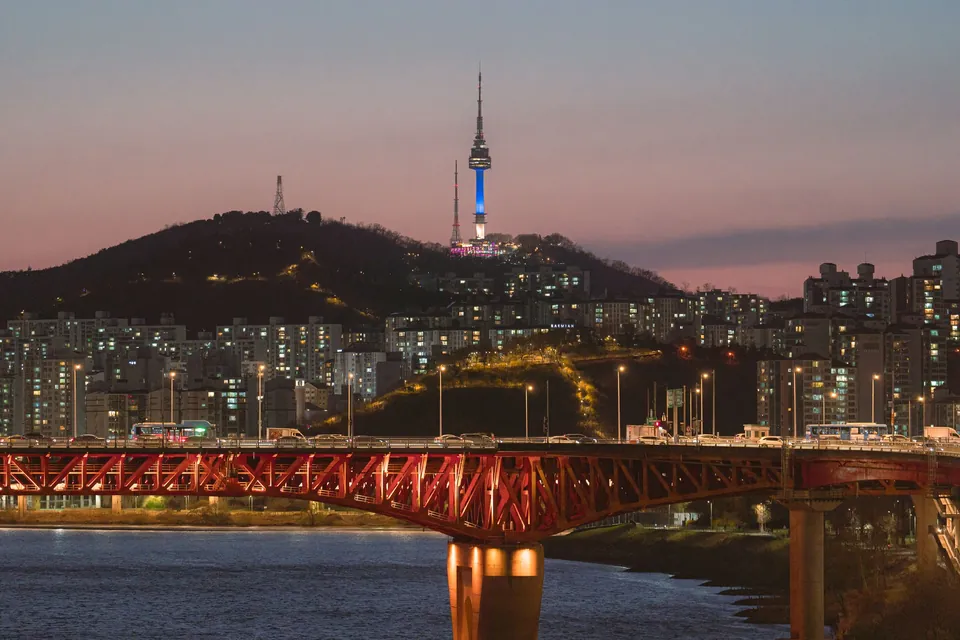
Q. Can I go sightseeing on day one? Pick one low effort thing near your hotel, like a riverside walk. For easy evening ideas, see N Seoul Tower and the Han River. Save timed tickets and long days for day two or later. (Peep advice)
What should I get done before I fly?
Entry paperwork, data and money are what eat arrival day when they go wrong. Each has its own guide, so here are the one-line versions.
Entry: US passport holders are K-ETA exempt through 31 December 2026 but need the free e-Arrival card before landing; read Korea entry requirements for dates and the 2027 change.
Data: set up an eSIM before you leave so maps and taxi apps work at the gate; compare options in the eSIM and SIM guide.
Money: a little won and a card that works abroad; see money in Korea.
Q. I booked on Asiana. Does the merger change anything? Korean Air and Asiana are scheduled to fully merge on 17 December 2026. From 2 November to 3 December 2026, Asiana bookings for flights on or after that date move to Korean Air flight numbers (KE instead of OZ).8 Check your booking for the new flight number before you go to the airport. Last checked 30 October 2026.
Your 24 hour checklist
Two clocks on your phone: home and Seoul.
Your landing day and time, written in Seoul time.
A hotel room that is ready when you land, especially for a pre-dawn arrival.
e-Arrival card done, eSIM installed.
A plan for the ride from Incheon.
One easy outdoor walk on day one, nothing booked.
A soft day penciled in after you get home.
Quick FAQ
About 13.5 hours nonstop from LAX on Air Premia's winter 2026 schedule, and about 11 hours on the way back.4 Exact times shift by season and airline, so read the duration on your own booking. Every flight lands at Incheon International Airport, about an hour outside central Seoul.
About 15 hours 45 minutes nonstop from JFK on Korean Air, and about 14 hours coming home.5, 6 In winter Seoul is 14 hours ahead of New York, so you land on a later calendar date than you left.1, 2 Check the arrival date on your booking, not just the hours in the air.
Seoul is 14 hours ahead of New York from 1 November 2026 to 13 March 2027, and 13 hours ahead the rest of the year.1, 2 Korea never changes its clocks, so only the US side moves. In winter, noon Wednesday in Seoul is 10 p.m. Tuesday in New York.
Seoul is 17 hours ahead of California in winter and 16 hours ahead during US daylight saving time.1, 2 In winter, noon Wednesday in Seoul is 7 p.m. Tuesday in Los Angeles. The quick shortcut: from Los Angeles time, subtract 7 hours and add a day.
Seoul is 19 hours ahead of Hawaii all year.1, 2 Neither Korea nor Hawaii uses daylight saving time, so the gap stays the same in November and March. Nonstop flights from Honolulu take about 9.5 to 11 hours, depending on the season.5
No. Korea stays on Korea Standard Time, UTC+9, all year.2 The gap to the US changes only because most US states move their clocks: daylight saving time ends on 1 November 2026 and starts again on 14 March 2027.1 Hawaii and most of Arizona do not change.
Often, on the clock. United's 11:30 a.m. flight from Incheon lands in San Francisco at 6:10 a.m. the same date, because the calendar rolls back on the way home.3 Your body still feels every hour in the air, so leave a soft day after you get back. (Peep advice)
At the CDC's average westward rate, roughly 5 days from the West Coast and about a week from the East Coast. (ref. 9; Peep estimate) People vary, and sleep on the plane changes the count. Daylight on arrival, short naps and a normal local bedtime help you adjust.9
Coming home, for most people. The flight back is an eastward shift, and the CDC says the body adjusts about 1 hour a day after flying east, against about 1.5 hours a day after flying west.9 Leave a soft day or two before a big work week. (Peep advice)
Book the hotel from the night before, or confirm early check-in in writing, so you are not waiting in a lobby until the afternoon. (Peep advice) Airport night buses run into Seoul in the small hours. Sleep a few hours, then get outside by late morning for daylight.9
In October 2026, Korean Air, Asiana, Delta, United, American, Alaska and Air Premia flew nonstop from the US to Seoul, depending on the city.7 Some routes are seasonal. Korean Air and Asiana are scheduled to fully merge on 17 December 2026, so check your booking for a KE flight number.8
No visa is needed for a short trip in 2026. US passport holders are K-ETA exempt through 31 December 2026 but need the free e-Arrival card before landing. Trips from 1 January 2027 may need a K-ETA, so read Korea entry requirements before you book.
Showing 5 of 12
Daylight Saving Time Rules. National Institute of Standards and Technology (NIST). Checked 30 October 2026. Link
Time Zone in Seoul, South Korea. timeanddate.com. Checked 30 October 2026. Link
Daily flights between San Francisco (SFO) and Incheon/Seoul (ICN). United Airlines Business Travel. Checked 30 October 2026. Link
2026년 12월, 2027년 01월, 02월 로스앤젤레스 노선 스케줄 변경 안내 (Los Angeles route schedule change, December 2026 to February 2027). Air Premia notice, 29 May 2026 (in Korean). Link
Flight schedules KE38 Chicago to Seoul, DL27 Atlanta to Seoul, KE54 Honolulu to Seoul and KE81 Seoul to New York. FlightMapper. Checked 30 October 2026. KE38 · DL27 · KE54 · KE81
KE82 Korean Air flight tracker, New York JFK to Seoul ICN. FlightStats, flight of 29 October 2026. Link
Flights to Seoul (ICN): non-stop flights from the US. FlightConnections. Checked 30 October 2026. Link
Korean Air to begin booking migration ahead of Asiana integration. Yonhap News Agency, 14 September 2026. Link
Jet Lag Disorder. CDC Yellow Book: Health Information for International Travel, 2026 edition. Link
Seoul, South Korea: Sunrise, Sunset, and Daylength, November 2026. timeanddate.com. Checked 30 October 2026. Link