DMZ tour from Seoul in 2026: why the JSA is still closed, the passport rule at Imjingak, official tour fees, what you can see without a tour, and what to wear.
PK
Peep Korea Editorial · 14 min read
Short answer
The JSA at Panmunjom is not open to foreign visitors: public tours have been suspended since July 2023, and the Ministry of Unification says foreigner visits are not running, checked 29 October 2026.1, 2 What you can do is the Paju DMZ Peace Tour from Imjingak to the Third Tunnel and Dora Observatory, about 3 hours, at 9,200 won on foot or 12,200 won with the monorail.5, 7 Bring your physical passport, not a photo of it, and expect the day to be cancelled at short notice if security or weather calls for it.5, 7
Search "DMZ tour" and you get blue skies, soldiers and the famous blue huts. The real day is quieter. It is a museum-like trip to a militarized border, run on passes and ID checks, where the most useful thing you bring is a passport.
Here is what is actually open in late 2026, what each stop is, and how to plan the day without surprises.
Is the JSA (Panmunjom) open in 2026?
No, not for foreign travelers. The Ministry of Unification's Panmunjom tour center says tours were suspended after a US soldier crossed the line on 18 July 2023, and that a restart will be announced on its site.1 Its application page adds that group and foreigner visits are currently not run.2
How it got here, in dated steps:
July 2023: public tours stopped. A short restart for special visits that November ended on 1 December 2023.3
16 May 2025: the ministry restarted "special visits" for invited policy groups only, with no date for general tours.3
October 2026: Yonhap reports that access to the DMZ is still tightly limited and that press group visits to Panmunjom have not resumed.4
Q. A tour listing says "JSA" or "Panmunjom". Is it real? Ask the seller one question before you pay: which official program are you booking through? Visits run only through the government's tour center, and that calendar shows no open dates.1 If the answer is vague, treat it as unconfirmed and do not pay.
Q. Will the JSA reopen soon? Nobody can promise a date. The official line is that it reopens after talks with the UN Command and other agencies, and the restart will be posted on panmuntour.go.kr.1 Check that page, not a blog.
What can I actually see on a DMZ tour from Seoul?
The open route runs from Imjingak, a public park about 56 km from Seoul City Hall, into the Civilian Control Zone to the Third Tunnel, Dora Observatory and the village of Tongilchon.5, 7, 9 You do not enter the DMZ itself; you look into it.
Stop
What it is
Can you go alone?
Imjingak
Park with the Freedom Bridge, an old rail bridge and memorials; open all year9
Yes, free
Third Tunnel
A tunnel dug from the North, found in 1978, about 52 km from Seoul5
Checked 29 October 2026. Routes and stops change with security conditions.
Q. Can I see North Korea from Dora Observatory? On a clear day, yes: the official listing names Kaesong city, the village of Daeseong-dong and the hills on the North Korean side.6 Haze decides how much you see, so a crisp autumn morning helps. (Peep observation)
Q. Is the Third Tunnel hard to walk? It is narrow and steep. The Paju tour site says wheelchair users and people with mobility difficulties may not enter the Third Tunnel, and people with blood pressure or breathing problems may be turned away.7 The monorail option is sold for this reason; walking means a long climb back up. (ref. 5; Peep observation)
Do I need a passport for a DMZ tour?
Yes. Every visitor needs ID checked against the ticket, and a foreign traveler shows a passport or an Alien Registration Card.5, 6 The Paju tour site says photos, screenshots and expired passports are not accepted.7
The original, in your hand. Not a scan, not your phone gallery.
Everyone present. Tickets are issued at Imjingak once the whole group has arrived.
Ticket desk hours. Sales run from 09:00 to 14:30.
Closed days. No tours on Mondays or on public holidays that fall on weekdays. VisitKorea also lists Seollal and Chuseok5, and the Paju site lists New Year's Day and Chuseok Day.
Q. My tour company has my passport number. Do I still need the passport? Yes. Your details on a list do not replace the document.7 Keep it on you, not in the hotel safe.
The official Paju DMZ Peace Tour costs 9,200 won for an adult on foot, or 12,200 won with the Third Tunnel monorail.5, 7 That is the official ticket; the monorail option adds 3,000 won.5, 7
Ticket (Paju DMZ Peace Tour)
On foot
With monorail
Adult
9,200 won
12,200 won
Teen and child
7,000 won
9,500 won
Published fees on VisitKorea, checked 29 October 2026.5 Ask at the Imjingak desk about senior and other discounts. The Paju site says foreigners pay the same fees.7
A commercial tour adds a coach from Seoul, an English-speaking guide and someone else doing the queue and ID check. Prices vary a lot with what is included, so compare stops, hours and pickup point rather than the headline price. (Peep observation) Booking the Paju tour yourself gets you in; it does not get you a private English guide. (Peep observation)
Q. Is the monorail worth 3,000 won more? If knees, heat or time matter, yes. The walk back up from the tunnel is steep. (Peep observation) Ask at the desk whether the monorail is running before you pay for it. (Peep advice)
Can I visit the DMZ without a tour?
Partly. You can reach Imjingak and Odusan on your own and buy the Paju DMZ Peace Tour ticket at Imjingak yourself; that tour is the bus that takes you past the checkpoint.7, 8, 9, 11 What you cannot do is drive or walk past the checkpoint on your own.
Either change to the short shuttle train to Imjingang Station, then walk about 15 minutes,
or take village bus 058B from near Munsan Station exit 1, about 30 minutes to the Imjingak stop.
The shuttle train is sparse. The government page lists Munsan departures at 09:20 and 17:05 on weekdays, and 09:35, 10:35, 15:45 and 17:20 on weekends and holidays, and warns that Korail can change them.8 Transit cards and fares are in how Seoul transit works.
Q. What about the DMZ Peace Trail? It is not an option for most visitors. The application page says only Korean nationals aged 8 and over can apply, at 10,000 won a person.12 Paju's course restarted on 2 September 2026 after a summer pause14, while trail sections inside the DMZ itself have been closed since May 2024, Yonhap reports.4
Q. Is there a train to Dorasan? Korail restarted the "DMZ Pyeonghwa-ieum" peace train from Seoul Station to Dorasan in April 2026, on the second and fourth Friday of each month, sold as a package with the border sites.13 It must be booked ahead and needs ID; check whether your passport can book it before you plan around it. (Peep advice)
Half-day, full-day or a JSA combo: which DMZ tour type?
Pick by how much you want explained. Half-day tours cover the core loop; full-day tours add a second area; "JSA combos" cannot run while Panmunjom is closed. (ref. 1; Peep observation)
Tour type
Usually covers
Day length (Peep estimate)
Do it yourself
Train to Munsan, Paju tour from Imjingak
About 6 to 7 hours door to door
Half-day group tour
Imjingak, Third Tunnel, Dora Observatory, sometimes Dorasan
About 6 to 7 hours with Seoul pickup
Full-day group tour
The half-day loop plus Odusan, the gondola or a talk
Q. Which is less tiring? A half-day tour, booked on a weekday. The Paju loop alone is about three hours, plus about an hour or more each way from central Seoul. (ref. 5; Peep estimate)
What should I wear on a DMZ tour?
Comfortable shoes with grip, layers for wind by the river, and nothing that looks military. The Third Tunnel is steep, and the observatories are exposed to the wind. (ref. 7; Peep observation)
Shoes: closed, flat and grippy. Panmunjom's own rules ban slippers and sandals.2
No shorts or short skirts if you ever get a JSA slot. That is a published rule there.2
No camouflage. Leave army-style prints at home anywhere near the line. (Peep advice)
Layers in late autumn. The Imjin valley is colder than downtown Seoul. (Peep observation) Our Seoul in November and December has the packing list.
Q. Can I bring food and water? Water, yes. Panmunjom's rules ban food and alcohol, and drinking before a visit.2 On the Paju loop, eat at Imjingak before or after. (Peep observation)
Can I take photos at the DMZ?
Yes, but only where allowed. In the Civilian Control Zone you may not photograph fences, guard posts or surveillance equipment, or post such photos online, and the gondola operator says breaking this can lead to charges under the military installations law.15
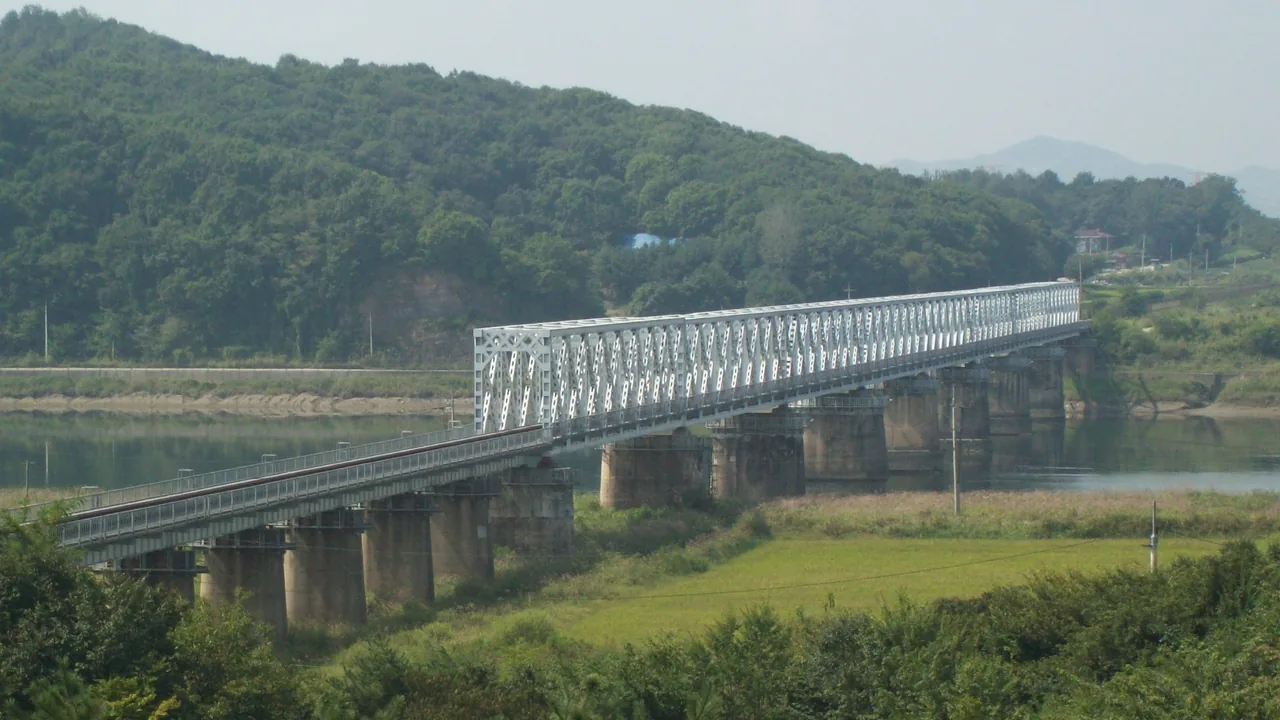
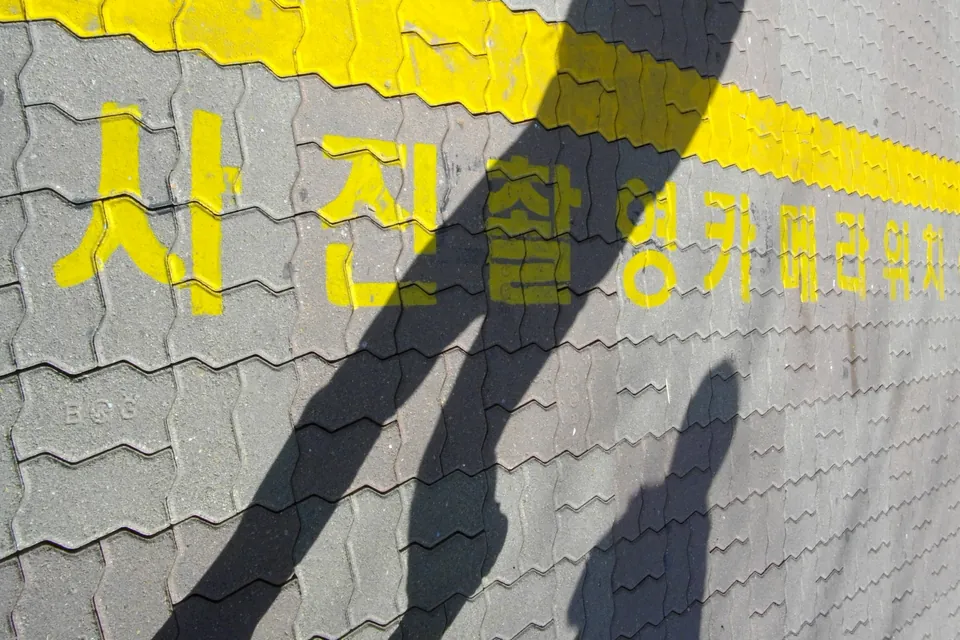
The photo line at the old Dora Observatory building, 2013. Photo: Abasaa, public domain, via Wikimedia Commons, cropped. Cover: the Gyeongui Line rail bridge over the Imjin River, by Rbtjd0201, public domain, via Wikimedia Commons, cropped.
How it works in practice:
Look for the line. Observatories mark where cameras are allowed. Behind it, you shoot; past it, you do not. (Peep observation)
Fences, guard posts, cameras: never in your frame.15
Drones, tripods, selfie sticks: leave them in Seoul. Panmunjom bans action cams, tripods and selfie sticks.2
Ask first. If a guide or soldier says no, that is the rule for that spot. (Peep advice)
Q. Can I post my DMZ photos on social media? Views and selfies, yes. Anything showing fences, posts or monitoring gear, no.15
How long is a DMZ day trip, and when should I go?
Plan for most of a day: the Paju loop is about three hours, and Seoul to Imjingak adds about one to one and a half hours each way. (ref. 5; Peep estimate) Go on a Tuesday to Friday, early, with a spare day in case it is cancelled.
Mondays are out. No Paju tours on Mondays or weekday public holidays.5, 7
Book ahead if you can. VisitKorea says visitors to the Third Tunnel must reserve the tour in advance.5
Go early. The Paju site warns that tickets often sell out early. Sales run from 09:00 to 14:30.7
Have a backup day. Tours can be cut for security or weather, sometimes on the day.7 Do not put the DMZ on your last morning in Korea.
Autumn and early winter give the clearest views. (Peep observation) The full calendar is in our Korea seasons guide.
Q. Can I add the gondola? Yes. The Imjingak Peace Gondola crosses the Imjin River into the Civilian Control Zone, 09:00 to 18:00, at 12,000 won round trip for an adult in a standard cabin (checked 29 October 2026).15, 16 It needs ID, because you cross into a controlled area.15
Q. Is it safe to visit the DMZ? The open route is a scheduled bus trip with ID checks, and it can be called off when security or weather conditions change.7 Stay on marked paths, follow staff instructions, and keep your phone charged for cancellation messages. (Peep advice)
Quick FAQ
No. Public Panmunjom tours have been suspended since July 2023.1
Foreigner visits are not running, per the Ministry of Unification, checked 29 October 2026.2
Yes, the Paju DMZ Peace Tour from Imjingak.5, 7
It goes to the Third Tunnel, Dora Observatory and Tongilchon.
9,200 won on foot or 12,200 won with the monorail, for adults.5, 7
Teens and children pay 7,000 or 9,500 won.
Yes, the original.5, 7
Photos, screenshots and expired passports are refused.7
No, not for the Paju tour.7
Carry the booklet itself.
Mondays, weekday public holidays, and Seollal and Chuseok.5, 7
Weekends are open but busier. (Peep observation)
About three hours from Imjingak.5
Add travel from Seoul for a 6 to 7 hour day. (Peep estimate)
Yes. Get to Imjingak by train and bus, then buy the Paju tour there.7, 8
You cannot pass the checkpoint on your own.
Gyeongui-Jungang Line to Munsan, then the shuttle train to Imjingang or bus 058B.8
The shuttle runs only a few times a day.
No. It is reached only on the tour from Imjingak.6
Bring a passport or ARC.6
No. Applications are for Korean nationals aged 8 and over.12
The fee is 10,000 won a person.
Skip camouflage and anything army-style. (Peep advice)
For Panmunjom, no shorts, short skirts, slippers or sandals.2
Yes, in allowed spots.15
Never photograph fences, guard posts or monitoring gear.
Do not. It is a military area with strict photo rules.15
Leave the drone in Seoul. (Peep advice)
A tunnel dug from the North and found in 1978.5
It is 1.6 km long and about 2 m wide.
Not easily. It is steep and narrow, and wheelchair users may not enter.7
The monorail helps on the way down and up.
Yes. The listing names Songaksan, the mountain at Kaesong, to the north.17
Entry has been free since 1 January 2024.11
No. It closes on Mondays, or the next day if Monday is a holiday.11
Weekend afternoons can mean an hour or more of parking queues.11
It can be called off for security or weather.7
Refunds depend on where you booked, so check before paying. (Peep advice)
Not comfortably. They sit on opposite sides of Seoul. (Peep estimate)
Give each its own day; see the Nami Island day trip.
Showing 5 of 20
판문점견학지원센터 (Panmunjom Tour Support Center). Ministry of Unification (in Korean). Suspension since 18 July 2023, restart to be announced. Checked 29 October 2026. Link
판문점 방문 (Visiting Panmunjom). Ministry of Unification (in Korean). Eligibility, no group or foreigner visits, visitor rules. Checked 29 October 2026. Link
판문점 견학 1년6개월만 재개…일반 개방 시기는 미정 (Panmunjom visits resume after 18 months; general opening undecided). Yonhap News, 15 May 2025 (in Korean). Link
유엔사 거부로 정부 DMZ조사 2년5개월째 중단 (Government DMZ surveys halted for 2 years 5 months). Yonhap News, 20 October 2026 (in Korean). Link
The 3rd Tunnel. VisitKorea, Korea Tourism Organization. Fees, hours, closed days, ID. Checked 29 October 2026. Link
Dora Observatory. VisitKorea, Korea Tourism Organization. Checked 29 October 2026. Link
DMZ Peace Tour: Visitor Guide and Hours/Fees. Paju City official tour site. Checked 29 October 2026. Link
집결 장소 (Meeting point and directions). Panmunjom Tour Support Center (in Korean). Munsan to Imjingang shuttle train, bus 058B. Checked 29 October 2026. Link
Imjingak Resort (Pyeonghwa Nuri Park). VisitKorea, Korea Tourism Organization. Checked 29 October 2026. Link
Dorasan Station. VisitKorea, Korea Tourism Organization. Checked 29 October 2026. Link
오두산통일전망대 관람안내 (Odusan Unification Observatory visitor information). Official site (in Korean). Checked 29 October 2026. Link
DMZ 평화의 길 방문절차안내 (DMZ Peace Trail application guide). Durunubi, Korea Tourism Organization (in Korean). Checked 29 October 2026. Link
코레일, 'DMZ 평화이음 열차' 운행 재개 (Korail restarts the DMZ peace train). Financial News, 9 April 2026 (in Korean). Link
파주 'DMZ 평화의 길' 9월 2일 운영 재개 (Paju DMZ Peace Trail resumes 2 September). Paju Times, 20 August 2026 (in Korean). Link
FAQ. Paju Imjingak Peace Gondola official site (in Korean). ID, photo rules in the Civilian Control Zone. Checked 29 October 2026. Link
이용요금 (Fees and hours). Paju Imjingak Peace Gondola official site (in Korean). Checked 29 October 2026. Link
Odusan Unification Observatory. VisitKorea, Korea Tourism Organization. Checked 29 October 2026. Link