Korea temple stay in 2026: what one night looks like hour by hour, how to book on the official Templestay site, Seoul temples, prices per night and the rules.
PK
Peep Korea Editorial · 20 min read
Short answer
A Korean temple stay is one night at a working Buddhist temple: you arrive around 13:30 to 14:30, wear a loaned vest and trousers, eat a silent temple dinner, and sleep by about 21:00.2, 3, 5 The wake-up call is around 04:00 for dawn chanting, and you are usually out by 10:00 or 11:00.3, 5 You book on the official Templestay site run by the Cultural Corps of Korean Buddhism; Seoul temples charged 80,000 to 120,000 won per adult per night when we checked on 3 November 2026.1, 3, 4, 5
A hotel gives you a bed. A temple gives you a timetable, a bowl of rice you finish to the last grain, and a 4 a.m. drumbeat you will remember longer than any minibar.
You do not need to be Buddhist, speak Korean or sit cross-legged for an hour. You do need socks, an early night and a little curiosity.
Updated November 2026. Peep Korea checked every price and schedule below on the official Templestay booking pages on 3 November 2026.
Quick answer
What it is: a stay inside a Buddhist temple with chanting, meditation, a temple meal and tea with a monk or nun.1
Three types: one-day (2 to 3 hours), experience-oriented (a full overnight schedule) and rest-oriented (free time between ceremonies).1
Where to book: eng.templestay.com, run by the Cultural Corps of Korean Buddhism under the Jogye Order.1, 18
Cost in Seoul: 80,000 to 120,000 won per adult per night; one-day programs from free to 30,000 won.3, 4, 5, 9, 10
Who goes: 349,236 people did a temple stay in 2025, a record, including 55,515 foreign participants.20
What is a temple stay in Korea?
It is a short stay at a Buddhist temple where you follow a slice of monastic routine: ceremonies, meditation, temple meals and a talk over tea. The Cultural Corps of Korean Buddhism describes it as a cultural program for understanding Korean tradition and Korean Buddhism.1
The program began in 2002, when Korea co-hosted the World Cup and needed both rooms and a way to show visitors its traditions.20 In the first year 33 temples took part; by mid 2026 the press office counted 170 temples running programs.20
The Korean word you will see is 템플스테이 (templestay), written as one word on the official site.
Q. Do I have to be Buddhist? No. The official FAQ says every activity is voluntary, and if a 108-bow session clashes with your beliefs you may sit quietly instead.2 Bongeunsa's guidelines welcome guests regardless of nationality or belief.5
Q. Is it a retreat or a hotel? Neither, exactly. Think of it as a guest seat in somebody else's home and practice. The schedule is theirs; you join in.
What happens during one night at a temple?
Expect an afternoon arrival, an early dinner, evening chanting, lights out around 21:00 and a 04:00 start. Here is how Jogyesa's regular overnight program runs on its booking page, checked 3 November 2026.3
Day 1
13:30 Meet at the information office, check in, change into the temple vest and trousers.
13:40 Orientation and temple etiquette.
14:20 Paper lotus lantern craft.
15:00 Copying a Buddhist text, or tea with a monk when five or more people are booked.
15:50 Temple tour.
16:30 Evening temple meal.
17:55 Watch the monks play the dharma instruments, then evening chanting (optional).
19:00 108 prostrations (optional).
21:00 Bedtime.
Day 2
04:00 Wake up to the sound of the instruments.
04:25 Dawn ceremony with a monk (optional).
05:00 Walking meditation or rest.
07:00 Breakfast.
10:00 Check out.
Other Seoul temples run close variations. Bongeunsa wakes guests at 04:00 and adds 108 bows at 05:00.5 Hwagyesa starts a little later with a 05:15 morning ceremony.6 Myogaksa schedules an hour of intensive meditation after dawn chanting.8
Q. What are the "dharma instruments"? Four instruments struck at dawn and dusk: a big drum, a bronze bell, a wooden fish and a cloud-shaped metal gong.2 The drum alone is worth the early alarm.
Q. What are 108 prostrations? A full bow, from standing to forehead on the floor and back, repeated 108 times. The number stands for 108 kinds of worldly distress in Buddhist teaching.2 Your thighs will notice. You may stop at any point.
How do I book a temple stay?
Book on the official English site, eng.templestay.com, under Reservation. Choose a region, a temple, a program type, your dates and the number of people, then send the form and pay the way that temple asks.1, 21
Step by step:
Filter first. The program list has a "Temples for Foreigners" filter and lets you pick Seoul or any province.21
Read the program page, not just the price. Each temple writes its own arrival time, packing list, refund rules and room setup.3, 4, 5
Check the booking window. Most Seoul programs close bookings one to three days before the start date.3, 4, 5 Bongeunsa and Myogaksa say dates usually open about a month ahead.5, 8
Pay the way the temple wants. Jogyesa wants payment when you book, by bank deposit or card online, and takes no cards on the spot.3 Hwagyesa takes cash or card at the temple.6 Lotus Lantern on Ganghwa Island takes cash only on arrival.12
Keep the email. Some temples send no confirmation letter, but each one keeps its own list, so you do not need to print anything. Questions go to support@templestay.com.1
Insider tip: read the refund line before you pay. Jogyesa refunds in full only seven or more days out; Bongeunsa refunds in full 14 days out and 70% at seven days; Hwagyesa refunds in full three days out.3, 5, 6 If your dates might move, that line matters more than a 10,000 won price gap.
Q. Can I just walk in? Not for an overnight stay. Programs are booked ahead and some close three days before.3 For a walk-in taste, see the free tea sessions under "one-day" below.
How much does a temple stay cost in 2026?
In Seoul, one night costs 80,000 to 120,000 won per adult on the official booking pages, checked 3 November 2026.3, 4, 5, 6, 8 Yonhap reported in July 2026 that regular adult rates run from 70,000 to 100,000 won a night across the country.18
That price usually covers the bed, dinner, breakfast, the uniform and the program. Lunch is included only where the schedule lists it.3, 5
Adult rates for one night from each temple's own page on eng.templestay.com. Temples set and change their own prices; check the page for your dates.
Q. Are there discounts for foreigners? Sometimes, for a limited window. In September 2026, 19 temples ran a foreigners-only stay at 30,000 won a night; that offer has ended.18 The November 2026 "Happiness Double" 30,000 won stay at 104 temples is for Korean nationals only.19 Hwagyesa's Christmas program is 50,000 won until 26 December 2026.7
Q. Is a private room extra? Usually yes, where offered. Jogyesa arranges a private room for an extra fee if you ask in advance, never on the day.3 Lotus Lantern lists a single room at 120,000 won a night.12
Which temples near Seoul do temple stays?
Seven Seoul temples are on the official list as easy to reach by subway or bus: Bongeunsa, Geumsunsa, Hwagyesa, Jinkwansa, Jogyesa, Myogaksa and the International Seon Center.1 Pick by the night you want, not the name.
Jogyesa, if you want the city. It sits in the middle of Jongno, a short walk from Anguk station exit 6.3 Subway and bus basics are in how Seoul transit works. The temple's own pitch is calm amid city noise. Palaces and Bukchon are close; see Gyeongbokgung and Bukchon.
Bongeunsa, if you are staying in Gangnam. The regular program runs on weekends, 100 metres from Bongeunsa station exit 1 on Line 9.5
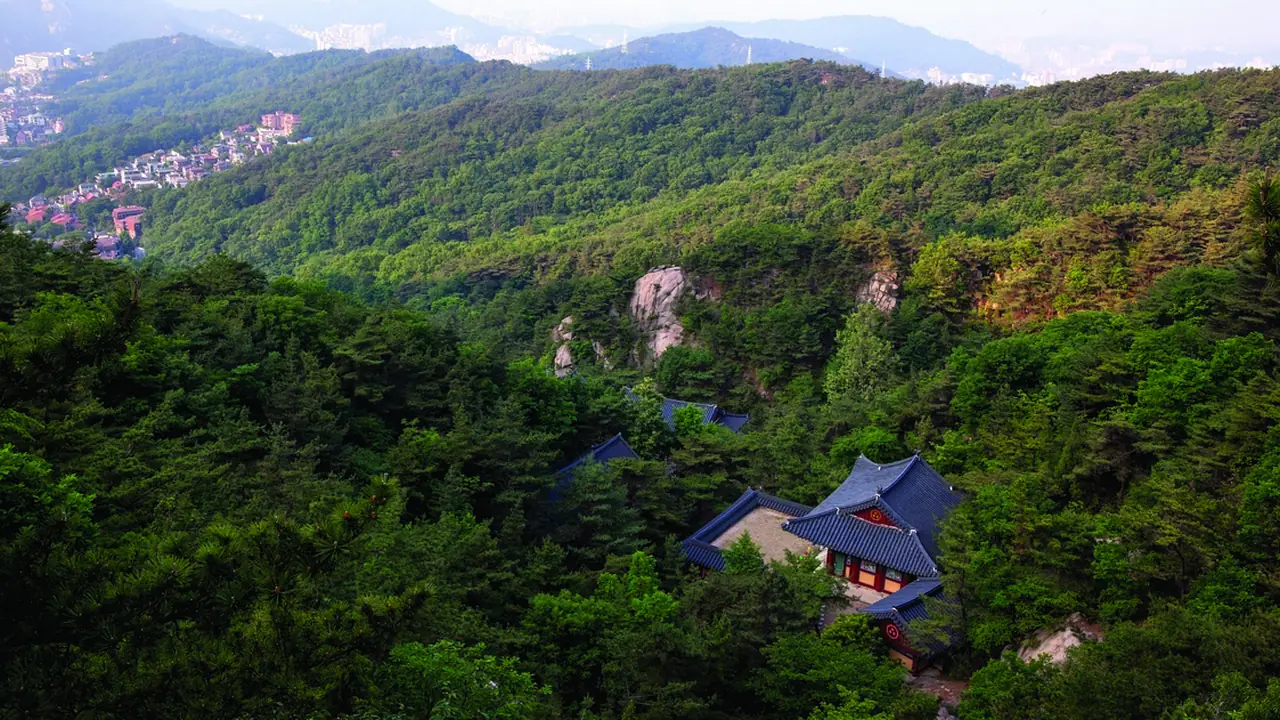
Geumsunsa, if you want a mountain without leaving Seoul. It sits on Bukhansan; you walk up a trail for about 20 minutes from the bus stop, and a small cable car carries luggage only.4
Hwagyesa, if you want rest. Its "Only Rest" program gives two ceremonies, two meals and free time, with bell ringing and bead making on offer.6
Myogaksa, if you want the full workout. 108 bows plus making your own 108-bead string on day one.8
International Seon Center, if you only have a morning. A day program of Seon meditation, lunch, lantern making and tea talk runs 10:00 to 14:00 for 30,000 won, near Omokgyo station on Line 5.9
Farther out, Lotus Lantern International Meditation Center on Ganghwa Island is known for meditation and runs a monthly three-night intensive retreat for 210,000 won, cash only.1, 12 Also on Ganghwa, Jeondeungsa rents a whole hanok building to one guest or a pair for 200,000 won per adult.13 Yongjusa in Hwaseong, Gyeonggi, runs a rest program at 80,000 won.17 On the east coast, Naksansa charges 120,000 won, and Woljeongsa in Pyeongchang offers a rest program with walks through its fir forest.14, 16
Q. Can I see the Seoul temples without staying? Yes. Jogyesa and Bongeunsa are open to visitors, and Jogyesa's "Always Templestay" is a 10,000 won morning tour with lantern making.22
What are the rules at a temple stay?
Keep quiet, dress modestly, no alcohol or smoking, shoes off indoors, socks on, and follow the bell. The official FAQ also asks guests to skip loud singing and showy affection.2, 6
The rules temples write on their pages:
Silence. Hwagyesa asks for "noble silence" during the stay; Bongeunsa asks for quiet near the halls.5, 6
Clothes. No sleeveless tops or flip-flops; dress respectfully in the halls.3, 4 Hwagyesa also asks guests to keep makeup low-key.6
Socks. Bongeunsa says bare feet are not acceptable in the halls.5
Meals. Take only what you can finish, eat quietly and do not comment on the food.5
No alcohol, no smoking, anywhere in the temple.3, 6
Etiquette that helps on day one
Hands: when walking or standing, lightly hold your left hand with your right in front of you. This posture is called chasu.2
Greeting a monk: stop, put your palms together and do a half bow.2
Entering a hall: use the side doors; the centre door and centre floor belong to the monks. Pause and half bow before you go in or out.2
People praying: walk behind them, never in front.2
Q. Are men and women in separate rooms? Often, yes. Hwagyesa notes that men and women traditionally sleep apart. Jogyesa groups rooms by booking, but even married couples get separate rooms; parents with minor children stay together.3, 6
Q. Can I use my phone? No temple page we checked bans phones outright, but silence rules cover ringtones and calls. Put it on silent and leave it in the room during ceremonies. (Peep advice)
What do you eat at a temple stay?
Plant-based temple food, served at fixed times, with no meat and no alcohol. Some programs serve it as balwoo gongyang, the formal monastic meal in a set of nested wooden bowls.1
The idea behind balwoo gongyang is equality and no waste: everyone gets the same food, and you clean your bowl so nothing is left.1 At the end you may be asked to rinse your bowls with water and drink it. Watch the person beside you and copy. (Peep observation)
Dinner comes early, often at 16:00 to 17:30, and breakfast around 06:30 to 07:30.3, 4, 6 Pack a snack if you are used to a late dinner, and eat it in your room. (Peep advice)
Q. Is temple food vegan? Usually close. Temple meals leave out meat and fish, and Korean temple cooking traditionally skips garlic and onion too. If you have an allergy, write it in the booking form's note to the temple. (Peep observation; Peep advice)
What should I pack?
Toiletries, a towel, socks, a water bottle, a change of clothes and a warm layer. Most temples provide only soap, toothpaste and the uniform.1
What Seoul temples ask for:
Towel: bring one to Geumsunsa, which asks guests to bring their own, and to Lotus Lantern, which says towels are not provided.4, 12 Jogyesa and Myogaksa provide one.3, 8
Tumbler or water bottle: Bongeunsa and Hwagyesa ask for one to cut waste.5, 6
A T-shirt for under the vest and loose clothes to sleep in.4, 6
Shoes that slip on and off, because you remove them at every hall.6
A passport or other ID where asked; Jinkwansa requires it for its program.23
Q. Is it cold at night? In autumn and winter, yes. The official guide warns that mountain temples are colder than you expect and asks for a jacket or sweater.1 Seoul's November and December weather is in Seoul in November and December.
Is a temple stay worth it for a first trip to Korea?
Yes, if one night of early bedtime and quiet sounds good to you. It is the closest most visitors get to the inside of a living Korean tradition, for 80,000 to 120,000 won a night in Seoul. (ref. 3, 5; Peep observation)
It suits you if:
you like early mornings, or want an excuse to try one
you are curious about Buddhism, meditation or Korean architecture
you want one night with no screens and no plans
Skip it, or pick a one-day program, if:
you need a private bathroom and a late check-in
you want nightlife in the same evening
you cannot sit on a floor cushion for 30 minutes
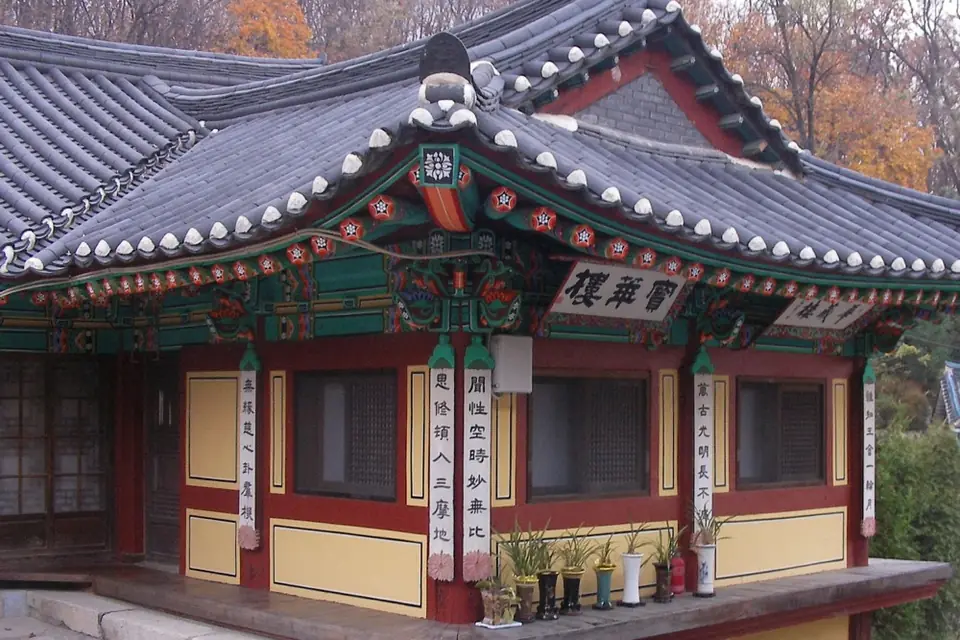
Hwagyesa, Seoul, in November (Martin Röll; CC BY-SA 2.0 licence; source Wikimedia Commons; cropped). Cover: Geumsunsa on Bukhansan, Seoul (Cultural Corps of Korean Buddhism; CC BY-SA 4.0 licence; source Wikimedia Commons; cropped).
Is there a one-day temple stay in Seoul?
Yes, and it is the easy way to try it. Seoul's one-day programs run two to six hours and cost from nothing to 30,000 won.9, 10, 11, 22
Templestay Information Center, Jongno: free tea with a monk, 50 minutes, several sessions a day. It is 250 metres from Anguk station exit 6 and 350 metres from Jonggak exit 3-1.10 Its hall welcomes visitors daily from 09:00 until 18:00, except New Year's Day and the Seollal and Chuseok holidays.10
Jogyesa "Always Templestay": temple tour and lotus lantern making from 10:00, 10,000 won.22
Bongeunsa BONG-PASS: drop in every Tuesday 10:00 to 16:00 for tea and meditation at your own pace, 5,000 won.11
International Seon Center: Seon meditation, lunch, lantern and tea talk, 10:00 to 14:00, 30,000 won.9
Q. Is the free tea with a monk really free? Yes. The booking page lists it as a free program at 0 won.10 Reserve your slot on the same site.
When should I do a temple stay?
Any month works. Autumn colour and still, frosty winter mornings suit mountain temples especially well. (Peep observation) Book early around Buddha's Birthday, 13 May 2027, when temples fill with lanterns and visitors. See Korea public holidays 2026 and 2027.
Watch the calendar for limited offers. September 2026 had a foreigners-only 30,000 won month, announced at the end of July.18 The site's event page is where such offers appear.21
Q. Do temples close over the holidays? Programs run on each temple's own calendar. The Templestay Information Center hall closes on New Year's Day and over Seollal and Chuseok.10 Check the program calendar for your temple.
Quick FAQ
A temple stay is a short program at a Buddhist temple where you follow monastic routine: chanting, meditation, temple meals and tea with a monk.1
The Cultural Corps of Korean Buddhism runs the national booking site, and programs range from a two-hour visit to several nights. You need no religious background, only respect for the schedule.
Seoul overnight programs cost 80,000 to 120,000 won per adult per night on the official booking pages, checked 3 November 2026.3, 4, 5
Jogyesa and Geumsunsa are 80,000 won, Hwagyesa 90,000, Myogaksa 95,000 and Bongeunsa's weekend program 120,000 won. The fee normally covers your bed, dinner, breakfast, uniform and program.
Use eng.templestay.com, choose Reservation, then filter by region, temple, program type, dates and group size.21
Read each program page for arrival time, packing list and refund rules, then pay online, in cash or by card as that temple asks.3, 6, 12 Booking takes about ten minutes. (Peep estimate)
No. Temple stays are open to anyone, and the official FAQ says every activity is voluntary.2
If bowing to the Buddha clashes with your beliefs, you may sit quietly through the 108 prostrations instead. Respectful attention is all that is asked of you.
Usually about 04:00. Jogyesa, Bongeunsa and Myogaksa wake guests at 04:00 for dawn chanting, and Hwagyesa's morning ceremony starts at 05:15.3, 5, 6, 8
Lights out is around 21:00, so most people still get a full night's sleep. Set a phone alarm on vibrate as a backup, because the wooden signal can be soft. (Peep advice)
No. The official guide says everything is up to you, and you can rest in your room if you feel unwell or tired.1, 2
Tell the templestay staff which sessions you will skip. If you join only one, make it the 04:00 dawn ceremony. (Peep advice)
Temples lend a vest and loose trousers for the stay.1, 3
Bring a T-shirt to wear under the vest, socks, and modest clothes for travel. Sleeveless tops and flip-flops are not suitable, and halls are socks-only.4, 5 You return the uniform when you check out.4
Bring toiletries, a towel, two pairs of socks, a water bottle, sleepwear and a warm layer.1, 5
Most temples supply only soap, toothpaste and the uniform. Geumsunsa asks you to bring a towel, and Lotus Lantern says towels are not provided.4, 12
Usually, yes. Temple life is communal, so you may share a floor-bedding room with other guests of the same gender.1
Some temples offer a private room for an extra fee if you ask ahead; Jogyesa will not arrange one on the day.3
Usually not. Jogyesa assigns couples to separate rooms even if they are family; only parents with minor children room together.3
Hwagyesa notes men and women traditionally sleep apart. Plan for one night on your own; it is part of the experience.
Plant-based temple food without meat or alcohol, served at fixed early hours.1
Some programs serve balwoo gongyang, a formal meal in wooden bowls where you finish everything and leave nothing.1 Dinner comes early, so pack a snack, and note any allergy in the booking form. (Peep advice)
Keep quiet, dress modestly, take shoes off indoors and wear socks.5, 6
Alcohol and smoking are banned throughout the temple, and loud singing and public displays of affection are discouraged. Bow with palms together when you meet a monk, and use the side doors of the main hall.2, 3
Yes. The English booking site has a "Temples for Foreigners" filter, and Seoul programs at Jogyesa, Bongeunsa, Hwagyesa and Myogaksa are written in English.21, 3, 5, 6, 8
Myogaksa says its program is in English or translated into English.8 A few Korean words help too; see Korean phrases for travelers.
Yes. The Templestay Information Center near Jogyesa runs free 50-minute tea sessions with a monk several times a day.10
It is a short walk from Anguk or Jonggak station. Reserve a session on the official Templestay site before you go, and pair it with a walk through Jogyesa next door.
About two to four weeks ahead for weekends. Bongeunsa and Myogaksa open dates about one month in advance.5, 8
Most Seoul temples stop taking bookings one to three days before the start date, so last-minute stays are rarely possible.3, 4 Holiday weekends and limited discount months fill first. (Peep observation)
Yes, but each temple sets its own refund rule. Jogyesa refunds fully only seven or more days out.3
Bongeunsa refunds fully 14 days out and 70% at seven days; Hwagyesa refunds fully three days out. Read the rule before you pay.5, 6
The official FAQ says rooms lock, outsiders are kept out after 22:00 and staff live on site for emergencies.2
Many guests come alone and share a room with other solo guests of the same gender. Keep the temple's phone number in your notes.
The official FAQ points to the International Seon Center in Seoul and Lotus Lantern International Meditation Center on Ganghwa Island.1
Lotus Lantern runs a one-night program at 70,000 won and a monthly three-night intensive at 210,000 won, both cash only.12
Generally yes, with a parent or another adult. The official FAQ asks families to phone the temple first, because rules vary.2
Some temples price children lower: Geumsunsa charges 60,000 won for a child, and Woljeongsa 70,000 won.4, 14 Families are usually given one room together.3
Not in the spa sense. There are no treatments, only ceremonies, meditation, simple meals, walks and early nights.1
For a hot-bath kind of rest, try a jjimjilbang instead; see the Korean spa guide. The temple gives you quiet and structure, and the spa gives you heat. Doing both in one trip works well.
Showing 5 of 20
What is Templestay (types, activities, what to bring, FAQ). Templestay, Cultural Corps of Korean Buddhism (English). Checked 3 November 2026. Link
템플스테이란? (What is Templestay: overnight schedule, etiquette and FAQ). Templestay, Cultural Corps of Korean Buddhism (in Korean). Checked 3 November 2026. Link
Jogyesa: Regular Templestay program (1 night 2 days). Templestay booking page. Checked 3 November 2026. Link
Geumsunsa: Relaxational Templestay (2 days 1 night). Templestay booking page. Checked 3 November 2026. Link
Bongeunsa: Regular Templestay (Saturday to Sunday). Templestay booking page. Checked 3 November 2026. Link
Hwagyesa: Only Rest and Only Don't Know programs. Templestay booking pages. Checked 3 November 2026. Only Rest · Only Don't Know
Hwagyesa: 2026 Christmas Templestay. Templestay booking page. Checked 3 November 2026. Link
Myogaksa: 2 days 1 night "Where is your mind?". Templestay booking page. Checked 3 November 2026. Link
International Seon Center: K-meditation day program "Luminous Lotus". Templestay booking page. Checked 3 November 2026. Link
Templestay Information Center: Conversation with a monk over tea, opening hours and directions. Templestay (English booking page and Korean center pages). Checked 3 November 2026. Tea program · Center hours · Directions
Bongeunsa: BONG-PASS (Tuesday drop-in program). Templestay booking page. Checked 3 November 2026. Link
Lotus Lantern International Meditation Center: 2 days 1 night Seon meditation and 3 nights 4 days intensive retreat. Templestay booking pages. Checked 3 November 2026. 1 night · 3 nights
Jeondeungsa: One Step Pause (hanok to yourself). Templestay booking page. Checked 3 November 2026. Link
Woljeongsa: Relaxing Templestay. Templestay booking page. Checked 3 November 2026. Link
Golgulsa: Moving Seon, Seonmudo (2 days 1 night). Templestay booking page. Checked 3 November 2026. Link
Naksansa: Templestay "Wave in the Wind". Templestay booking page. Checked 3 November 2026. Link
Yongjusa: Calm Relaxation. Templestay booking page. Checked 3 November 2026. Link
Jogye Order to offer discounted temple stays for foreigners next month. Yonhap News Agency, 30 July 2026. Link
'가을 사찰에서의 하룻밤 3만원'…11월 템플스테이 할인 (A 30,000 won autumn night: November temple stay discount). Yonhap News Agency, 11 September 2026 (in Korean). Link
템플스테이 작년 35만명 체험, 역대 최대 (Record 350,000 temple stay participants last year). Cultural Corps of Korean Buddhism press release, 8 August 2026 (in Korean). Link
Templestay reservations: program search and filters. Templestay (English). Checked 3 November 2026. Link
Jogyesa: Always Templestay (daily). Templestay booking page. Checked 3 November 2026. Link
Jinkwansa: Relish the nature. Templestay booking page. Checked 3 November 2026. Link