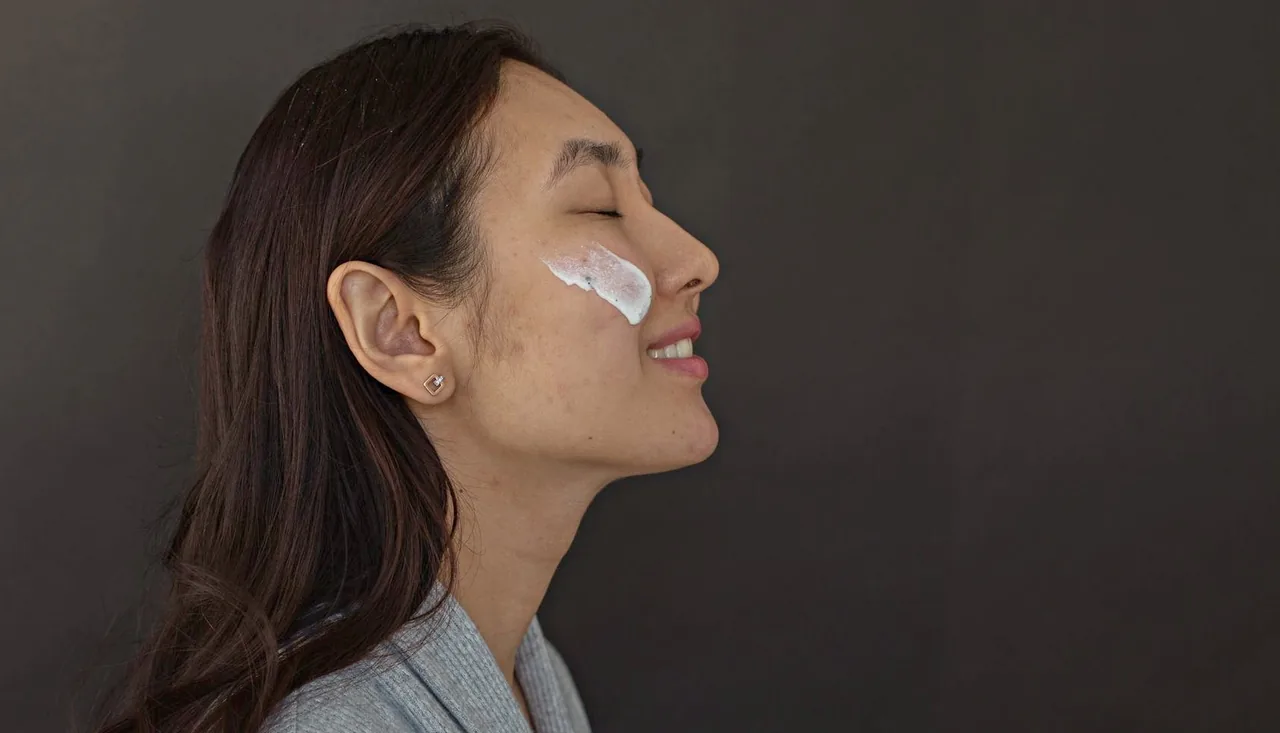
Fraxel and CO2 lasers in Seoul are not the same appointment. What ablative and non-ablative mean, how many days your face needs, and where it fits in a trip.
PK
Peep Korea Editorial · 14 min read
Short answer
"Fraxel" on a Seoul menu can mean a gentle non-ablative laser (red for a day or two) or a fractional CO2 laser (crusting and peeling for about a week).3, 4, 5 Both usually take two to four sessions, and an ablative CO2 session does not belong in the last days before your flight.4 Before you pay, get the device name, "ablative or non-ablative" and an itemized won quote in writing; this guide prints no Seoul prices.
Save this one question for the consult: "Will the surface of my skin be broken, and what will my face look like on day three?" If nobody can answer it in one sentence, you do not know yet what you booked.
Is Fraxel the same as a CO2 laser?
No. Fraxel is a brand known mainly for non-ablative 1550 nm lasers that heat the skin and leave the surface closed.6 A fractional CO2 laser is ablative: it vaporizes tiny columns of skin, so the face weeps, crusts and peels.2, 3
Both are "fractional", meaning they treat a grid of microscopic spots and leave the skin between them untouched, so it heals faster.1, 2 The difference is depth, and depth decides your week.
Non-ablative fractional (1550 nm family)
Ablative fractional (CO2, erbium)
Skin surface
Stays closed
Broken in tiny columns
What you see
Redness, swelling, a sandpaper feel
Oozing, crusting, then peeling
Social downtime
Hours to a few days
About a week, pink for weeks to months
Sessions
Often 2 to 4
Often 2 to 4
Short trip?
Often fits, if booked early
Only with a long stay and a clinic check
Ranges from ASPS, Mayo Clinic and ASDS patient pages; your settings and skin decide your own week.3, 4, 5
Q. So which one should I pick? Pick by your days, not the name. Short trip: ask about non-ablative. Long stay and deeper scars: ask the doctor whether ablative makes sense for your skin.
How do I tell which laser a Seoul menu means?
Read the word next to "Fraxel". Korean menus often use 프락셀 (Fraxel) loosely for fractional lasers in general, so "CO2 프락셀" can be an ablative treatment wearing a non-ablative brand name. Here is a quick decoder:
"CO2", "CO2 프락셀", "eCO2": ablative. eCO2 is a fractional CO2 laser from Korea's Lutronic, approved in Korea and cleared by the US FDA in 2008.7 Plan for a visible week.
"Fraxel Dual", "1550", "1927": non-ablative. Fraxel Dual runs at 1550 nm plus 1927 nm for shallower pigment.6 Plan for red days, not a crusted week.
"Mosaic", "모자이크": non-ablative. Lutronic's Mosaic line runs at 1550 nm; a newer Mosaic 3D launched in Korea in April 2025.8
"Erbium": ablative too.2 Ask about downtime the same way as for CO2.
Just "프락셀" or "fractional": could be either. Ask before you book.
Then ask three things in writing:
The device name.
Ablative or non-ablative.
The depth or energy setting the doctor plans.
A menu photo is not an answer to any of these.
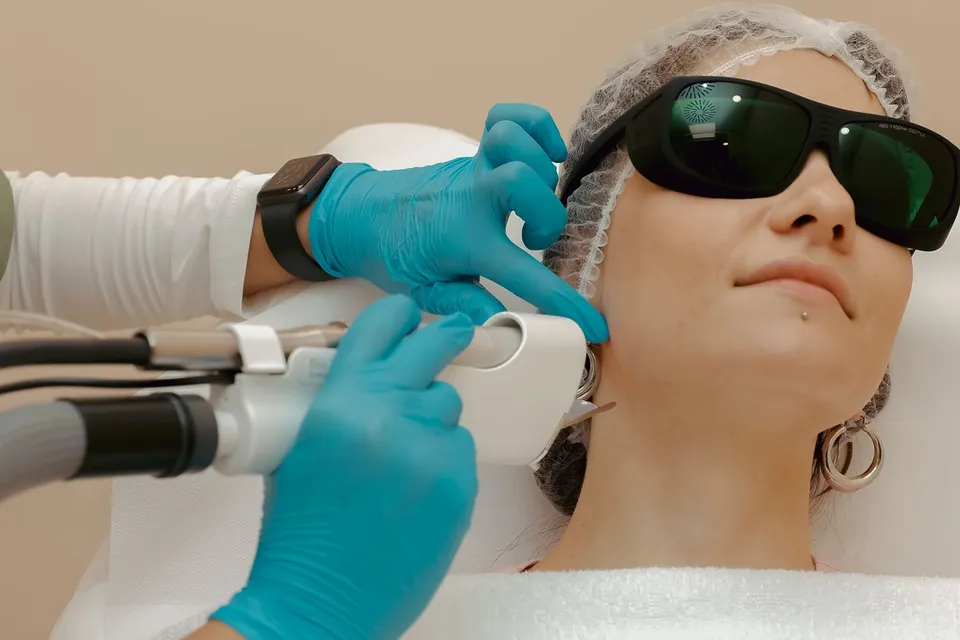
Eye protection is standard for facial lasers. Ask which device is in that hand, by name.
How long is the downtime after Fraxel or a CO2 laser?
Non-ablative: hours to a few days of redness and swelling, and many people go back to work the next day.4, 5 Ablative CO2: skin typically dries and peels about five days to a week after treatment, CO2 resurfacing generally needs up to two weeks, and the new skin stays pink for two to three months, sometimes longer.3
What that means in practice:
Non-ablative: looks like a sunburn. Dinner out is usually fine; a hat and sunscreen are not optional.4, 5
Ablative: the first days are oozing and crusting, then peeling. Fractional settings are milder than the old full-face passes, but plan for several visible days, not several hours.3
Both: the face can feel hot and tight afterward. Ask the clinic when you can wear makeup.
Q. Will I look "normal" for photos on day three? After non-ablative, often close. After ablative, usually not: day three is crusting territory.3
How many days before my flight home should I get it?
Count backwards from the flight. A non-ablative session can sit in the first half of a short trip. An ablative CO2 session belongs in the first days of a long stay, with a clinic check before you fly.
Why: if the surface takes about a week to close3, booking CO2 two days before a long-haul flight means healing crusted skin in a dry cabin, far from the doctor who set the laser.
A quick planner:
Trip under a week: non-ablative, booked on day 1 or 2. Leave a free day before the flight in case something looks wrong.
One week and you want CO2: only on day 1 or 2, and only if a check-up fits before you leave. You will still fly with pink, healing skin.
Two weeks or more: room for an ablative session plus a follow-up visit in Seoul.
Season: Seoul sightseeing is mostly outdoors and new skin stays sensitive for months, so autumn and winter, with fewer long bright days, are easier for resurfacing.4, 13
Our aftercare guide has the downtime table by treatment and cabin tips.
How many sessions will I need?
Usually two to four. Mayo Clinic says fractional treatments, ablative or not, generally need two to four sessions spaced weeks or months apart for a noticeable result.4 One visit on a one-week trip is a start, not a finish.
Deep scars may need more. Ask how many the doctor expects before you pay for the first.
Judge the result at about three months, not on the flight home. Collagen keeps remodeling for months; the original fractional study measured wrinkle and texture changes three months after the last session.1
If you cannot come back to Seoul, ask whether the remaining sessions can be done at home, and send your settings to that doctor.
What can a fractional laser fix, and what can it not?
It is mainly a texture tool: atrophic acne scars, enlarged-looking pores, fine lines, rough sun-damaged skin and some surgical scars. Non-ablative types also treat some sun spots.2, 6
It will not:
Lift a jowl or sagging skin.
Replace filler or fix a shadow from volume loss.
"Remove" pores. It can make them look smaller by improving the skin around them; treat any promise of pore removal as a sales line.
Act as a melasma plan. Heat can make melasma worse, so our melasma guide treats it separately.
Scars are the honest middle. How much one changes depends on its shape and depth, and many dermatologists combine a laser with other steps. Our skin treatments overview compares RF microneedling, pico lasers and more.
Is a fractional laser safe for darker skin?
It can be done, but the main risk is different. In skin that tans easily, the common problem is not a burn but a brown mark that appears weeks later, called post-inflammatory hyperpigmentation (PIH), the most common side effect of lasers in darker skin.3, 9
The numbers worth knowing:
Non-ablative, skin types IV to VI: a 2022 meta-analysis found PIH in a pooled 8.1% of people.10
Ablative CO2, skin type IV, acne scars: in a Thai trial of 40 people, 75% of face sides that got only petroleum jelly afterward developed PIH, against 40% of sides that also got two days of a strong steroid ointment.9
A gentler single-pass CO2 protocol: a small study saw no PIH in seven people with skin types 4 and 5.11
Takeaway: settings and aftercare change the odds. If your skin browns easily, ask how the clinic adjusts density and energy, and what it prescribes for the first days. Our guide for Black, Latina and other non-Asian patients goes deeper on skin type and lasers.
What should I ask at the consult?
Send this before you book, and ask it again in the room. Clear answers in writing are your safety net.
Send the clinic:
Daylight photos of the area, no filter, no makeup.
What bothers you, in one line: "rolling acne scars on both cheeks", not "texture".
Your dates in Seoul and your flight date.
Your skin history: tans or burns, dark marks after acne or past treatments, cold sores, isotretinoin (Accutane) in the past year, any retinoid you use.
Ask the doctor:
☐ Which device, ablative or non-ablative, and which setting?
☐ How many sessions, and how far apart?
☐ What will my face look like on day three and day seven?
☐ When can I fly, and can I be seen once before I leave?
☐ What numbing, prescriptions and aftercare products are in the quote?
☐ If my skin tans easily, how will you adjust, and what do I apply afterward?
Still choosing where to go? Our skin clinics guide explains how to read a clinic's sign and check who is actually a dermatologist.
How much does a fractional laser cost in Korea?
We do not print a number. No neutral, dated source publishes Seoul fractional-laser prices, so compare itemized won quotes. For a home benchmark, ASPS reports an average US physician fee of $1,829 for skin resurfacing, a category that mixes lasers with peels and dermabrasion and leaves out facility, anesthesia and prescriptions.14, 15
A Seoul quote is built from parts. Check each one:
Device, by name.
Area: full face, cheeks only, or scars only.
Passes or energy level.
Numbing cream.
Aftercare products or prescriptions.
VAT: the refund that used to return Korea's 10% VAT to foreign visitors on cosmetic treatment ended for treatment after 31 December 2025, so ask whether the won figure already includes it.16, 17
A low headline number can mean cheeks only or one light pass. Our foreigner pricing guide shows how to compare quotes line by line.
What is the aftercare checklist after a fractional laser?
Follow your clinic's sheet first. These are the points the medical sources agree on:
☐Sunscreen every day, broad-spectrum, SPF 30 or higher, reapplied outdoors. After ablative resurfacing, think months, not days.4, 13 Our sunscreen guide explains how Korean labels differ.
☐No retinoids or glycolic acid until around six weeks after resurfacing, or until your doctor says so.3
☐Cold sores? Ask about an antiviral before and after; resurfacing around the mouth can reactivate them.3
☐Watch for warning signs: fever, bleeding, or pain that keeps climbing instead of easing. Message the clinic that day with a photo.3, 18
Q. I took isotretinoin (Accutane). Do I have to wait? Older advice said 6 to 12 months. A 2017 expert consensus found too little evidence to delay fractional lasers, but advised against fully ablative lasers during isotretinoin treatment.12 Tell the doctor your dates and let them decide.
No. Fraxel is a brand known mainly for non-ablative 1550 nm lasers that leave the surface closed.6
A CO2 fractional laser is ablative and removes tiny columns of skin. Ask which one the menu means.
The laser treats a grid of microscopic spots and leaves the skin between them untouched.1
That untouched skin helps the treated spots heal faster.2
Plan on crusting and peeling for about a week.3
Then pink skin that fades over two to three months, sometimes longer.
Usually yes, with redness and some swelling for a day or two.4, 5
Wear a hat and sunscreen, and ask the clinic when makeup is fine.
Two to four is typical for fractional treatments, spaced weeks or months apart.4
Deep scars may need more; ask before you pay for the first.
Only on day 1 or 2, and only if a clinic check fits before you leave.
You will still fly with pink, healing skin. Non-ablative is the easier fit.
The flight is rarely the problem. Distance is.
Ablative skin takes about a week to close3, so leave room for one check-up in Seoul before you fly.
Acne scars are among the uses the US FDA cleared Fraxel's laser for6, and fractional CO2 has been studied for them too.9
Results depend on scar shape and depth. Ask which of your scars should change, and by how much.
It can make pores look smaller by improving the skin around them.
No laser removes pores.
Be careful. Heat can worsen melasma.
It needs a separate plan; see our melasma guide.
Not automatically, but your risk of dark marks afterward is higher.9, 10, 11
Ask how the clinic adjusts settings for your skin and what it prescribes for the first days.
Fraxel's signature machines are non-ablative 1550 nm lasers from Solta Medical.6
eCO2 is an ablative fractional CO2 laser from Korea's Lutronic, approved in Korea and the US in 2008.7
Clinics usually apply numbing cream first.4
Non-ablative feels hot and prickly; ablative is more intense and feels like a strong sunburn afterward.3
A 2017 expert consensus found too little evidence to delay fractional lasers, but advised against fully ablative lasers during isotretinoin.12
Tell the doctor your dates and let them decide.
Yes. Resurfacing around the mouth can reactivate them, and doctors often prescribe an antiviral before and after.3
Mention it in your first message.
Not right away. Retinoid and glycolic acid products usually restart around six weeks after resurfacing, or when your doctor says so.3
Every day, broad-spectrum, SPF 30 or higher, reapplied outdoors.4
After ablative resurfacing, think months, not days.13
Some smoothness shows once the skin has peeled, but collagen keeps remodeling for months.
Judge it at about three months.1
Not by itself. It can mean a smaller area, a lighter setting or a promotion.
It is a problem when the quote does not name the device, the area and who treats you.
Message the clinic that day, with a photo.
Fever, bleeding or climbing pain are reasons to be seen; infection is a listed complication of resurfacing.3, 18
Showing 5 of 20
Medical note
This article is for general education and is not medical advice, a diagnosis, or a promise of outcome. No prices for Korea are printed here; a clinic's itemized quote is the only number that counts. Fraxel, eCO2 and Mosaic are named to explain device types and regulatory status, not to endorse a device or a clinic. Active skin infection, cold sores, pregnancy, recent isotretinoin, a history of keloids or dark marks after injury, and melasma all need a qualified clinician's review before resurfacing.
Manstein D, Herron GS, Sink RK, Tanner H, Anderson RR. Fractional photothermolysis: a new concept for cutaneous remodeling using microscopic patterns of thermal injury.Lasers in Surgery and Medicine, 2004;34(5):426-438. PubMed
Laser Resurfacing. American Society for Laser Medicine and Surgery, for the public. Link
What should I expect during my laser skin resurfacing recovery? American Society of Plastic Surgeons. Link
Laser resurfacing. Mayo Clinic, Tests and Procedures. Link
Non-ablative Laser Rejuvenation. American Society for Dermatologic Surgery. Link
510(k) K130193: Fraxel DUAL 1550/1927 Laser System. US FDA 510(k) database, decision June 14, 2013. Link
루트로닉, 레이저기기 '에코투' FDA 승인 (Lutronic's eCO2 laser cleared by the FDA; approved in Korea in February). Money Today, July 10, 2008 (in Korean). Link
사이노슈어 루트로닉, 비침습 프락셔널 레이저 '모자이크 3D' 국내 출시 (Cynosure Lutronic launches the non-ablative fractional laser Mosaic 3D in Korea). Uihak Sinmun (의학신문), April 4, 2025 (in Korean). Link
Cheyasak N, Manuskiatti W, Maneeprasopchoke P, Wanitphakdeedecha R. Topical corticosteroids minimise the risk of postinflammatory hyper-pigmentation after ablative fractional CO2 laser resurfacing in Asians.Acta Dermato-Venereologica, 2015;95(2):201-205. PubMed
Hu S, Atmakuri M, Rosenberg J. Adverse Events of Nonablative Lasers and Energy-Based Therapies in Subjects with Fitzpatrick Skin Phototypes IV to VI: A Systematic Review and Meta-Analysis.Aesthetic Surgery Journal, 2022. PubMed
Tan KL, Kurniawati C, Gold MH. Low risk of postinflammatory hyperpigmentation in skin types 4 and 5 after treatment with fractional CO2 laser device.Journal of Drugs in Dermatology, 2008;7(8):774-777. PubMed
Spring LK, Krakowski AC, Alam M, et al. Isotretinoin and Timing of Procedural Interventions: A Systematic Review With Consensus Recommendations.JAMA Dermatology, 2017;153(8):802-809. PubMed
Kang BY, Cohen JL, Geronemus R, et al. Consensus Statement on the Prevention and Management of Complications of Fully Ablative Laser Resurfacing of the Face.Lasers in Surgery and Medicine, 2025;57(6):477-489. PubMed
How much does laser skin resurfacing cost? American Society of Plastic Surgeons. Link
2024 Plastic Surgery Statistics Report. American Society of Plastic Surgeons, 2025. Link
Restriction of Special Taxation Act, Article 107-3 (VAT refund for foreign tourists' cosmetic medical services). Korea Ministry of Government Legislation, National Law Information Center (in Korean). Link
내년부터 외국인이 한국서 성형해도 부가세 환급 안해준다 (No VAT refund for foreigners' cosmetic surgery from next year). Newsis, July 31, 2025 (in Korean). Link
Laser Skin Resurfacing and Other Rejuvenation Treatments. Johns Hopkins Medicine. Link