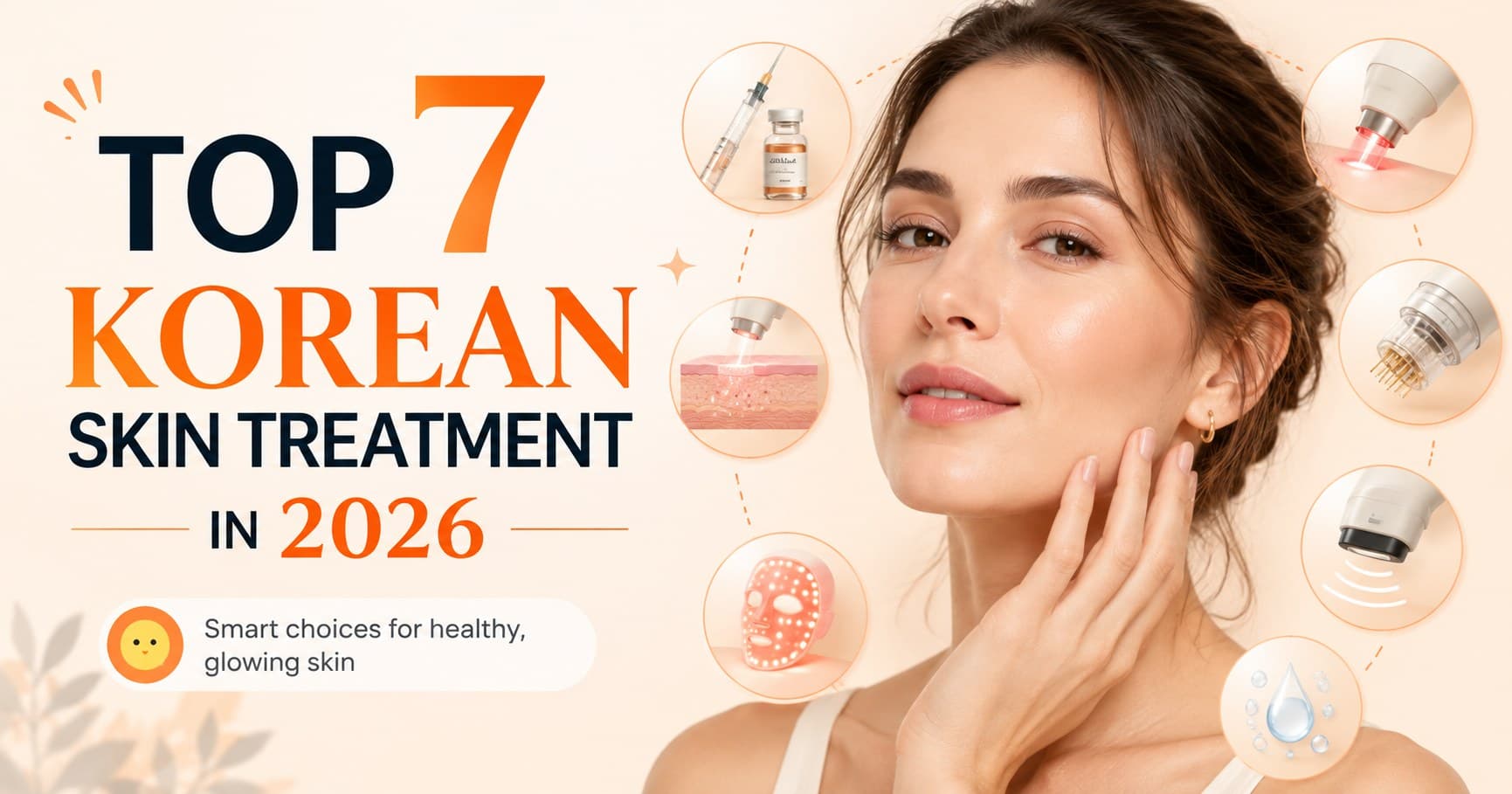
Rejuran, Pico, Potenza, Ultherapy - and all those other names you keep seeing. Here's what they actually do, who they're for, and which ones might be worth your time.
If you spend enough time on Korean beauty TikTok, something strange starts to happen.
You arrive looking for a facial.
Twenty minutes later, you're researching salmon DNA, radiofrequency needles, ultrasound lifting, picosecond lasers, and something called LDM.
Welcome to Korean dermatology.
The good news? Korea really does offer an unusually deep menu of aesthetic treatments. The less-good news is that more options do not necessarily make choosing easier.
That's especially true when you're visiting Seoul for the first time.
So instead of another giant list of everything a Korean clinic can possibly do, here are seven treatments actually worth understanding before you book anything - and, more importantly, what problem each one is trying to solve.
One rule before we start: the treatment everyone is talking about is not automatically the treatment your skin needs. Your skin type, pigmentation, medical history, medications, previous procedures and goals all matter. A qualified clinician should evaluate you before treatment.
1. Rejuran (polynucleotide injections): the famous "salmon DNA" one
Best for: texture, fine lines, elasticity and overall skin quality
Yes, this is the salmon one.
And no, they're not injecting salmon sperm into your face, despite what TikTok may have led you to believe.
Rejuran is a brand of injectable polynucleotide, or PN, derived from purified salmon DNA. Unlike traditional filler, the goal isn't to make your cheekbones bigger or change the shape of your face. It's used as a regenerative skin-quality treatment.
That's probably the easiest way to understand it:
Filler changes volume. PN injections are trying to improve the skin itself.
People typically consider it for dullness, fine lines, uneven texture, enlarged pores and reduced elasticity.
Recent literature on aesthetic PN treatments describes proposed effects related to tissue remodelling and hydration, although this remains an evolving evidence base - not magic in a syringe.
What nobody puts in the Instagram caption: it's a lot of tiny injections.
Numbing cream helps, but don't automatically assume this is a relaxing spa treatment. Small bumps, swelling and redness can stick around for a few days.
And don't judge it in the elevator on your way out. This isn't supposed to produce a dramatic instant transformation.
Peep take: Interesting if your goal is better skin, not a different face.
2. Pico laser (picosecond laser): when pigment is the problem
Best for: freckles, sunspots, certain pigmentation and some acne scars
"Pico" isn't really one treatment.
It's a family of lasers that deliver extremely short pulses measured in picoseconds. They're used for several things, including pigmented lesions, tattoo removal, photoaging and - in fractional modes - acne scarring.
Published reviews support picosecond lasers for a range of dermatologic applications, although effectiveness depends heavily on what is actually being treated and which settings are used.
That's an important distinction, because:
Brown spot ≠ melasma ≠ acne mark.
They may look like variations of "pigmentation" to you. They aren't necessarily the same problem medically.
This is exactly why walking into a clinic and saying "I want the laser I saw on TikTok" is backwards.
Start with the diagnosis.
Then choose the laser.
Fractional picosecond lasers also have evidence for atrophic acne scars. A meta-analysis in the Journal of Cosmetic Dermatology found improvement comparable with other fractional lasers, with lower post-inflammatory hyperpigmentation and pain across the included studies. (ref. 1)
Downtime can be relatively modest, but it depends on the device, intensity and indication.
And afterwards?
Sunscreen becomes non-negotiable - and if you're wondering why Korean and Western formulas feel so different, we broke that down here.
3. Potenza (RF microneedling): for the "my skin texture is driving me crazy" crowd
Best for: acne scars, pores, texture and mild laxity
Potenza belongs to the radiofrequency microneedling category.
Imagine microneedling, except the needles can also deliver radiofrequency energy beneath the skin.
The controlled injury from the needles plus RF energy is intended to stimulate remodelling and collagen production.
That makes RF microneedling particularly interesting for problems that live more in the architecture of the skin than simply on its surface.
Acne scars.
Texture.
Pores.
Some fine lines and mild laxity.
A 2025 systematic review found that fractional RF microneedling consistently improved atrophic acne-scar scores across the studies examined, though devices, settings and indications varied considerably. (ref. 2)
Here's the trade-off:
This isn't usually the treatment we'd schedule immediately before engagement photos.
Redness and swelling for several days can happen, and the collagen-related improvements aren't instant. They develop over weeks and months.
Peep take: If acne scarring is your real concern, this deserves a much more serious look than whatever "glass skin" treatment is trending this week.
4. Ultherapy (microfocused ultrasound): the one people expect to be a facelift
Best for: mild-to-moderate laxity around the jawline, neck and brow
Let's clear up the biggest misconception first:
Ultherapy is not a facelift without surgery.
It's a non-invasive microfocused-ultrasound treatment intended to heat targeted tissue beneath the skin and stimulate a remodelling response.
The Ulthera System is FDA-cleared for indications including lifting the eyebrow and lax tissue beneath the chin and on the neck, and its imaging function lets the operator visualise tissue beneath the skin during treatment. (ref. 3)
So why does everyone talk about the SMAS? (That's the connective layer surgeons reposition in a facelift - we cover it in detail in SMAS vs. Deep Plane Facelift.)
Because focused ultrasound can target relatively deep tissue planes. But that doesn't mean it reproduces what a surgeon physically does during a facelift.
That's a very important distinction.
For the right person - someone with early or moderate laxity who wants a subtle improvement without surgery - it can make sense.
For someone with substantial loose skin expecting a dramatic transformation?
Different conversation.
Improvements tend to appear gradually as collagen remodelling occurs, and results vary with age, skin quality and degree of laxity.
Peep take: Think subtle tightening, not new jawline by Friday.
5. Laser toning: Korea's famous brightening treatment, with an asterisk
Best for: selected pigmentation problems
If you've spent any time researching Korean dermatology, you've probably seen incredibly inexpensive "laser toning" packages.
There's a reason they're everywhere.
Low-fluence Q-switched Nd:YAG laser toning has been widely used in Asia for pigmentation, particularly melasma. But this is one treatment where more is definitely not always better.
A systematic review and meta-analysis found low-fluence Nd:YAG can be effective for melasma, while also reporting recurrence and adverse effects including mottled hypopigmentation, which has been associated with excessive cumulative treatment. (ref. 4) Aggressive treatment can also provoke hyperpigmentation.
The practical conclusion across this literature is consistent: low-fluence Q-switched Nd:YAG is better thought of as one part of a multimodal melasma strategy - alongside photoprotection and other appropriate treatments - rather than a standalone cure.
This is one place we'd be especially wary of the
"10 sessions for ₩___!"
sales pitch.
Your skin doesn't care that the package was a bargain.
Peep take: Get the pigmentation diagnosed first. Especially if someone says the word melasma.
6. LDM (local dynamic micro-massage): the quiet one
Best for: people who want something gentle, or who are recovering from other treatments
LDM is almost the opposite of Potenza.
No needles.
No dramatic resurfacing.
Very little drama at all.
It uses alternating ultrasound frequencies and is commonly offered in Korean clinics as a gentle supportive treatment, including after more aggressive procedures - typically for sensitive skin, hydration, temporary inflammation and recovery support.
Worth being straight about the evidence here: LDM has a much thinner published literature than the lasers and energy devices above. Most of what you'll read about it comes from clinics rather than from trials.
And this is where expectations matter.
If someone promises LDM is going to dramatically lift your lower face or erase deep acne scars, we'd have questions.
Its appeal is precisely that it is gentle.
Peep take: Think supporting actor, not lead character.
7. Skin boosters: the category everyone confuses with filler
Best for: hydration, elasticity and overall skin quality
"Skin booster" isn't one universal product.
It's a category.
Different injectables use different ingredients and behave differently, which is why asking "should I get a skin booster?" is a little like asking "should I take medicine?"
Which one?
For what?
One of the most established ingredients in this category is hyaluronic acid (HA).
HA attracts and retains water, and injectable HA formulations intended to improve skin quality have shown promising evidence. A systematic review of 13 studies reported improvements in measures including hydration, firmness, brightness, texture, radiance and elasticity, while also noting the need for larger randomised trials. (ref. 5)
The key distinction from conventional filler is the goal:
Traditional filler → shape and volume
Skin booster → skin quality
Temporary bumps or swelling can occur after the microinjections.
Peep take: Don't shop for "a skin booster." Ask exactly which product, what's in it, and why that formulation fits your skin.
So what should you actually get?
Here's the boring answer that will probably save you money:
Maybe not the treatment you planned to get.
That's actually one of the advantages of doing this properly.
You might arrive convinced you need Ultherapy and discover pigmentation is what bothers you most.
You might want Rejuran because everyone on TikTok got it, while a dermatologist looks at your acne scars and recommends RF microneedling instead.
Or you may discover that what you thought was a sunspot is melasma - and suddenly the treatment strategy changes completely.
That's why the consultation matters.
A good consultation should answer three things:
- What is actually happening with my skin? Not what Instagram thinks is happening.
- Which treatment addresses that specific problem?
- What can this treatment realistically change - and what can't it?
Medical history, medications, allergies, previous procedures, skin type and treatment goals can all change what is appropriate for you.
One last Seoul rule
Don't try to do everything just because you're here.
Korea's enormous aesthetic-treatment menu is part of what makes it exciting. It's also what makes it easy to overdo.
The smartest first visit isn't necessarily the one where you leave having tried seven treatments.
It's the one where you finally understand what your skin actually needs.
And maybe that's the real Korean skincare secret nobody puts on TikTok.
Frequently asked questions
Which Korean skin treatment is best for first-timers?
There's no universal "starter" treatment. The right choice depends on your skin concern. Someone with acne scars needs something very different from someone with pigmentation or laxity. Start with a consultation to identify your actual issue before choosing a treatment.
How much do these treatments cost in Korea?
Prices vary widely by clinic, device and treatment intensity. As a rough guide: Rejuran runs ₩200,000-400,000 per session, Pico laser ₩100,000-300,000, Potenza ₩300,000-600,000, and Ultherapy ₩500,000-2,000,000+ depending on coverage area. Laser toning packages can be very cheap (₩30,000-50,000 per session) - but read the article above about why cheaper isn't always better.
How many sessions do I need?
It depends on the treatment and your condition. Rejuran and skin boosters typically involve 2-4 sessions spaced weeks apart. RF microneedling might need 3-6 sessions for acne scars. Ultherapy is often a single treatment. Laser toning for melasma can require ongoing maintenance. A good clinician will give you a realistic treatment plan, not just sell you packages.
Is there downtime?
Varies significantly. LDM has essentially none. Rejuran may leave tiny bumps for a few days. Pico laser can cause redness for 1-3 days. Potenza and aggressive RF microneedling may need 3-7 days of visible recovery. Ultherapy can cause swelling and tenderness for days to weeks. Plan accordingly, especially if you're visiting Seoul for a short trip.
Can I combine multiple treatments in one visit?
Sometimes, but not always safely. Some treatments can be layered; others shouldn't be done together. Doing too much at once can increase side effects or complicate recovery. A responsible clinic will tell you what can safely be combined and what should be spaced out.
Medical note
This article is for educational purposes and isn't a substitute for diagnosis or medical advice. Product and device names are used to describe treatment categories, not as endorsements. Treatment suitability, risks, settings and recovery vary by patient, product and device. Consult a qualified medical professional before undergoing an aesthetic procedure.
References
- Fractional picosecond laser for atrophic acne scars: a meta-analysis. Journal of Cosmetic Dermatology. Link
- Fractional Radiofrequency Microneedling as a Monotherapy in Acne Scar Management: A Systematic Review of Current Evidence. Clinical, Cosmetic and Investigational Dermatology, 2025. PubMed
- Ulthera System - about ultrasound skin lifting and cleared indications. Ultherapy
- Efficacy and Safety of Low Fluence Nd:YAG Laser Treatment in Melasma: A Meta-Analysis and Systematic Review. PubMed
- The Effectiveness of Injectable Hyaluronic Acid in the Improvement of the Facial Skin Quality: A Systematic Review. Clinical, Cosmetic and Investigational Dermatology. Link