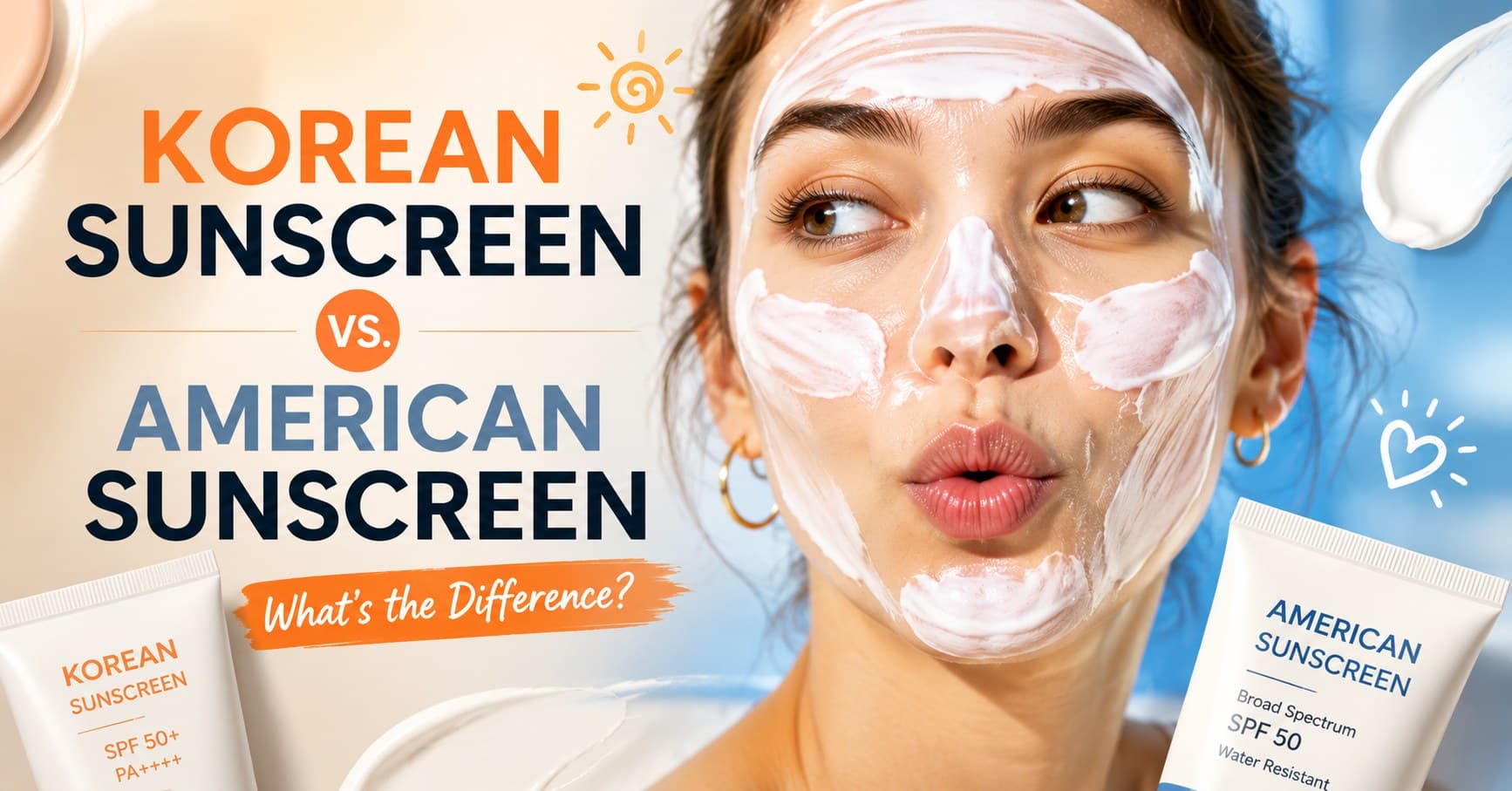
Korean sunscreen feels like skincare. American sunscreen often feels like... sunscreen. There's actually a pretty fascinating reason for that - and in 2026, the story just changed.
Here's a question.
How did sunscreen become something people actually look forward to putting on?
Because if you grew up in the U.S., sunscreen probably meant a thick white bottle your mom pulled out at the beach. It smelled like vacation, made your face shiny, and somehow ended up in your eyes approximately four minutes later.
Then Korean sunscreen showed up.
Suddenly sunscreen was watery. Silky. Hydrating. Some formulas felt more like a $40 serum than SPF.
And naturally, the internet reached a conclusion:
Korean sunscreen is better.
Except that's not quite the story.
The real difference has less to do with Korea having discovered some secret skincare technology, and much more to do with regulation, UV filters, and two very different ideas about what sunscreen is supposed to be.
And as of 2026, America is finally starting to catch up.
First: they're solving the same problem
Before we start an international sunscreen war, let's get something straight.
Both countries make sunscreens designed to protect your skin from ultraviolet radiation.
There are two rays worth remembering:
UVB - the one you associate with burning.
UVA - the sneaky one associated with skin aging, pigmentation, and deeper cumulative damage. (Pigmentation that's already there is a different problem - see the treatments Korean clinics actually use for it.)
UVA can also pass through window glass, which is one reason dermatologists don't consider sunscreen exclusively a beach product.
SPF mostly tells you about UVB protection. An SPF 30 sunscreen filters roughly 97% of UVB radiation when properly applied. Going higher gives you additional protection, but SPF 100 doesn't mean you can apply it at breakfast and forget about it until dinner. (ref. 4)
So far, Korea and America aren't particularly different.
Then you turn the bottle around.
The first big difference: SPF 50+ PA++++
If you've bought sunscreen in Seoul, you've probably seen this:
SPF 50+ PA++++
The SPF part is familiar.
Those four little plus signs?
That's where things get interesting.
Korean products commonly use the PA system to communicate UVA protection. More plus signs indicate greater UVA protection, with PA++++ representing the highest category in that labelling system.
American sunscreen takes another approach.
Instead of putting a PA grade on the front, qualifying U.S. sunscreens use the term Broad Spectrum, which tells you the product meets FDA requirements for UVA as well as UVB protection. (ref. 5)
So when you compare bottles, don't make the mistake of assuming:
PA++++ = powerful
Broad Spectrum = weaker
They're different labelling systems, not a scoreboard between countries.
But here's the real reason Korean sunscreen feels different
The answer is surprisingly bureaucratic.
Sunscreen is regulated differently in the two countries.
In South Korea, UV-protection products fall under the country's functional cosmetics framework, overseen by the Ministry of Food and Drug Safety.
In America, sunscreen is regulated by the FDA as an over-the-counter drug.
That distinction matters.
Historically, American manufacturers have had access to a more limited - and older - menu of UV filters. (ref. 8) Korean formulators, meanwhile, have been able to formulate with newer filters already common in parts of Asia and Europe.
And newer filters can give cosmetic chemists more options when they're trying to solve the eternal sunscreen problem:
How do you create serious UV protection without making someone's face feel like it has been buttered?
That's a big part of why so many Korean sunscreens became famous for disappearing into the skin.
But here's the plot twist.
America just got a new sunscreen filter
For years, beauty enthusiasts complained that American sunscreen technology was stuck in the past.
Then, on June 9, 2026, something unusual happened.
The FDA added bemotrizinol - also known as BEMT, and commonly associated with the trade name Tinosorb S - to the permitted over-the-counter sunscreen active ingredients, at concentrations up to 6%. (ref. 1)
In the FDA's own words, it is "the first new active ingredient added to the over-the-counter (OTC) sunscreen monograph since the late 1990s." (ref. 1)
That's a genuinely big deal.
Bemotrizinol protects against both UVA and UVB rays, has low levels of absorption through the skin, and has already been used internationally for years. The FDA considers it generally recognised as safe and effective for adults and children six months and older. (ref. 1) The American Academy of Dermatology expects the first U.S. products containing it later in 2026. (ref. 3)
So the old internet line -
"America only has old sunscreen filters."
- is becoming outdated.
The gap hasn't disappeared.
But for the first time in a long time, it's moving.
So why does Korean sunscreen still feel so good?
Part of it is technology.
But part of it is simply what Korean consumers expect from sunscreen.
In Korea, sunscreen often sits psychologically closer to
moisturiser → serum → daily skincare
than
pool → beach → sports
That changes product development.
If you're expected to put something on your face every morning, underneath makeup, you care enormously about:
- how quickly it absorbs
- whether it pills
- whether it leaves a white cast
- whether it feels greasy
- whether it dries you out
- whether you'll actually want to put it on again tomorrow
That's why you'll see Korean sunscreens with serum-like textures and familiar skincare ingredients such as centella, niacinamide, hyaluronic acid and soothing botanicals.
It's not that adding centella suddenly makes SPF more powerful.
It makes the experience of wearing sunscreen better.
And that matters more than it sounds.
Because the world's technically greatest sunscreen isn't terribly useful if you hate it so much that it lives untouched in your bathroom cabinet.
Does that mean American sunscreen is worse?
No.
And this is where TikTok comparisons often go off the rails.
Imagine spending eight hours walking around Seoul in October. Cosmetic elegance matters enormously - you're wearing this under makeup, all day, every day.
Now imagine surfing in Hawaii for three hours.
The priorities have completely changed. Now it's water resistance, durability and reliable outdoor protection.
American sunscreens include plenty of formulas designed around exactly those use cases.
The American Academy of Dermatology recommends a broad-spectrum, water-resistant SPF 30 or higher when you're outdoors, with reapplication roughly every two hours and after swimming or sweating. (ref. 2)
So asking
"Which country makes better sunscreen?"
isn't really the best question.
Ask
"What am I doing today?"
Chemical vs. mineral: one myth we should retire
You've probably heard this explanation:
Chemical sunscreen absorbs UV. Mineral sunscreen reflects it.
It's a wonderfully simple explanation.
Unfortunately, reality is more complicated.
Mineral filters such as zinc oxide and titanium dioxide do scatter some UV radiation, but they also protect substantially through absorption. (ref. 6) So don't choose between mineral and organic filters based on the idea that one creates a magical physical shield while the other works completely differently.
What matters more is how your skin reacts to the finished formula.
Sensitive skin? A fragrance-free mineral formula may work beautifully.
Deeper skin tone? Some traditional mineral formulas can leave a noticeable white cast, so a tinted mineral sunscreen or a transparent organic-filter formula may be much easier to wear.
Acne-prone? Look for a comfortable formula labelled non-comedogenic or designed for acne-prone skin.
Dry? You may love the moisturising Korean formulas everyone keeps talking about.
There's no medal for choosing the theoretically coolest filter.
Wait - do I actually need sunscreen indoors?
This one gets exaggerated online.
If you're spending your entire day in a windowless basement, your sunscreen emergency is probably not particularly urgent.
But UVA can pass through window glass, so meaningful exposure can occur if you spend significant time next to sunny windows or driving.
The bigger rule is much simpler:
If you're going outside, make sunscreen part of your morning routine.
The AAD recommends broad-spectrum SPF 30 or higher, and enough product to actually achieve the labelled protection. When outdoors, reapply approximately every two hours and after swimming or sweating. (ref. 2)
And yes, quantity matters.
A gorgeous SPF 50 applied in a microscopic Instagram-worthy dot is not functioning like the SPF 50 that was tested in the lab. (ref. 7)
Korean vs. American sunscreen in 20 seconds
| 🇰🇷 Korean | 🇺🇸 American | |
|---|---|---|
| Typical label | SPF + PA | SPF + Broad Spectrum |
| Regulation | Functional cosmetic | OTC drug |
| Modern filters | Wider historical access | Expanding in 2026 |
| Typical daily feel | Often lightweight, skincare-like | Varies widely |
| Under makeup | Often excellent | Formula-dependent |
| Outdoor / sports options | Available | Many strong options |
| Water resistance | Check the individual product | Many dedicated options |
| Best use | Often fantastic for everyday wear | Everyday and outdoor |
And here's the important part:
These are market tendencies, not rules.
There are heavy Korean sunscreens.
There are beautiful American sunscreens.
There are mediocre products from both countries.
The passport on the bottle doesn't protect your face. The formulation does.
So which one should you buy?
For an ordinary workday, the honest answer is: the sunscreen you genuinely enjoy putting on every morning. Korean formulas often win that contest because they're so cosmetically elegant, and a sunscreen you actually apply beats a technically superior one you avoid.
For hiking, swimming, running, or spending hours outside, stop caring whether the bottle came from Seoul or California and start looking for:
- Broad-spectrum UVA/UVB protection
- SPF 30 or higher
- Water resistance
- A formula you'll apply generously and reapply
That's ultimately the slightly boring answer dermatologists keep coming back to.
And they're right.
The best sunscreen isn't Korean.
It isn't American.
It's the one you'll actually wear enough of, every single day.
Maybe the real Korean sunscreen revolution wasn't inventing stronger sunscreen after all.
Maybe it was making sunscreen feel good enough that people finally wanted to use it.
Quick FAQ
Is Korean sunscreen better than American sunscreen? Not objectively. Korean products often excel at lightweight everyday wear and have historically had access to a broader range of newer UV filters. American products include excellent everyday formulas and many strong water-resistant options.
Why does Korean sunscreen often feel lighter? A combination of available UV filters, formulation technology, and a market heavily focused on elegant daily skincare.
What changed in America in 2026? The FDA added bemotrizinol to the OTC sunscreen monograph on June 9, 2026 - the first new sunscreen active ingredient added there since the late 1990s. (ref. 1)
Is SPF 50 dramatically better than SPF 30? No. SPF 30 filters about 97% of UVB under test conditions, while higher SPFs filter somewhat more. No sunscreen blocks 100%, and higher SPF doesn't remove the need to reapply. (ref. 4)
Which should I use every day? The AAD recommends broad-spectrum SPF 30 or higher; for outdoor exposure, choose water resistance as well. (ref. 2)
Medical note
This article is for general education and is not medical advice. Product and ingredient names are used to describe categories and regulatory status, not as endorsements. If you have a specific skin condition, photosensitivity, or are taking medication that affects sun sensitivity, speak to a qualified clinician.
References
- FDA Expands Sunscreen Options for the First Time in 20 Years. U.S. Food and Drug Administration, June 9, 2026. Link
- Sunscreen FAQs. American Academy of Dermatology. Link
- The latest in sun protection. American Academy of Dermatology. Link
- Sun Protection Factor (SPF). U.S. Food and Drug Administration. Link
- Questions and Answers: FDA posts deemed final order and proposed order for over-the-counter sunscreen. U.S. Food and Drug Administration. Link
- Sunscreen fact and fiction: What the science says. Stanford Medicine. Link
- Sunscreen SPF testing - information for consumers. Therapeutic Goods Administration (Australia). Link
- How Sunscreen Ingredients Are Regulated in the U.S. Environmental Working Group. Link