The cheapest mistake under the eye is not a bad surgeon. It is the right surgeon, and the wrong operation.
People search "eye bag removal Korea" and get one number. That number can mean fat slid into the hollow, fat taken out, or skin cut away. Same mirror. Three different weeks. Staff who sit with patients hear the same sentence after the consult: I thought bag surgery was one thing. It is not. The bag is a look. The operation is a choice about fat and skin.
If you remember one test, remember this. Pinch the skin under the eye. If it barely moves and the puff is a firm pad, you are mostly talking about fat. If the skin creases and stays creased, a fat-only plan will not give you the photo that made you book.
Three things photograph as one bag
The bulge is fat. The wall that holds it behind the lid weakens and the pad pushes forward. Some families show it by thirty. (ref. 5) Hold a mirror at your chin and look up. A puff that grows is usually fat.
The groove sits just under it. Surgeons call it the tear trough, the line where lid meets cheek, and the bulge above makes it look deeper. (ref. 6) It is why some people who only had fat taken out look more tired afterward.
The color is skin. Brown is pigment. Blue or purple is vessels under thin skin. Darkness the color of your skin is a shadow cast by the shape. (ref. 7) Stretch the skin gently toward your ear. Pigment stays. A shadow fades. An operation only touches the shadow.
The small roll right under the lashes is aegyo-sal. It is muscle, not a bag, and Seoul planning often protects it. (ref. 8) If you like yours, say so before anyone draws on your face.
One complaint, two operations
Lower blepharoplasty and under-eye fat repositioning both sit on the same search page. They do not do the same job.
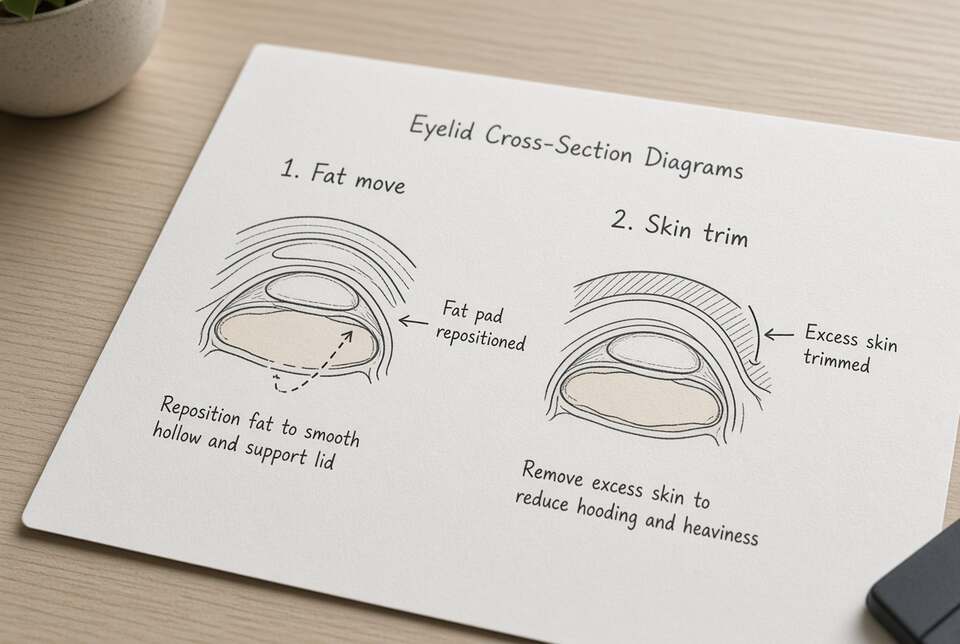
Fat repositioning, often through the inside of the lid, moves the pad that bulges into the groove beneath it. The aim is a smoother step from lid to cheek, not a tighter lid. Younger patients, and anyone whose skin still snaps back, are the usual fit. Take the fat out and throw it away, and the hollow you hated in photos can look deeper in six months.
Fat grafting rides along with either operation, and it is the line most often added in the room. Tiny amounts of your own fat, usually from the thigh or belly, are injected into the groove. It answers lost volume, not a bulge, and it is the least predictable of the three. Some fat does not survive. What survives can sit as a bump under the thinnest skin on your face. A 2024 review of 33 studies put overall complications after under-eye fat grafting or repositioning at about 11 percent, uneven contour about 6, and repeat surgery about 2. (ref. 10)
Lower blepharoplasty is the operation for extra skin. The incision is usually just under the lash line. Skin is lifted, fat may be moved or reduced, and the spare skin is trimmed. It is the plan when the pinch test fails. It is also the plan that can change the shape of the eye if too much skin goes.
A coordinator who calls both "eye bag surgery" is describing the complaint. You are buying the method.
The incision is the part people skip
Transconjunctival means inside the lid. No skin cut. Useful when the problem is fat and the skin is fine. It does not tighten a crepey lid. Booking it because you want no scar, when the skin is the problem, is how people fly home with the same fold.
Subciliary means under the lashes. That is the cut that lets a surgeon take skin. The scar is usually hidden in the lash line. It is still a cut, and it is the one that needs the longer calm week.
Neither incision is the deluxe version of the other. They answer different tissues.
The trade is the lid itself. The skin approach carries a higher risk of the lower lid sitting lower, showing white under the iris, or turning outward. The inside approach carries less. (ref. 5, 9) That is why a real exam includes a pull. The surgeon draws the lid gently away from the eye. More than about 6 mm counts as lax, and a lax lid often needs the outer corner supported. (ref. 5) A desk that quotes before anyone pulled your lid has chosen a price, not an incision.
What the quote is hiding
Clinic guides in 2026 put common Seoul ranges roughly here. They are not a Peep quote.
- Fat repositioning: often about 1,000,000 to 3,500,000 won. Some desks list a basic case near 2,000,000 to 3,500,000.
- Lower blepharoplasty: often about 1,500,000 to 5,000,000 won. Skin plus fat work sits higher.
- A combined plan: commonly talked about from roughly 3,500,000 to 5,500,000 won.
A US quote for the same name is often higher. The Korean number still leaves out the nights you should not fly, the bruise you cannot put on camera, and the laser someone adds in the consult. A price without the incision is not a price.
VAT is the other quiet line. Korea's 10 percent refund for foreign visitors' cosmetic procedures covered treatment received by 31 December 2025, and it was not extended. (ref. 14, 15) Ask whether the won figure already includes VAT.
Why a fair result gets called a fail
Swelling under the eye lies. The first week can look worse than the bag you came to fix. Fat that was moved needs time to sit. Skin that was trimmed can feel tight, then soften. Most people are presentable in one to two weeks. The shape you judge is closer to six weeks, sometimes longer.
The flight follows the same calendar. ASPS suggests waiting seven to ten days before flying after eyelid surgery. (ref. 12) Skin-incision stitches commonly come out around day five to seven in Seoul. The inside approach has no stitches you can see, and the swelling keeps the same schedule anyway.
The result people regret is usually a mismatch. Fat removed from a lid that needed the pad moved. Skin left on a lid that needed it gone. Or both eyes done to match a photo of someone whose crease was never the problem.
What to send before the deposit
Three daylight photos, no filter. Looking straight ahead. Looking up. Smiling. Then one sentence about the shape you mind. "A puff that grows when I look up" can be assessed. "Dark circles" cannot.
Before money moves, get four answers. Inside or skin incision, and why for your lid. Fat moved, removed, or grafted. Whether the outer corner needs support. Who operates, by name, and where you need to be on day six. A reply with only a package price has not answered.
Quick FAQ
Is an eye bag always fat? No. It can be fat, spare skin, a hollow under the pad, or all three. The pinch test is the crude way to tell skin from pad. A surgeon still has to look at lid support before naming the operation.
Is fat repositioning the same as lower blepharoplasty? No. Repositioning moves fat into the groove. Lower blepharoplasty can remove or move fat and also take skin. The shared nickname is the trap.
Which one has no scar? The inside-lid approach has no skin scar. It also cannot take loose skin. No scar is not the better operation. It is the operation for a different tissue.
Can I just have the fat removed? You can. If the hollow is the thing you notice in photos, removing the pad can make that hollow clearer. Moving it is often the point.
Who is a poor fit for fat repositioning alone? Someone whose under-eye skin creases and stays creased. A fat-only plan leaves that skin where it is.
Does lower blepharoplasty change eye shape? It can, if too much skin is taken or the lid is not supported. A natural result is a dose of skin, not a promise of the technique name.
How long before I can fly? Many desks talk about a week for an uncomplicated case. ASPS suggests seven to ten days after eyelid surgery. (ref. 12) Bruising and the pressure of a long flight are why people stay longer. Ask for the flight day in writing before you buy the ticket.
When can I judge the result? Not in the hotel mirror on day three. Swelling hides the point of the operation. Six weeks is a fairer look. Some lids settle longer.
What does it cost in Seoul? Clinic guides in 2026 cluster fat repositioning around 1,000,000 to 3,500,000 won, and lower blepharoplasty around 1,500,000 to 5,000,000, higher when skin and fat are both in the plan. That is not your quote.
Why is one clinic half the price? Often a smaller plan, a promotion, or a fee that appears later as English service. Compare the incision and what happens to the fat, not the nickname.
Is the VAT refund still real? Not for new treatment. The 10 percent refund for foreign visitors' cosmetic procedures covered treatment received by 31 December 2025 and was not extended. (ref. 14, 15) Some blogs still promise it. Ask the clinic whether the won figure includes VAT.
Can filler do this instead? Filler can soften a mild groove when the skin is good and the bag is small. Clinic guides in 2026 commonly put tear trough filler around 200,000 to 800,000 won a session. Hyaluronic acid can be dissolved with hyaluronidase if it sits wrong. (ref. 11) It does not remove a skin fold or move a fat pad. Filler over a real bag usually makes the bag look bigger.
What if only one eye looks bad? Lids are rarely twins. Surgeons often treat both so the difference you notice in photos does not simply switch sides.
Is this a lunchtime procedure? No. It is usually a day surgery, then a week you should not schedule as a normal trip. Calling it lunchtime is how people miss the flight rule.
Do I need a companion? For an uncomplicated lid, many people manage. The first night is easier with someone who can read the instructions while your eyes are swollen.
What should the quote name? The incision, whether fat is moved or removed, whether skin is taken, the brand of any added laser, and the fee in won. A line that says eye bag is not a quote.
Can this fix dark circles? Only the shadow that comes from a groove or a pad. Pigment is a skin problem. Surgery does not bleach it.
What if I already had filler there? Say so. Filler changes what the surgeon feels and can change the plan. Hiding it does not make the operation cleaner.
Is revision common? Not as a routine. It shows up when the first plan treated the wrong tissue, or when too much skin was taken. A second operation is a different quote.
What is aegyo-sal, and will surgery remove it? Aegyo-sal is the small roll of muscle under the lashes that shows when you smile. It is not a bag. A careful plan treats the fat below without flattening it. (ref. 8) Tell the surgeon whether you want to keep yours.
Is under-eye fat grafting permanent? The fat that survives tends to stay. Not all of it survives, so the shape shifts over the first months and some people need a touch-up. Permanent also means a lump will not dissolve on its own, the way filler can. Ask what the clinic does if the graft settles unevenly, and what that costs.
What are the serious risks? The main ones are a lower lid that sits lower or turns outward, dry or irritated eyes, and asymmetry. (ref. 5, 9) Vision loss is rare, reported at roughly 1 in 20,000 eyelid operations, most often from bleeding behind the eye. (ref. 13) Severe pain, pressure, or a change in vision in the first day is an emergency. Know how to reach the clinic at night before you leave it.
What should I tell the clinic before surgery? Blood thinners and supplements such as fish oil or vitamin E. Dry eye, thyroid eye disease, previous laser eye surgery, and any earlier lid surgery. Filler already under the eyes, and roughly when. Write it in English and ask the surgeon, not only the coordinator, to confirm it was read.
Should I book eyes and a nose together? You can. Bundle pricing is common, and the swelling is shared. Decide that before you land, not the morning you are already changed into a gown.
Medical note
This article is for general education and is not medical advice, a diagnosis, or a promise of outcome. Prices are compiled clinic-guide ranges, not a Peep quote. Technique names describe categories, not a recommended clinic. Lid surgery should be planned by a qualified surgeon who has examined you.
References
- Under Eye Fat Repositioning Cost in Korea. Gangnam Plastic Surgery clinic guide, January 4, 2026. Price ranges, not a Peep quote. Link
- Eye Bag Removal Surgery Cost in Korea. Gangnam Plastic Surgery clinic guide, December 25, 2025. Link
- Under-Eye Fat Repositioning in Korea. Procedure and range summary, clinic directory. Link
- Peep Korea staff consult notes on patients who booked eye bag surgery without an incision named. Used for the complaint. Not quoted.
- Murri M, Hamill EB, Hauck MJ, Marx DP. An Update on Lower Lid Blepharoplasty. Seminars in Plastic Surgery, 2017. Link
- Termanini KM, Alghoul MS. Tear Trough Deformity: Update on Anatomy and Clinical Management. Aesthetic Surgery Journal, 2026. PubMed
- Sarkar R, Ranjan R, Garg S, et al. Periorbital Hyperpigmentation: A Comprehensive Review. Journal of Clinical and Aesthetic Dermatology, 2016. Link
- Kim HS, Choi CW, Kim BR, Youn SW. Effectiveness of Transconjunctival Fat Removal and Resected Fat Grafting for Lower Eye Bag and Tear Trough Deformity. JAMA Facial Plastic Surgery, 2019. A Korean series of 229 patients. Link
- Lelli GJ Jr, Lisman RD. Blepharoplasty complications. Plastic and Reconstructive Surgery, 2010. PubMed
- Xu Z, Zheng F, Zhao X, et al. Complications of Fat Grafting and Repositioning for Correction of Lower Eyelid Pouch With Tear Trough Deformity or Lid-Cheek Junction: A Systematic Review. Annals of Plastic Surgery, 2024. PubMed
- Kroumpouzos G, Treacy P. Hyaluronidase for Dermal Filler Complications: Review of Applications and Dosage Recommendations. JMIR Dermatology, 2024. Link
- Briefing Paper: Cosmetic Surgery Tourism. American Society of Plastic Surgeons. Flight timing after eyelid surgery. Link
- Mejia JD, Egro FM, Nahai F. Visual loss after blepharoplasty: incidence, management, and preventive measures. Aesthetic Surgery Journal, 2011. PubMed
- Restriction of Special Taxation Act, Article 107-3 (VAT refund for foreign tourists' cosmetic medical services). Korea Ministry of Government Legislation, National Law Information Center (in Korean). Applies to services received by 31 December 2025. Link
- 내년부터 외국인이 한국서 성형해도 부가세 환급 안해준다 (No VAT refund for foreigners' cosmetic surgery from next year). Newsis, July 31, 2025 (in Korean). Link